| Material Identity | UNS designation | S30403, commonly known as 304L stainless steel | Confirm the designation on the material test certificate and purchase order. |
| Common international equivalents | EN 1.4307; EN X2CrNi18-9; JIS SUS304L; ASTM/ASME 304L | Equivalent grades are not automatically identical; specify the governing standard and edition. |
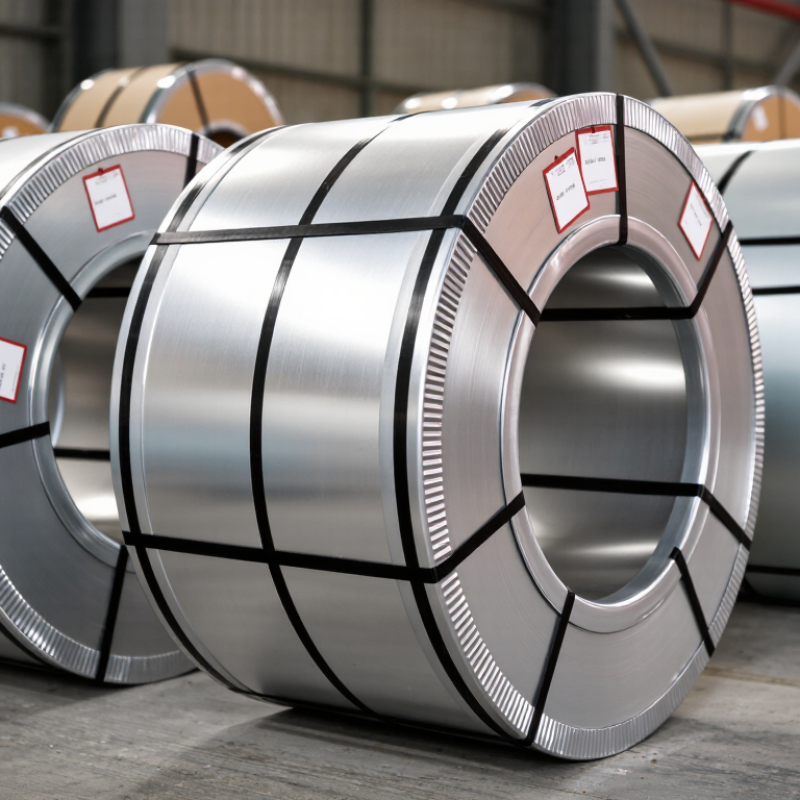
| Product form | Cold-rolled or hot-rolled stainless steel coil, usually supplied in annealed and pickled condition where applicable | State the rolling route, surface finish, edge condition, and processing condition in the specification. |
| Typical applications | Food-processing equipment, architectural panels, chemical-service components, kitchen equipment, heat exchangers, and general fabrication | Check corrosion, temperature, weldability, and regulatory requirements for the final application. |
| Carbon content | Maximum 0.030% by mass under common ASTM 304L requirements | The lower carbon limit reduces sensitization risk during welding compared with standard 304. |
| Chromium content | Typically 18.0–20.0% by mass under ASTM chemistry limits | Chromium supports the passive corrosion-resistant surface; verify actual heat analysis. |
| Nickel content | Typically 8.0–12.0% by mass under ASTM chemistry limits | Nickel stabilizes the austenitic structure and affects forming and low-temperature performance. |
| Other chemistry limits | Typical ASTM maximums: Mn 2.00%, Si 1.00%, P 0.045%, S 0.030%, N 0.10% | Use the exact standard, product form, and supplementary requirements for acceptance. |
| Mechanical and Physical Properties | Minimum tensile strength | Approximately 485 MPa (70 ksi) for annealed material under ASTM A240 requirements | Confirm whether the order uses ASTM, EN, JIS, or another mechanical-property specification. |
| Minimum yield strength | Approximately 170 MPa (25 ksi) at 0.2% offset for annealed material under ASTM A240 | Cold reduction can increase strength while reducing ductility; do not compare conditions without adjustment. |
| Minimum elongation | Approximately 40% in 50 mm (2 in.) under common ASTM requirements | Important for deep drawing, bending, stamping, and forming operations. |
| Density | Approximately 7.9–8.0 g/cm³ at room temperature | For estimating mass: weight ≈ density × width × thickness × length. |
| Elastic modulus | Approximately 193 GPa at room temperature | Use the design code applicable to the finished component for engineering calculations. |
| Melting range | Approximately 1,400–1,450°C | This is a general physical range, not a recommended operating temperature limit. |
| Magnetic response | Generally non-magnetic when fully annealed; slight magnetism may occur after cold working | Magnet testing alone is not a valid grade-verification method. |
| Coil Specification | Thickness range | Must be quoted as a product-specific range; cold-rolled and hot-rolled capabilities differ | Define nominal thickness, permissible tolerance, measurement method, and whether ASTM or EN tolerances apply. |
| Width range | Must be confirmed by the supplier’s mill and slitting capability | Specify full-width coil or slit coil, target width, width tolerance, and burr limits. |
| Surface finish examples | 2B, BA, No. 1, No. 3, and No. 4 are widely used descriptions; availability depends on production route | Finish names can vary by market; include a reference sample, roughness target, and inspection method. |
| Coil inside diameter | Common mill options include approximately 508 mm or 610 mm, but the actual value is supplier- and line-dependent | Confirm compatibility with the buyer’s decoiler and handling equipment before ordering. |
| Coil outside diameter and unit weight | Variable; determined by thickness, width, inside diameter, line capacity, and maximum lifting weight | Request maximum outside diameter, maximum gross weight, coil eye orientation, and lifting requirements. |
| Edge condition | Mill edge or slit edge | Slit-edge burr height and edge quality should be defined where the coil feeds an automated process. |
| Standards and Documentation | Primary material standard | ASTM A240/A240M is commonly used for chromium and chromium-nickel stainless steel plate, sheet, and strip for pressure vessels and general applications | The purchase order should identify the exact standard, grade, condition, dimensions, and supplementary requirements. |
| Dimensional and surface requirements | ASTM A480/A480M is commonly referenced for general requirements, dimensions, tolerances, and workmanship | Check the current edition and any tighter contractual tolerances. |
| Inspection certificate | EN 10204 Type 3.1 is commonly requested for independent manufacturer test results; Type 3.2 may require third-party or purchaser inspection | Specify certificate type before production, not after shipment. |
| Traceability | Heat number, coil number, grade, size, finish, and certificate reference should be linked | Require permanent or durable identification that remains readable during storage and processing. |
| Recommended documents | Commercial invoice, packing list, bill of lading, certificate of origin where required, material test certificate, and inspection report | Document requirements vary by destination, customs regime, payment terms, and end-use regulations. |
| Shipping and Packaging | Recommended packaging | Moisture-resistant wrapping, corrosion protection, steel or reinforced bands, edge protection, and a suitable skid or cradle | Packaging should prevent seawater, condensation, abrasion, telescoping, and impact damage. |
| Corrosion protection | Use dry packaging and approved vapor or desiccant protection where appropriate; avoid chloride contamination | Stainless steel can develop staining or corrosion from salt, carbon steel dust, and wet packaging. |
| Container loading | Feasibility depends on coil diameter, width, gross weight, axle limits, and container payload | Confirm loading plan and maximum permissible weight with the freight forwarder before finalizing the order. |
| Coil orientation | Eye-to-side or eye-to-sky loading may be used depending on handling equipment and transport method | State the required orientation on the packing instruction and verify it with photographs before dispatch. |
| Trade terms | Specify the agreed Incoterms® rule and named place, such as FCA, FOB, CFR, CIF, or DAP | The named place determines cost, risk transfer, export clearance, insurance, and import responsibilities. |
| Transit planning | Allow time for production, inspection, export clearance, port handling, ocean transit, customs, and inland delivery | Use a delivery window rather than relying only on a factory-ready date. |
| Supplier Evaluation | Production capability | Evaluate melting, rolling, annealing, pickling, finishing, slitting, inspection, and packing capabilities relevant to the order | A supplier should demonstrate capability for the exact thickness, width, finish, and tolerance combination. |
| Quality system | Review documented quality controls, calibration records, nonconformance handling, and batch traceability | A quality-system certificate supports evaluation but does not replace product inspection. |
| Pre-shipment inspection | Check dimensions, surface, quantity, markings, packaging, coil weight, and documents against the purchase order | Use a mutually approved inspection plan and acceptance criteria. |
| Testing methods | Typical checks include chemical analysis, tensile testing, hardness where specified, dimensional measurement, and visual inspection | Non-destructive testing should be added only when required by the application or contract. |
| Commercial reliability | Compare lead-time consistency, minimum order quantity, production scheduling, claim response, and replacement policy | The lowest quoted price may not provide the lowest landed cost or supply risk. |
| Landed-cost calculation | Material price + processing + packaging + inland freight + export fees + ocean freight + insurance + duties + taxes + destination delivery | Compare quotations using the same specification, Incoterms® rule, currency, quantity, and delivery point. |
| Purchasing Checklist | Required order information | Grade, standard, thickness, width, quantity, finish, edge, coil dimensions, weight limits, packaging, inspection, and delivery term | Incomplete specifications increase the risk of disputes, rework, and customs delays. |
| Sample approval | Approve a representative surface and dimensional sample before mass production when appearance is important | Define whether the sample is a visual reference only or a contractual acceptance standard. |
| Acceptance and claims | Set inspection timing, sampling level, defect classification, notification period, evidence requirements, and remedy options | Align the claim procedure with the destination port, warehouse, and downstream processing schedule. |
| Storage after arrival | Store indoors in a clean, dry, ventilated area away from carbon steel dust, chlorides, standing water, and direct weather exposure | Use suitable supports and lifting methods to prevent coil deformation and surface damage. |

.svg)