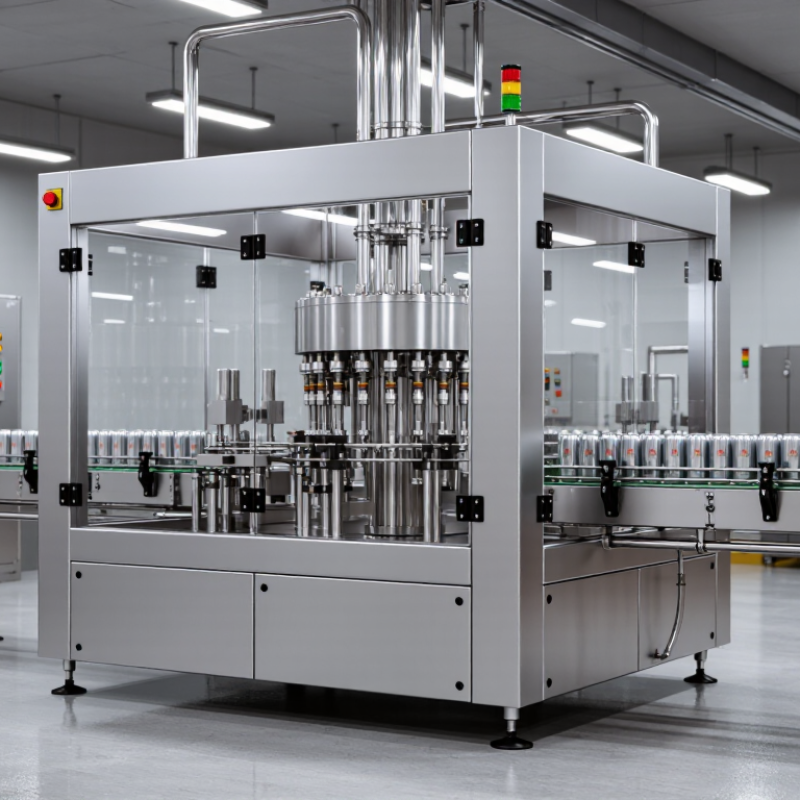
| Machine Type | Automatic counter-pressure can filler | Suitable for carbonated beverages, beer, sparkling water, and other products that require controlled pressure filling. | Provides better carbonation retention than atmospheric filling when the product and container require pressure control. |
| Machine Type | Atmospheric liquid filler | Suitable for non-carbonated water, juice, sauces, and other low-viscosity liquids. | Usually simpler to operate and maintain, but it is not the preferred choice for carbonated products. |
| Machine Type | Volumetric or piston filler | Suitable for products requiring controlled dosing, including some viscous or particulate-free liquids. | Confirm product viscosity, filling accuracy, cleaning method, and compatibility with the can format. |
| Typical Capacity | Small and medium production lines | Approximately 600–6,000 cans per hour, depending on the number of filling valves, can size, product, and operating conditions. | Use the supplier's tested output rather than the maximum theoretical speed when comparing offers. |
| Typical Capacity | High-speed production lines | More than 6,000 cans per hour may be achievable with multi-head fillers and integrated seaming, conveying, and control systems. | Verify line speed under the exact can diameter, height, product temperature, carbonation level, and packaging configuration. |
| Can Compatibility | Container dimensions | Common beverage cans often vary in diameter and height; the exact range must be confirmed before ordering. | Provide can drawings, opening dimensions, lid specifications, and sample containers for validation. |
| Filling Accuracy | Controlled fill volume | Accuracy depends on the filling principle, product properties, valve condition, pressure stability, and calibration. | Request a documented acceptance test using the buyer's product and containers. |
| Product Temperature | Temperature-controlled filling | Carbonated products are commonly filled cold to reduce foaming and improve fill consistency; the exact temperature depends on the product. | Coordinate the filler with the cooling system, product tank, piping, and carbon dioxide management system. |
| Utilities | Electrical supply | Confirm voltage, frequency, phase, connected load, and control-panel requirements before shipment. | Electrical specifications must match the destination country's industrial power supply and local installation rules. |
| Utilities | Compressed air | Typical pneumatic systems require clean, dry, oil-free compressed air; pressure and flow must be verified from the machine data sheet. | Provide filtration, a regulator, a dryer, and adequate receiver capacity where required. |
| Utilities | Water and drainage | Cleaning and sanitation require suitable water quality, drainage capacity, and hygienic floor design. | Plan drainage, splash control, wastewater handling, and access for cleaning around the filler. |
| Installation | Foundation and leveling | Install the machine on a stable, level floor capable of supporting the equipment and dynamic operating loads. | Check floor loading, anchor requirements, clearance, and access for maintenance before delivery. |
| Installation | Line integration | Coordinate infeed conveyors, rinsers, fillers, seamers, date coders, inspection devices, and discharge conveyors. | Confirm conveyor height, transfer points, line direction, control signals, and emergency-stop interfaces. |
| Installation | Commissioning procedure | Use dry runs, water trials, product trials, sanitation checks, fill-volume checks, and seam-quality verification. | Record test results and obtain operator training before final acceptance. |
| Sanitation | Product-contact materials | Food-contact parts should be suitable for the product, cleaning chemicals, temperature, and applicable food-contact requirements. | Request material certificates and a list of product-contact components, seals, and lubricants. |
| Sanitation | Cleaning method | Depending on the design, cleaning may use manual cleaning, clean-in-place procedures, or a combination of both. | Confirm chemical concentration, cleaning temperature, contact time, rinsing procedure, and verification method. |
| Routine Maintenance | Daily checks | Inspect leaks, abnormal noise, guards, sensors, fill valves, product lines, conveyor transfers, and emergency stops. | Use a signed checklist and correct minor faults before starting continuous production. |
| Routine Maintenance | Weekly or periodic checks | Inspect seals, clamps, pneumatic components, lubrication points, fasteners, valve movement, and sensor alignment. | Maintenance intervals should follow the equipment manual and actual operating hours. |
| Spare Parts | Recommended startup inventory | Keep critical seals, gaskets, valve springs, sensors, fuses, pneumatic fittings, belts, and lubrication materials available. | Request part numbers, exploded drawings, recommended quantities, shelf-life information, and lead times. |
| Safety | Machine guarding | Moving parts, rotating mechanisms, pinch points, hot surfaces, and pressurized areas should be protected by suitable guards. | Interlocked doors and guards should stop hazardous motion when opened or removed. |
| Safety | Emergency protection | Emergency-stop devices should be accessible from operator and maintenance positions and connected to the safety circuit. | Test emergency stops regularly and document reset and restart procedures. |
| Safety | Lockout and tagout | Before maintenance, isolate electrical, pneumatic, product-pressure, and other stored-energy sources. | Mandatory maintenance control Train authorized personnel in local lockout and tagout procedures. |
| Operator Training | Required training topics | Normal operation, changeover, sanitation, quality checks, alarm handling, emergency stops, and basic troubleshooting. | Training should be available in the operating team's working language and supported by manuals and diagrams. |
| Quality Control | Fill and seam inspection | Check fill level or volume, container appearance, leakage, vacuum or pressure where applicable, and can-seam integrity. | Use calibrated measuring equipment and define acceptable limits before production approval. |
| Control System | Automation and data access | Prefer clear alarms, recipe management, variable-speed control, access-level permissions, and production counters. | Confirm language options, data export, remote-support policy, cybersecurity controls, and backup procedures. |
| Changeover | Format-part replacement | Changing between can sizes may require guides, star wheels, filling components, sensors, and conveyor adjustments. | Ask for changeover time, required tools, adjustment points, and the complete format-parts list. |
| Documentation | Technical file | Obtain manuals, electrical diagrams, pneumatic diagrams, parts lists, maintenance schedules, risk information, and test records. | Documentation should match the delivered machine configuration and destination-market requirements. |
| Export Compliance | Destination-country requirements | Electrical safety, machinery safety, pressure equipment, food-contact, labeling, and electromagnetic-compatibility requirements may apply. | Confirm applicable regulations with the importer, local authorities, and a qualified compliance professional. |
| Export Packaging | Protection during transport | Use corrosion protection, moisture barriers, shock protection, secure blocking, and clearly marked lifting points. | Packaging should be appropriate for the selected transport mode, route, climate, and storage period. |
| Shipping Data | Commercial and logistics information | Prepare machine dimensions, gross and net weight, package count, center of gravity, lifting instructions, harmonized classification, and origin information. | Use accurate data for freight quotations, customs clearance, insurance, and warehouse planning. |
| Trade Terms | Delivery and responsibility split | Clarify the selected Incoterm, export clearance, freight, insurance, import clearance, duties, taxes, unloading, and inland delivery. | Put responsibilities, transfer of risk, documentation, and delivery milestones in the purchase contract. |
| After-Sales Support | Service response and remote assistance | Define spare-parts availability, technical response time, remote diagnostic access, training, and on-site service conditions. | Best practice Include service-level expectations and escalation contacts in the commercial agreement. |
| Acceptance Criteria | Factory and site acceptance tests | Assess capacity, fill consistency, product loss, sanitation performance, safety functions, changeover, and integration with upstream and downstream equipment. | Use a signed acceptance protocol based on the buyer's product, can format, utilities, and agreed operating conditions. |

.svg)