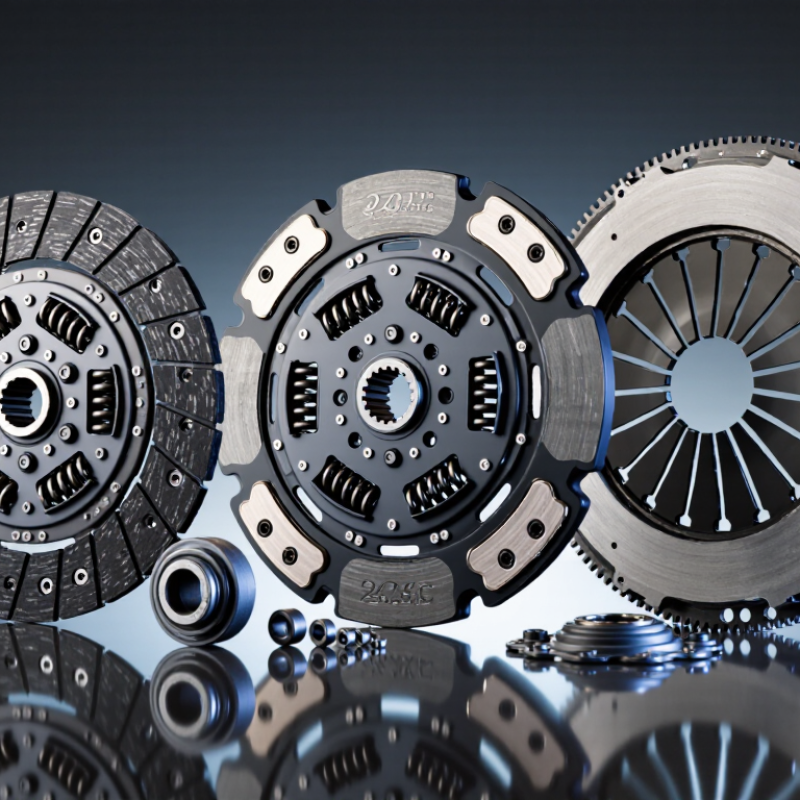
| Organic Full-Face | Woven organic friction lining, commonly reinforced with resin and textile fibers | Full circular friction surface with continuous lining contact | Usually includes a sprung hub and torsion springs for driveline damping | Diaphragm-spring pressure plate with a broad friction ring | Smooth take-up and progressive engagement | Good everyday heat control; torque capacity is generally lower than ceramic or metallic designs of the same diameter | Passenger cars, light commercial vehicles, commuting, and standard replacement use | Best balance of smoothness, noise control, pedal feel, and normal service life | Can suffer faster wear or fade under repeated high-temperature slipping | High |
| Organic Segmented or High-Performance Organic | High-temperature organic compound, sometimes with segmented lining blocks | Segmented or grooved full-face lining to improve heat release and debris evacuation | Typically sprung for road use; hub and spline count remain application-specific | Higher-clamp diaphragm spring than a standard replacement design | Moderately smooth with quicker engagement than a conventional full-face disc | Improved thermal response and moderate torque increase while retaining usable street manners | Modified street vehicles, towing-oriented passenger vehicles, and mixed road use | Combines better heat management with more forgiving engagement than puck-style discs | May require higher pedal effort and can transmit more driveline vibration | Medium-High |
| Ceramic-Paddle | Sintered ceramic friction buttons or ceramic-metallic segments | Commonly 4-, 6-, or 8-paddle segmented disc with reduced lining area | May use a sprung hub for street applications or a rigid hub for competition use | High-clamp diaphragm or strap-drive pressure plate, depending on the kit | Fast, aggressive engagement with less modulation at low speed | High heat tolerance and strong short-duration torque capacity; reduced contact area can increase wear on the mating surfaces | Track-day vehicles, performance builds, rally-style use, and demanding launches | High friction stability at elevated temperatures and quick engagement | More chatter, reduced low-speed smoothness, and greater flywheel or pressure-plate shock | Low-Medium |
| Semi-Metallic | Organic base blended with metallic fibers or particles | Full-face or segmented lining with grooves for cooling and wear control | Usually sprung for road-oriented designs; rigid hubs are also used in competition versions | Medium- to high-clamp diaphragm-spring pressure plate | Quicker and firmer than organic, but generally more controllable than ceramic-paddle | Good compromise between heat resistance and street usability; metallic content can increase abrasion | Performance road vehicles, light towing, and mixed-use applications | Balanced friction performance across a broad temperature range | Can produce more noise and flywheel wear than a fully organic lining | Medium |
| Dual-Friction | Organic lining on one side and ceramic, metallic, or high-performance lining on the other | Different friction materials are used on the flywheel-facing and pressure-plate-facing sides | Normally uses a sprung hub to preserve road manners and reduce torsional vibration | High-clamp diaphragm-spring pressure plate designed to match the mixed-friction disc | Smoother than a fully aggressive disc while providing a stronger bite under load | Useful thermal and torque improvement with a compromise between comfort and performance | Street performance vehicles, occasional towing, and vehicles with upgraded engine output | Offers a practical middle ground between full-face organic comfort and ceramic grip | Friction behavior is less uniform and replacement matching must follow the correct disc orientation | Medium-High |
| Rigid-Hub Racing | Ceramic, metallic, or other high-temperature competition friction segments | Segmented disc with a rigid hub and little or no torsional cushioning | Rigid hub transfers engine torque directly to the transmission input shaft | High-clamp diaphragm-spring or multi-finger competition pressure plate | Very rapid engagement with limited slip control | High resistance to repeated heat cycles and hard launches; increased shock loading reaches the gearbox and driveline | Drag racing, circuit racing, off-road competition, and dedicated competition vehicles | Direct torque transfer and strong resistance to clutch slip | Poor low-speed drivability, more noise, and higher risk of driveline shock or gear damage | Low |
| 240mm Twin-Disc Kit | Organic, ceramic, metallic, or mixed friction materials across two driven discs | Two smaller-thickness friction discs share the torque load within a specialized cover assembly | May use sprung hubs, rigid hubs, or a combination depending on the application | Dedicated twin-disc cover with intermediate floater plate; not interchangeable with a standard single-disc cover | Can be street-friendly or highly aggressive depending on lining, hub, and clamp-force design | Higher torque capacity and greater heat surface area within a similar nominal diameter; setup and service are more complex | High-output engines, motorsport, heavy-duty performance conversions, and limited-space installations | Substantially increases torque capacity without simply using a much larger clutch diameter | Higher cost, more demanding installation, possible rattle, and stricter release-system requirements | Application-Dependent |

.svg)