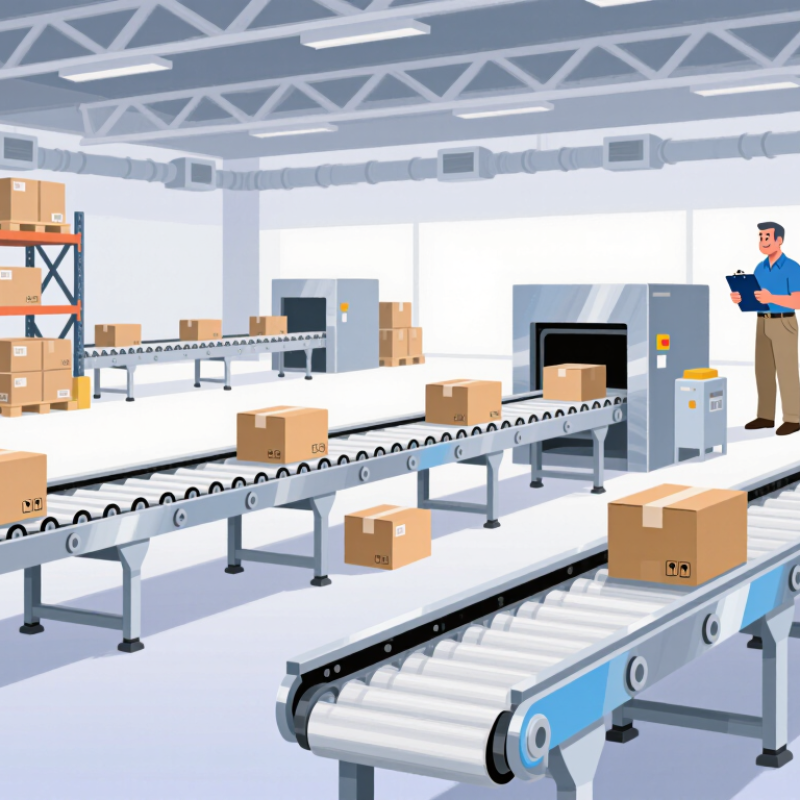
| What a roller conveyor is | A material-handling conveyor made from a series of parallel rollers mounted in a frame. Products move on the roller surfaces along a defined path. | It is suitable for unit loads with a relatively firm, flat underside, such as cartons, totes, pallets, drums, and trays. |
| How gravity roller conveyors work | The load moves because of a slight conveyor incline, manual pushing, or gravity-assisted accumulation. Rollers rotate beneath the load as it travels. | They generally require less equipment and energy than powered systems, making them practical for loading, unloading, staging, and short-distance transfers. |
| How powered roller conveyors work | An electric motor drives rollers directly or through chains, belts, shafts, or motorized rollers. The drive system provides controlled movement and may support accumulation. | Powered systems are better for longer lines, consistent throughput, controlled spacing, inclines, declines, and automated material-flow operations. |
| Common conveyor categories | Gravity roller, powered roller, chain-driven roller, line-shaft roller, belt-driven roller, flexible roller, accumulation roller, and pallet roller conveyors. | The correct category depends on load weight, product dimensions, required speed, accumulation needs, layout, and operating environment. |
| Typical roller diameter | Common industrial roller diameters include approximately 25 mm, 38 mm, 50 mm, 60 mm, 76 mm, and 89 mm. The appropriate size depends on load and conveyor duty. | Larger rollers generally provide greater load capacity and durability, while smaller rollers can suit lighter products and tighter transfer spacing. |
| Roller spacing | Roller pitch must allow the smallest load to be supported by multiple rollers at the same time. A common design rule is to keep at least three rollers under the load. | Correct spacing reduces rocking, tipping, product damage, and unstable transfers. |
| Typical frame materials | Carbon steel is widely used for general industrial applications. Stainless steel is selected for corrosion resistance and hygiene-sensitive environments. Aluminum is used where low weight and modularity are priorities. | Material selection affects service life, cleanability, total weight, corrosion resistance, and purchase cost. |
| Typical load range | Light-duty roller conveyors may handle parcels and cartons weighing a few kilograms. Heavy-duty pallet systems can be engineered for loads of several hundred kilograms or more per load, depending on design. | Buyers should confirm the maximum load per roller, maximum load per linear meter, and safety factor rather than relying only on a general conveyor category. |
| Load bottom condition | Flat, rigid, and stable bottoms work best. Loads with flexible packaging, uneven bases, loose items, or protruding parts may require a belt conveyor, special rollers, guides, or a carrier. | Bottom condition directly affects tracking, rolling resistance, transfer reliability, and product safety. |
| Speed considerations | Gravity conveyors operate according to slope, load characteristics, and manual handling. Powered roller speed is selected according to product type, throughput, accumulation method, and safety requirements. | Excessive speed can cause product impact, noise, poor spacing, and unsafe transfers. |
| Accumulation capability | Accumulation may be zero-pressure, minimum-pressure, or controlled-pressure. Powered zones, sensors, and control logic are commonly used to regulate product spacing. | The accumulation method helps prevent collisions, package damage, and unplanned line stoppages. |
| Layout options | Straight sections, curves, transfers, merges, diverters, inclines, declines, telescopic sections, and flexible sections can be combined into a material-flow layout. | A supplier should review the complete flow path rather than quote isolated conveyor sections without checking transfers and clearances. |
| Typical applications | Warehousing, distribution, manufacturing, packaging, order fulfillment, pallet handling, parcel handling, airport logistics, and assembly operations. | Application conditions determine the required conveyor type, controls, guarding, sanitation level, and maintenance plan. |
| Supplier engineering capability | A qualified supplier should be able to provide load calculations, roller and frame selection, drive sizing, layout drawings, safety features, installation guidance, and commissioning support. | Engineering support reduces the risk of under-capacity equipment, unsuitable transfers, and costly redesigns. |
| Safety features to request | Emergency-stop devices, pinch-point protection, side guards, load backstops, protective covers, safe access points, warning labels, and appropriate electrical protection should be considered. | Safety requirements vary by application and jurisdiction, so buyers should request documentation aligned with the installation location. |
| Maintenance requirements | Routine checks may include roller condition, bearings, drive components, chain or belt tension, fasteners, sensors, guards, alignment, and debris removal. | A supplier offering spare-parts lists, maintenance instructions, and service support can reduce downtime over the equipment life cycle. |
| Global purchasing documents | International buyers commonly request technical drawings, bills of materials, electrical diagrams, packing specifications, manuals, inspection records, warranty terms, and shipping dimensions. | Complete documentation supports customs clearance, installation, local compliance review, spare-parts planning, and future expansion. |
| Key quotation inputs | Load type, minimum and maximum dimensions, load weight, throughput, conveyor length and width, elevation changes, operating hours, environment, power supply, controls, and required delivery scope. | Providing these details allows suppliers to prepare comparable and technically accurate quotations. |

.svg)