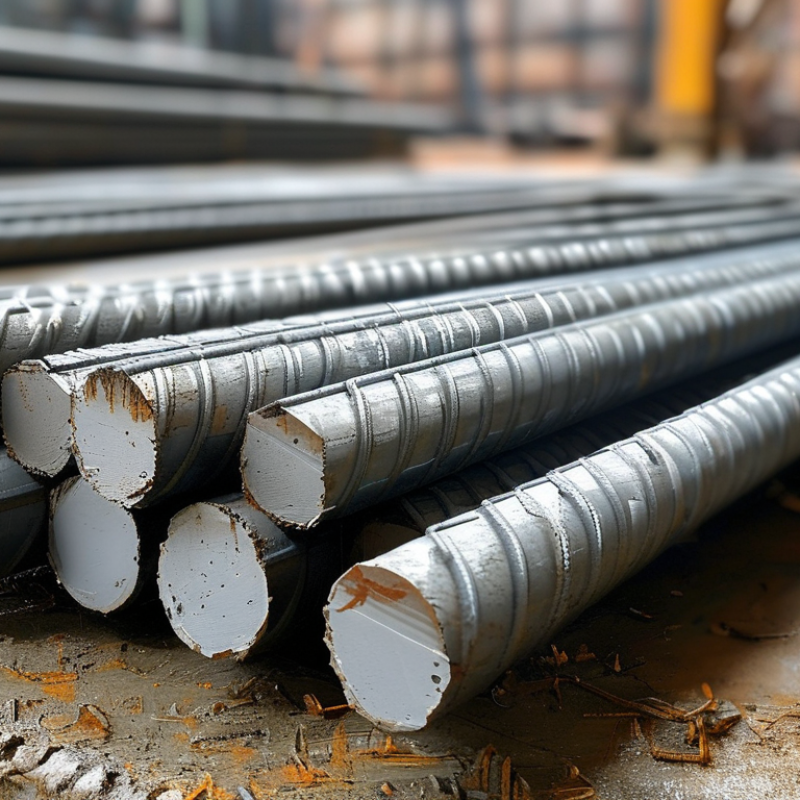
Carbon-Steel Rebar
Grade 60 | ASTM A615/A615M
Grade 60 | 60 ksi
420 MPa | Uncoated carbon steel; requires adequate concrete cover and a suitable exposure design. | General-purpose reinforcing bar. Welding should not be assumed acceptable without checking the chemical composition and approved welding procedure. | Building foundations, slabs, beams, columns, retaining walls, bridges, and general reinforced-concrete construction. | Widely specified and readily available. Confirm nominal diameter, bend schedule, bar markings, elongation, and heat or lot traceability. |
Carbon-Steel Rebar
Grade 80 | ASTM A615/A615M
Grade 80 | 80 ksi
550 MPa | Uncoated carbon steel; durability depends on concrete quality, cover, cracking control, and exposure conditions. | Higher strength can reduce bar congestion, but detailing, development length, lap splices, and seismic requirements must be checked. | High-load columns, heavily reinforced beams, foundations, high-rise structures, and projects seeking lower reinforcement tonnage. | Use only where the design code permits Grade 80. Verify bendability, seismic classification, splice design, and compatibility with couplers. |
Weldable Carbon-Steel Rebar
Grade 60 | ASTM A706/A706M
Grade 60 | 60 ksi
420 MPa | Normally uncoated; corrosion performance is governed by the concrete environment unless an additional coating is specified. | Controlled chemical composition and tensile properties make it suitable for welding when the approved welding procedure is followed. | Seismic frames, congested reinforcement cages, prefabricated assemblies, and structures requiring welded connections. | Request the A706 material certificate and carbon-equivalent information. Do not substitute A615 for A706 where weldability is mandatory. |
Weldable Carbon-Steel Rebar
Grade 80 | ASTM A706/A706M
Grade 80 | 80 ksi
550 MPa | Normally uncoated; use a corrosion-resistant coating when the exposure classification requires additional protection. | Designed for controlled fabrication and welding, subject to qualified procedures and project-specific heat input limits. | Seismic and high-load structures where both higher strength and controlled weldability are required. | Confirm that the design standard accepts Grade 80 A706. Check ductility, welding procedure qualification, splice details, and availability in required sizes. |
| Hot-Dip Galvanized Rebar | ASTM A767/A767M
with a specified zinc coating class | Based on the selected steel grade
commonly 60 ksi / 420 MPa | Zinc coating provides sacrificial protection and improves durability in many chloride or moisture exposures. | Can be cut and bent with suitable handling. Avoid damaging the coating; repair damaged areas according to the project specification. | Parking structures, bridge decks, marine-adjacent construction, road infrastructure, balconies, and exposed concrete elements. | Specify coating class, coating thickness or mass, bend diameter, handling requirements, and compatibility with tie wire, couplers, and repairs. |
| Fusion-Bonded Epoxy-Coated Rebar | ASTM A775/A775M
or ASTM A934/A934M for prefabricated bars | Based on the selected steel grade
commonly 60 ksi / 420 MPa | Nonmetallic epoxy barrier separates the steel from chlorides, moisture, and other aggressive agents. | Requires careful transport, storage, cutting, bending, and field repair to prevent coating damage. | Bridge decks, parking garages, waterfront structures, salt-exposed roads, wastewater facilities, and deicing-salt environments. | Confirm coating thickness, holiday testing, allowable damage, repair material, bend test requirements, and inspection records. |
| Stainless-Steel Reinforcing Bar | ASTM A955/A955M
or the applicable stainless reinforcement specification | Grade-dependent;
common grades include 60 ksi / 420 MPa and higher grades | High resistance to chloride-induced corrosion and carbonation compared with ordinary carbon steel. | Fabrication practices depend on the stainless grade. Prevent contamination from carbon-steel tools, storage racks, and cutting debris. | Severe marine exposure, bridge decks with long service-life targets, tunnels, seawalls, wastewater plants, and critical repairs. | Specify stainless grade, magnetic behavior, mechanical properties, welding procedure, surface condition, and galvanic compatibility with adjacent metals. |
| Chromium-Alloy Corrosion-Resistant Rebar | ASTM A1035/A1035M
grade and class must be specified | Grade-dependent;
high-strength options are available | Chromium-enriched alloy provides improved resistance to corrosion without using a separate surface coating. | Fabrication and welding requirements vary by grade and chemistry; follow the producer's qualified procedures and the project specification. | Long-life bridge decks, marine structures, high-performance concrete, and applications where reduced maintenance is important. | Do not purchase by “chromium rebar” alone. State the exact ASTM grade/class, yield strength, bend requirements, welding limits, and acceptance tests. |
Ribbed High-Ductility Rebar
B500B | EN 10080
with the applicable national product standard | 500 MPa minimum yield strength | Normally uncoated carbon steel; additional galvanizing or epoxy coating requires a separate specification. | Ductility Class B provides controlled ductility and weldability characteristics subject to the applicable national standard and procedure. | European-design reinforced-concrete buildings, foundations, industrial structures, and general infrastructure. | Confirm product certification, nominal diameter, rib geometry, ductility values, weldability, and compatibility with Eurocode-based design. |
Ribbed High-Ductility Rebar
B500C | EN 10080
with the applicable national product standard | 500 MPa minimum yield strength | Normally uncoated carbon steel; specify a separate corrosion-protection system for aggressive exposure. | Ductility Class C offers higher ductility than Class B and is commonly selected where seismic or plastic-deformation capacity is important. | Seismic regions, ductile moment frames, reinforced-concrete buildings, bridges, and structures designed for significant inelastic behavior. | Check the national annex, seismic detailing rules, k-factor or ductility requirements, weldability, and required certification. |

.svg)