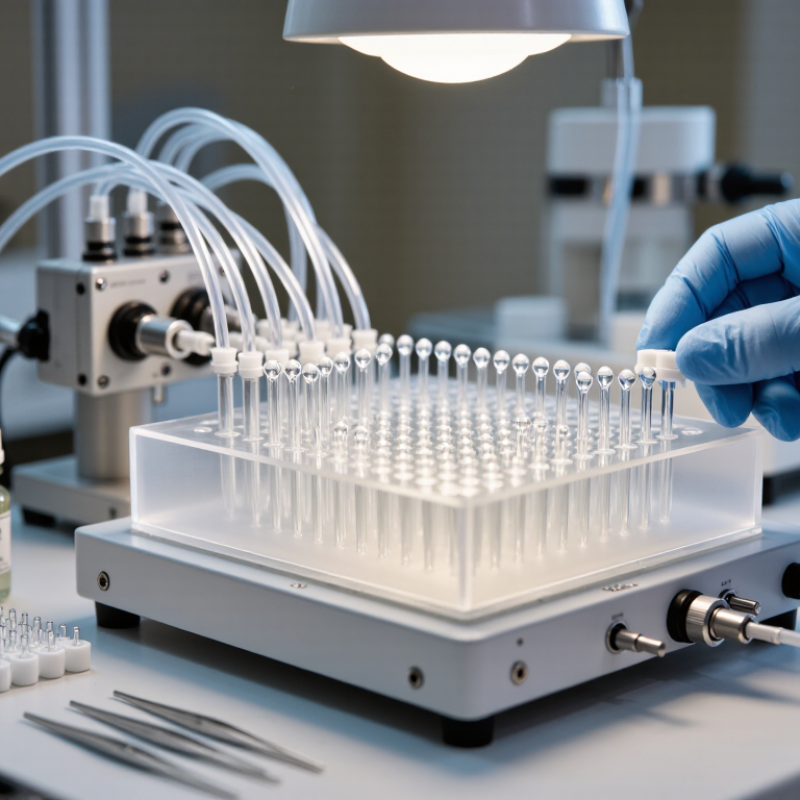
Choosing a droplet molding apparatus starts with flow control, not a glossy feature list. A system rated for 10² droplets per second may suit slow screening, but it can waste time during larger experiments. At 10⁴ droplets per second, small pressure changes become visible as size drift, satellite droplets, or occasional merging. Match the operating range to your real workload, not the maximum number printed in a specification sheet. Ask whether the quoted rate means stable production or a brief peak. That distinction matters.
During evaluation, run water-like and viscous test fluids at 100, 1,000, and 10,000 droplets per second. Record droplet diameter, coefficient of variation, pressure, temperature, and rejected droplets. Use a camera with enough frame rate to catch brief instabilities. Inspect the first and last minutes of every run. They often differ.
A reliable apparatus should restart consistently after pauses and maintain clean separation at the target speed. Check whether tubing volume creates a delay between pump changes and droplet response. That delay can mislead operators.
Keep spare nozzles and a written cleaning procedure nearby; tiny residue can distort results surprisingly fast.
My own preference is a system with transparent limits and accessible calibration. I have seen a smooth image hide an 8% size increase over one hour. It looked acceptable at first. Repeatability deserves more attention than a single impressive run.
Still, I would not reject a lower-throughput unit automatically. For delicate formulations, 10² droplets per second may protect uniformity better than forced speed. 马会

.svg)