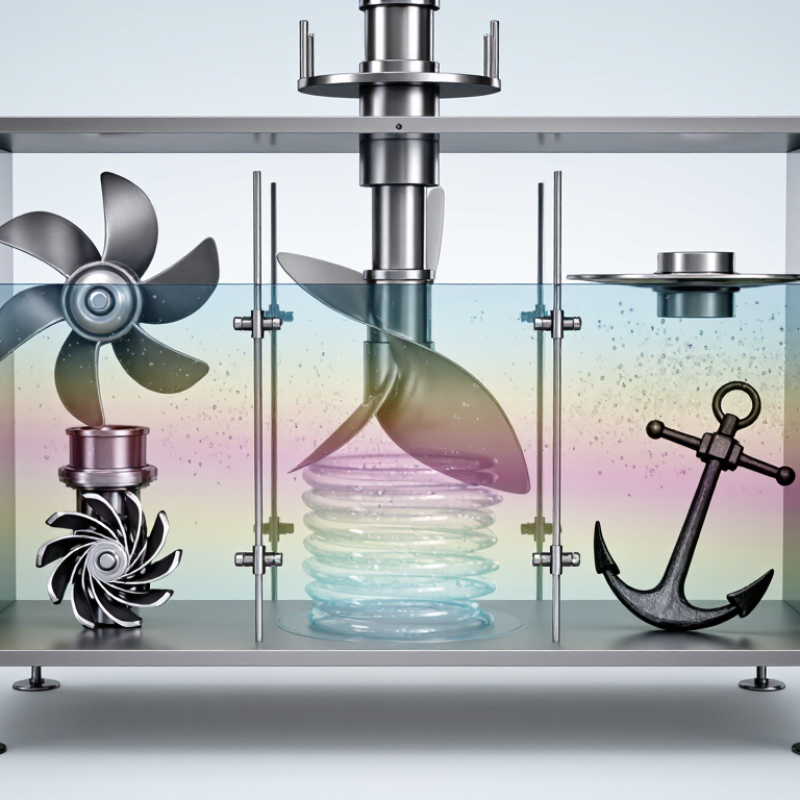
| Propeller Agitator | Primarily axial flow with strong circulation along the vessel axis | Low-viscosity blending Suspension Gas dispersion | Water-like liquids and fluids generally below approximately 2,000 mPa·s | Approximately 300–1,500 rpm | High circulation rate, compact design, and effective mixing at relatively low power | Check liquid viscosity, impeller diameter, vessel geometry, and the need for baffles |
| Pitched-Blade Turbine | Combination of axial and radial flow, depending on blade angle and configuration | General blending Solid suspension Heat transfer | Low- to medium-viscosity liquids with suspended solids | Approximately 100–600 rpm | Versatile performance and a balanced combination of circulation and shear | Choose blade angle and diameter according to solids concentration, settling behavior, and power demand |
| Flat-Blade Turbine | Strong radial flow with high local turbulence | Gas dispersion Liquid blending Reaction processes | Low- to medium-viscosity liquids where shear and turbulence are required | Approximately 100–800 rpm | Good gas dispersion and strong mixing intensity | Consider shear sensitivity, vortex control, power input, and the possibility of mechanical damage to fragile particles |
| Hydrofoil Impeller | High-efficiency axial flow with relatively low turbulence | Large-volume blending Solids suspension Flocculation | Low-viscosity fluids and processes requiring gentle, energy-efficient circulation | Approximately 50–400 rpm | Low power consumption, high pumping capacity, and reduced shear | Use baffles and adequate submergence; evaluate solids settling velocity and required turnover time |
| Anchor Agitator | Primarily tangential and wall-sweeping flow | Viscous blending Heat transfer Wall scraping | Medium- to high-viscosity fluids, often approximately 1,000–100,000 mPa·s | Approximately 5–100 rpm | Good wall coverage and improved heat transfer in jacketed vessels | Maintain suitable wall clearance; assess torque, vessel diameter, yield stress, and heating or cooling requirements |
| Helical-Ribbon Agitator | Strong axial and helical circulation with efficient movement through viscous material | High-viscosity blending Paste mixing Emulsions | Highly viscous liquids, pastes, creams, and non-Newtonian materials | Approximately 10–150 rpm | Effective bulk movement and good mixing in materials that do not flow easily | Requires accurate torque sizing; consider clearance, batch fill level, and whether a scraper is needed |
| Gate Agitator | Low-shear circumferential flow near the vessel wall | Gentle blending Heat transfer Settling prevention | Viscous, shear-sensitive, or heat-sensitive products | Approximately 5–80 rpm | Gentle operation and broad wall coverage with limited product damage | Evaluate viscosity changes during heating or cooling and the required drive torque at start-up |
| High-Shear Rotor–Stator | Localized radial flow with intense shear in a narrow rotor–stator gap | Emulsification Particle-size reduction Deagglomeration | Dispersions, emulsions, suspensions, and formulations requiring fine droplets or particles | Approximately 1,000–10,000 rpm | Rapid dispersion and high local energy density | Check temperature rise, air entrainment, product sensitivity, residence time, and cleaning requirements |
| Magnetic Agitator | Small-scale axial or radial circulation generated by a magnetically driven bar or impeller | Laboratory blending Closed processing Sterile applications | Low-viscosity liquids in small vessels where shaft penetration should be avoided | Approximately 100–2,000 rpm | No mechanical shaft seal, low contamination risk, and simple operation | Confirm vessel size, liquid viscosity, coupling strength, operating temperature, and maximum fill volume |
| Static Mixer | Internal fixed elements repeatedly divide, rotate, and recombine the flowing streams | Continuous blending Inline dosing Gas-liquid contact | Continuous-flow liquids, gases, and liquid–liquid streams with suitable flowability | Not applicable; performance depends on flow rate and pressure drop | No rotating drive, low maintenance, and compact continuous operation | Size for flow rate, viscosity ratio, mixing quality, pressure drop, fouling tendency, and cleanability |

.svg)