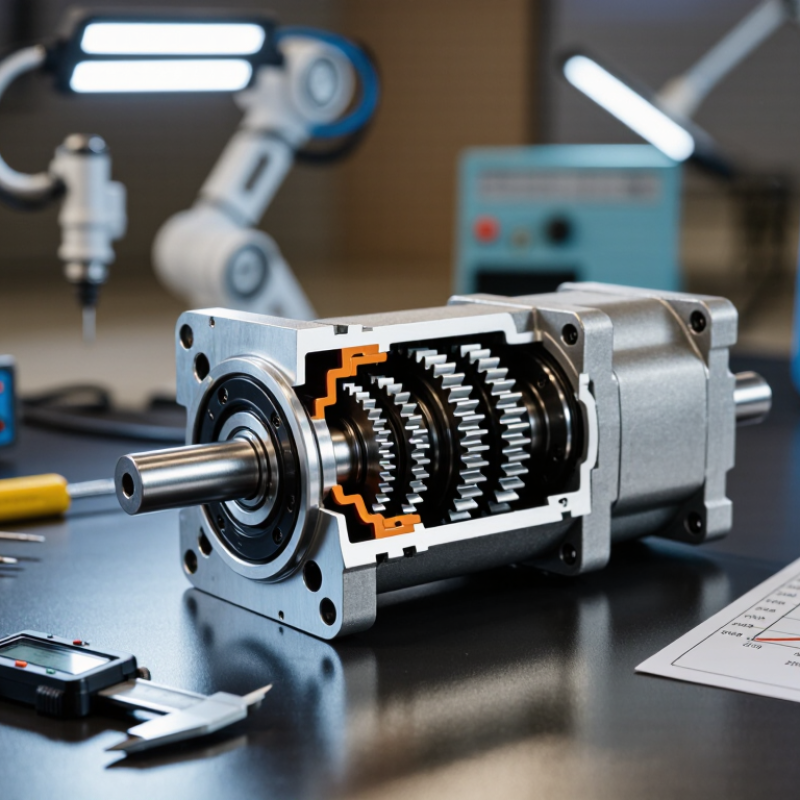
| Rated Voltage | 3–6 V, 12 V, 24 V, or 48 V DC | Match the motor to the available battery, control board, or industrial power supply. Lower-voltage systems are common in portable equipment, while 24 V and 48 V systems are widely used in industrial automation and mobile machinery. | Growing adoption of 24 V and 48 V architectures in automated equipment, mobile robots, material handling, and battery-powered systems. |
| Continuous Output Torque | Approximately 0.02–20 N·m, depending on motor size and gearbox stage | Use continuous torque for normal operating loads and peak torque for acceleration, startup, or temporary overloads. A safety margin is normally required to handle friction, shock loads, and duty-cycle variation. | Higher torque density is increasingly important where equipment designers need smaller actuators without sacrificing load capacity. |
| Gear Ratio | 3:1–1,000:1; common selections include 16:1, ೀ 64:1, 100:1, and 256:1 | Low ratios provide higher speed with moderate torque; high ratios provide greater torque and lower output speed. The required ratio should be calculated from load torque, target speed, acceleration, and duty cycle. | Modular multi-stage gearboxes are favored for applications requiring several speed and torque configurations from one motor platform. |
| Output Speed | Approximately 1–3,000 rpm, depending on input speed and ratio | Confirm no-load speed, rated-load speed, and speed regulation. Output speed can fall as load torque increases, especially in compact brushed motor systems. | Demand is rising for compact, low-speed actuators used in valves, grippers, dosing equipment, seat adjustment, and precision positioning. |
| Gearbox Efficiency | About 55–90%, depending on ratio, number of stages, lubrication, and load | Higher ratios and additional stages generally reduce efficiency. Buyers should compare measured efficiency at the actual operating torque and speed rather than relying only on a maximum value. | Energy efficiency is becoming a key purchasing criterion in battery-powered products and equipment operating continuously or intermittently throughout the day. |
| Motor Technology | Brushed DC or brushless DC motor combined with a planetary gearbox | Brushed motors can offer lower initial cost and simple control. Brushless motors typically provide longer service life, improved thermal performance, and better suitability for frequent or continuous operation. | Brushless configurations are gaining preference in robotics, medical equipment, automated guided vehicles, and applications with high operating hours. |
| Speed Feedback | No feedback, Hall sensors, magnetic encoder, or optical encoder | Open-loop motors may be adequate for simple fans, pumps, locks, and adjustment mechanisms. Encoders are preferred when accurate position, speed regulation, synchronization, or fault detection is required. | Integrated feedback is increasingly specified for collaborative automation, robotic joints, smart actuators, and closed-loop motion control. |
| Backlash | Approximately 1–3° for standard planetary gearboxes; lower values require specialized designs | Backlash affects positioning accuracy and repeatability. Buyers should check backlash at the output shaft under defined measurement conditions and load direction. | Low-backlash solutions are increasingly required in robotic grippers, camera systems, laboratory instruments, and compact positioning modules. |
| Operating Life | Several hundred to more than 10,000 operating hours, depending on load, speed, lubrication, and duty cycle | Request life calculations or test conditions based on the actual torque-speed profile. Gear wear, brush wear, bearing load, thermal stress, and shock loading all affect service life. | Global buyers are placing greater emphasis on predictive maintenance, replaceable modules, and documented life testing. |
| Ingress Protection | Common configurations range from open-frame designs to IP54–IP65; higher protection requires appropriate sealing | Choose protection according to dust, moisture, cleaning procedures, and installation location. A sealed gearbox does not automatically mean that the motor assembly has the same protection rating. | Demand for sealed motor-gearbox assemblies is increasing in outdoor equipment, warehouse automation, agricultural machinery, and mobile platforms. |
| Operating Temperature | Typically −20°C to +60°C; specialized designs may support wider ranges | Check allowable winding temperature, gearbox lubricant range, battery conditions, and starting torque at low temperature. Continuous operation near the thermal limit can shorten service life. | More equipment is being designed for cold-chain logistics, outdoor automation, high-temperature enclosures, and variable global climates. |
| Noise and Vibration | Often approximately 45–70 dB(A), depending on speed, load, gear geometry, motor type, and mounting | Ask for test distance, rotational speed, load condition, and measurement method. Proper alignment, lubrication, bearing quality, and housing rigidity strongly influence acoustic performance. | Low-noise operation is increasingly important in medical devices, office automation, smart home products, and indoor service robots. |
| Duty Cycle | Intermittent duty, cyclic duty, or continuous duty depending on thermal design | Calculate RMS torque and average power over the complete motion cycle. A motor suitable for short movements may overheat when used continuously at the same load. | Application-specific sizing is replacing simple maximum-torque selection as buyers seek smaller, more efficient, and more reliable systems. |
| Common Applications | Robotics, AGVs, electric locks, pumps, valves, medical devices, office automation, and smart appliances | Planetary gear motors are suitable where compact dimensions, high torque density, coaxial output, and controlled speed are important. | The strongest application momentum is associated with warehouse automation, compact robotics, battery-powered devices, and intelligent electromechanical systems. |
| Customization Requirements | Shaft geometry, mounting pattern, connector, cable length, encoder, brake, winding, gear ratio, and output bearing | Provide a complete technical specification before quotation, including load profile, dimensions, voltage, speed, torque, duty cycle, environment, and annual volume. | Platform-based customization helps global buyers reduce redesign time while maintaining common components across multiple product models. |
| Compliance and Documentation | Technical drawings, performance curves, material information, test reports, and applicable market compliance documents | Confirm documentation requirements for the destination market, electrical system, product category, and transportation conditions. Traceability and consistent test methods simplify supplier qualification. | Procurement teams increasingly evaluate suppliers on documentation quality, product consistency, lifecycle support, and sustainability information—not price alone. |

.svg)