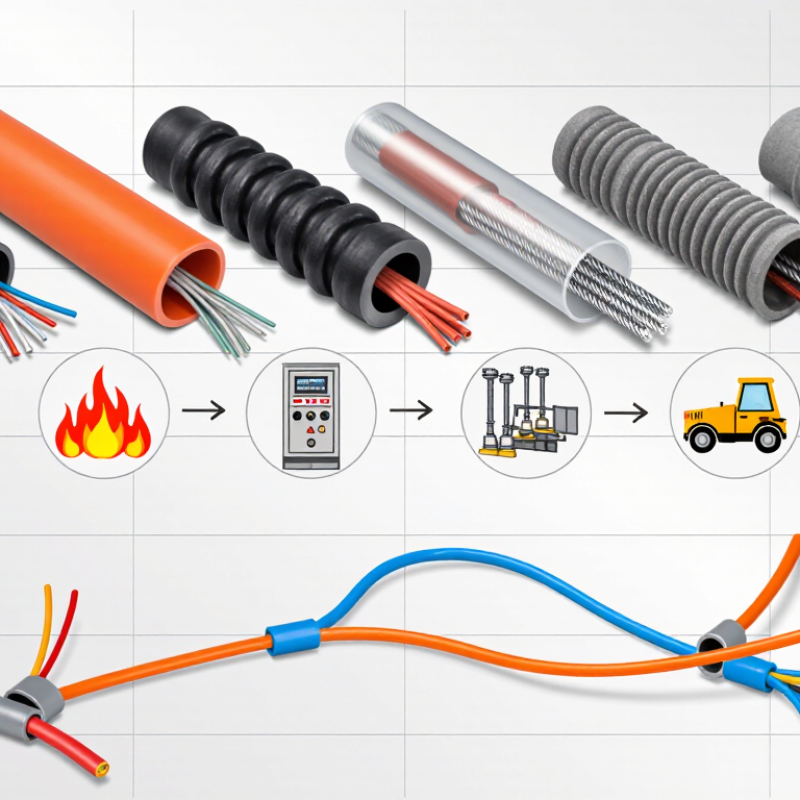
| Expandable Braided Sleeve | Polyester (PET) monofilament and multifilament braid | Approximately 3–25 mm; expands to accommodate irregular shapes and connectors | Typically −50°C to +150°C | Abrasion, chafing, light impact, and cable-bundle protection | Automotive harnesses, control cabinets, robotics, appliance wiring, and general cable management | Lightweight, flexible, easy to install, allows heat dissipation, and provides good coverage for curved cable routes | Not a sealed waterproof barrier; open braid can allow dust and liquid penetration | Best Overall |
| Split-Braided Sleeve | Slit PET braided sleeving with a longitudinal opening | Approximately 6–50 mm; suitable for pre-assembled cable bundles | Typically −50°C to +150°C | Abrasion protection and retrofit bundling | Existing wiring looms, maintenance work, server wiring, industrial control panels, and cable assemblies with attached connectors | Can be fitted without disconnecting cables; quick installation and easy access for inspection or repair | Less resistant to pull-out and displacement than a closed braided sleeve; usually requires end fixing | Best for Retrofit |
| Hook-and-Loop Wrap Sleeve | Woven polyester or nylon fabric with hook-and-loop closure | Approximately 10–60 mm, depending on wrap width and cable bundle size | Typically −40°C to +125°C | Abrasion, light crushing, organization, and repeated access protection | Data centers, office equipment, audio-video systems, test benches, and frequently modified cable bundles | Reusable, openable along the entire length, easy to add or remove cables, and suitable for field maintenance | Generally offers lower heat and abrasion resistance than industrial braided or fiberglass sleeves; closure may collect dust | Best for Maintenance |
| Spiral Wrap | Polyethylene (PE) or nylon (PA) | Approximately 3–50 mm; available in multiple inner diameters and spiral pitches | PE: typically −40°C to +85°C
PA: typically −40°C to +125°C | Light abrasion protection, cable bundling, and controlled branching | Desk wiring, control panels, machinery, battery cables, and installations requiring branch exits | Low cost, flexible, easy to cut, and allows individual cables to exit at selected points | Does not provide continuous coverage; cables remain partly exposed between spiral turns | Best for Branching |
| Corrugated Flexible Conduit | Polypropylene (PP), polyethylene (PE), or polyamide (PA) | Approximately 5–50 mm internal diameter; larger sizes are available for industrial routing | Typically −40°C to +120°C, depending on polymer and construction | Mechanical impact, abrasion, crushing, and routing protection | Automotive wiring, machinery, factory automation, outdoor equipment, and cable runs exposed to movement | Higher mechanical protection than open braid; flexible, crush-resistant, and compatible with conduit fittings | Not automatically watertight; the assembly requires suitable end fittings and seals for liquid protection | Best for Impact Protection |
| Silicone-Coated Fiberglass Sleeve | Texturized fiberglass braid coated with silicone rubber | Approximately 3–30 mm internal diameter; select a size that fits freely over the cable | Typically −60°C to +260°C; short-term limits may vary by construction | High-temperature, flame, molten-splash, and abrasion protection | Motors, generators, ovens, furnaces, welding equipment, engine compartments, and high-temperature electrical leads | Excellent thermal resistance, flexible installation, electrical insulation, and good resistance to sparks and hot particles | Bulkier and more expensive than PET sleeves; the coating can be damaged by sharp edges or severe flexing | Best for High Heat |
| Stainless-Steel Braided Sleeve | 304 or 316 stainless-steel wire braid | Approximately 6–50 mm; choose the inside diameter based on bundle size and installation clearance | Typically suitable for continuous exposure up to approximately +500°C, depending on wire grade and construction | Severe abrasion, cutting, mechanical impact, rodents, and high-temperature protection | Industrial furnaces, foundries, heavy machinery, marine systems, and areas exposed to sharp or abrasive hazards | Very high mechanical strength, excellent abrasion resistance, non-combustible metal construction, and strong chemical durability | Heavier, less flexible, and more difficult to terminate; it is electrically conductive and requires insulation or grounding where necessary | Best for Severe Duty |

.svg)