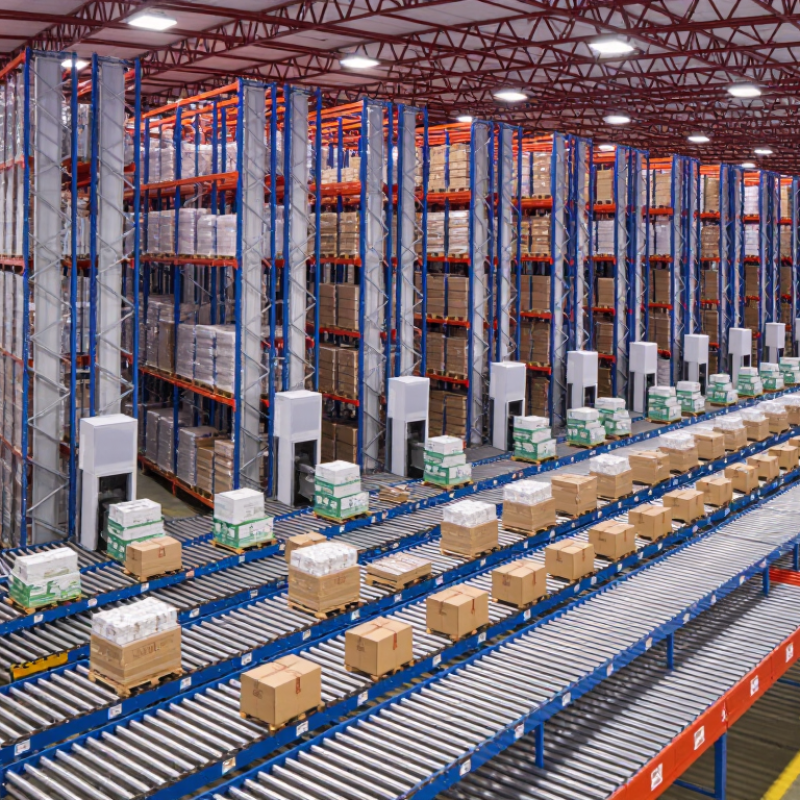
| Carton Load Capacity | Approximately 5–80 kg per carton, depending on the roller track and lane width | Use light-duty tracks for small parcels and reinforced tracks for heavy cases | Supports gravity movement without powered conveyors in many picking applications | Confirm the maximum carton weight, bottom stiffness, and load distribution before selection |
| Roller Track Type | Plastic wheels, steel rollers, or skate-wheel tracks | Plastic wheels for lightweight cartons; steel rollers for higher loads and frequent replenishment | Provides controlled carton flow and adapts the rack to different packaging conditions | Evaluate noise, rolling resistance, corrosion exposure, and maintenance access |
| Track Incline | Commonly about 3°–8°, subject to carton size, weight, and track design | Use a lower incline for fragile or unstable cartons and a higher incline for reliable movement of heavier cartons | Creates gravity-fed FIFO movement from the replenishment side to the picking side | Test representative cartons because excessive slope can increase impact and product damage |
| Lane Width | Typically 300–1,200 mm, with custom widths available for mixed carton sizes | Select a lane slightly wider than the carton width to allow smooth loading and unloading | Improves product accessibility while reducing carton jams | Base the width on actual carton dimensions, tolerances, labels, and packaging deformation |
| Lane Depth | Commonly 1,200–3,600 mm; deeper lanes hold more cartons but require tighter flow control | Use short lanes for high-SKU, high-turnover products and deeper lanes for stable fast-moving SKUs | Balances storage density with replenishment frequency and inventory visibility | Check SKU velocity, replenishment cycles, carton quantity per lane, and available rack depth |
| Carton Size Range | Often designed for cartons from approximately 150 × 100 mm to 800 × 600 mm | Use adjustable dividers and modular tracks for mixed-size carton storage | Allows one rack structure to handle multiple product categories | Verify the smallest and largest carton footprints, heights, and center-of-gravity conditions |
| FIFO Control | Front access with rear replenishment and lane-level stock rotation | Install rear loading access, lane labels, and positive carton stop controls | Helps reduce product aging and supports date-sensitive inventory management | FIFO performance depends on correct loading discipline and unobstructed track movement |
| Carton Separators | Adjustable steel or polymer dividers positioned along each lane | Choose tool-free adjustable dividers for frequently changing SKU assortments | Prevents cartons from shifting between lanes and improves item identification | Confirm divider height, spacing adjustment, edge protection, and compatibility with cartons |
| Entry and Exit Stops | Front carton stops, rear retaining rails, and optional brake rollers | Use brake rollers or speed controllers for heavy cartons and long lanes | Controls carton speed and reduces impact at the picking face | Select stop components according to carton mass, slope, and operator ergonomics |
| Rack Frame Height | Common installations range from approximately 1,800 mm to 6,000 mm | Match beam levels to carton height, picking ergonomics, and replenishment equipment | Uses vertical warehouse space while maintaining practical access | Consider ceiling height, sprinkler clearance, seismic requirements, and lifting equipment |
| Load per Rack Level | Frequently engineered within approximately 300–1,500 kg per level | Specify level capacity based on the maximum number and weight of cartons stored | Supports stable storage and reduces the risk of beam or frame overload | Require structural calculations for the actual layout, loading pattern, and local regulations |
| Material and Finish | Cold-formed or structural steel with powder-coated or galvanized components | Use powder coating for dry indoor warehouses and galvanized finishes for humid or corrosive areas | Improves durability, visibility, and resistance to routine warehouse wear | Review coating thickness, corrosion exposure, cleaning methods, and local fire requirements |
| Picking Ergonomics | Frequently picked cartons positioned between waist and shoulder height | Combine flow lanes with ergonomic working heights, clear labels, and accessible replenishment zones | Reduces bending, reaching, and unnecessary walking during order picking | Assess worker height range, carton weight, picking frequency, and manual handling limits |
| Modularity and Expansion | Bolt-in tracks, adjustable beams, movable dividers, and expandable rack bays | Choose modular components when SKU profiles or throughput are expected to change | Simplifies reconfiguration and reduces the need for complete rack replacement | Confirm spare-part availability, future bay compatibility, and installation requirements |
| Safety Features | Back guards, end protectors, aisle guards, anti-collapse features, and load notices | Add protection where forklifts, pallet trucks, or powered handling equipment operate nearby | Helps protect operators, cartons, rack frames, and adjacent warehouse equipment | Apply local rack safety standards and schedule routine inspections after installation |
| Best-Fit Applications | E-commerce fulfillment, spare parts, retail distribution, food packaging, and light manufacturing | Use carton flow for high-SKU operations requiring frequent manual picking and replenishment | Improves pick density, stock rotation, and order preparation speed | For pallets, very irregular loads, or low-velocity inventory, consider other storage systems |

.svg)