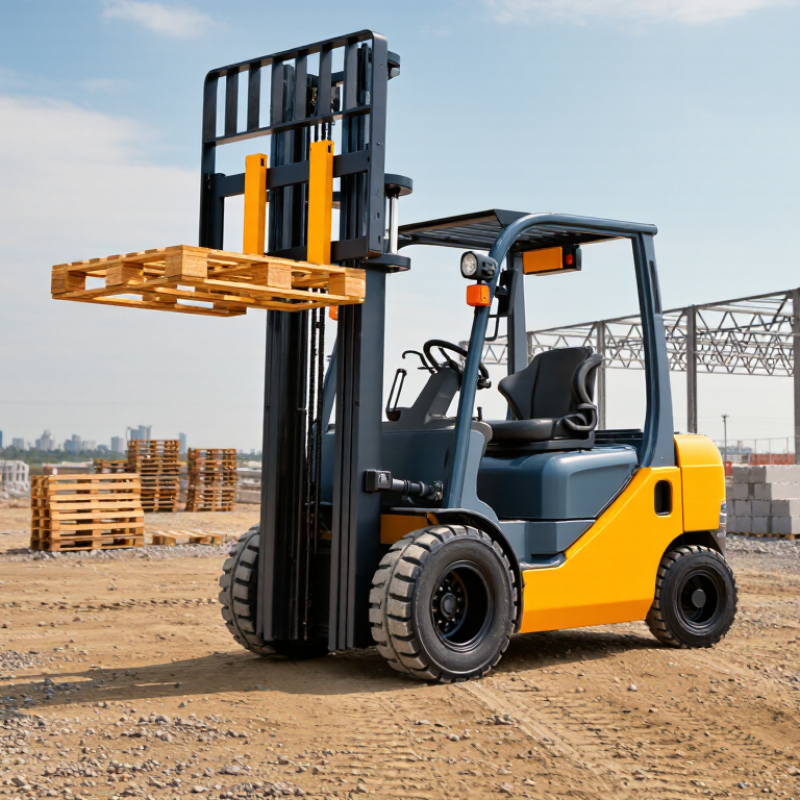
| Applicable Safety Standards | GB/T 5144-2008 addresses safety requirements for powered industrial trucks. ISO 3691-1 specifies safety requirements and verification for self-propelled industrial trucks within its stated scope. | Request the current conformity documentation, risk assessment, operating instructions, and inspection records. Confirm that the truck configuration and intended application fall within the applicable standard scope. | Required |
| Rated Load Capacity | Common 4-wheel rough-terrain and industrial configurations are often offered in approximately 2,000–5,000 kg capacity classes; the actual rating depends on the load center, mast, attachments, and configuration. | Check the data plate and load chart. Never select capacity from the nominal model class alone; verify the rated capacity at the actual load center and lift height. | Required |
| Load Center | Typical rated-load centers for many counterbalanced forklifts are around 500–600 mm, but the value varies by design and capacity class. | Measure the real load depth and compare it with the truck’s rated load center. A longer or uneven load can reduce allowable capacity and longitudinal stability. | Required |
| 4-Wheel-Drive System | Four-wheel drive can improve traction on compacted gravel, construction sites, ramps, and uneven outdoor surfaces. It does not automatically increase rated lifting capacity. | Check axle rating, differential or axle protection, ground clearance, tire type, turning radius, braking performance, and the manufacturer’s approved surface conditions. | Recommended for Outdoor Use |
| Operating Surface and Grade | Safe gradeability is application-specific and depends on load, direction of travel, surface condition, tire selection, and braking capacity. No single grade value applies to every forklift. | Use the supplier’s verified gradeability chart. Travel with the load uphill where required by the operating instructions, reduce speed, and avoid loose edges, potholes, and unstable shoulders. | Required |
| Mast Configuration | Common options include duplex and triplex masts. A triplex mast provides greater lift height with lower collapsed height, while a duplex mast generally has fewer moving stages and simpler visibility characteristics. | Compare free lift, collapsed height, maximum lift height, mast deflection, visibility through the mast, and the required overhead clearance at the worksite. | Required |
| Mast and Fork Inspection | Critical components include mast channels, rollers, lift chains, chain anchors, hydraulic cylinders, hoses, fork heels, fork shanks, and locking mechanisms. | Look for cracks, bending, corrosion, stretched or damaged chains, hydraulic leaks, unequal chain tension, worn fork heels, and missing fork-retaining devices. | Required |
| Fork Dimensions | Fork length and cross-section must match the load and carriage rating. Longer forks may reduce effective capacity when the load center moves forward. | Verify fork markings, fork spacing, locking pins, heel condition, and the required fork length for pallets or non-palletized loads. Do not use cracked or excessively worn forks. | Required |
| Overhead Guard | A properly designed overhead guard helps protect the operator from falling objects within its intended protection limits. It is not designed to support an elevated load. | Check guard mounting, welds, roof mesh or bars, deformation, clearance, and compatibility with the mast and attachments. Do not remove or modify the guard without approved engineering documentation. | Required |
| Operator Restraint | A functioning seat belt or approved operator restraint helps keep the operator within the protected zone during tip-over or sudden movement. | Inspect the belt, buckle, anchor points, seat switch, and interlock system. The truck should not be operated with a damaged, bypassed, or nonfunctional restraint. | Required |
| Operator Visibility | Visibility can be affected by mast stages, load height, fork carriage width, attachments, lighting, and rear counterweight design. | Conduct a route-specific visibility trial with the intended load. Provide mirrors, lighting, warning systems, a spotter, or a controlled travel procedure where direct visibility is restricted. | Required |
| Braking and Parking | The service brake must provide controlled stopping, while the parking brake must hold the unloaded or loaded truck as specified by the approved design and operating instructions. | Test service and parking brakes before each shift. Check brake fluid or air-system condition where applicable, tire grip, pedal response, and parking-brake holding performance. | Required |
| Steering and Stability | Counterbalanced forklifts steer from the rear, producing a tail-swing hazard. Stability is influenced by load center, lift height, speed, turning radius, slope, and surface conditions. | Check steering free play, axle condition, turning response, stability controls, and the rated capacity chart. Keep the load low during travel and avoid sudden turns with an elevated load. | Required |
| Tires and Wheels | Pneumatic tires are generally suited to rougher outdoor surfaces; solid or cushion tires are commonly used where puncture resistance and firm floors are more important. | Match tire type and ply rating to the surface and load. Inspect pressure, tread, cuts, sidewall damage, wheel nuts, rim condition, and equal tire size on the axle. | Required |
| Hydraulic System | The hydraulic system controls lifting, tilting, and attachment functions. Leakage or uncontrolled drift can create crushing and dropped-load hazards. | Check hoses, fittings, cylinders, control valves, oil level, mast drift, tilt-hold function, and hose routing. Use only compatible hydraulic oil and approved replacement components. | Required |
| Warning and Lighting Equipment | Typical equipment may include headlights, rear work lights, brake lights, audible horn, reversing alarm, beacon, and pedestrian-warning systems. | Select equipment according to traffic density, noise level, visibility, and local workplace rules. Test all warning devices at the start of each shift. | Recommended |
| Emergency Isolation and Controls | Controls should be clearly identified and protected against unintended activation. Emergency isolation arrangements depend on the truck’s power system and design. | Verify ignition or power isolation, neutral-start function, control labeling, emergency procedures, and safe shutdown instructions. Do not bypass interlocks. | Required |
| Attachments | Side shifters, clamps, rotators, extensions, and other attachments change the load center and may reduce residual capacity. | Confirm attachment rating, locking method, hydraulic compatibility, visibility, load-chart adjustment, and compatibility with the carriage and forks. | Required |
| Noise, Exhaust, and Ventilation | Internal-combustion trucks can produce exhaust emissions and heat. Indoor use requires suitable ventilation and compliance with workplace exposure controls. | Assess fuel type, emission controls, exhaust routing, noise, ventilation, fire precautions, and whether an electric or lower-emission configuration is more suitable. | Application Dependent |
| Pre-Shift Inspection | A documented inspection should cover tires, forks, mast, chains, hydraulics, steering, brakes, restraint, horn, lights, alarms, leaks, and visible structural damage. | Remove the truck from service when a safety-critical defect is found. Repairs should be completed and recorded by competent personnel before returning the truck to operation. | Required |
| Operator Competence | Operators require site-specific training covering controls, load handling, stability, pedestrian interaction, ramps, attachments, charging or fueling, and emergency response. | Use authorized operators only. Maintain training, evaluation, refresher, and authorization records in accordance with applicable workplace requirements. | Required |

.svg)