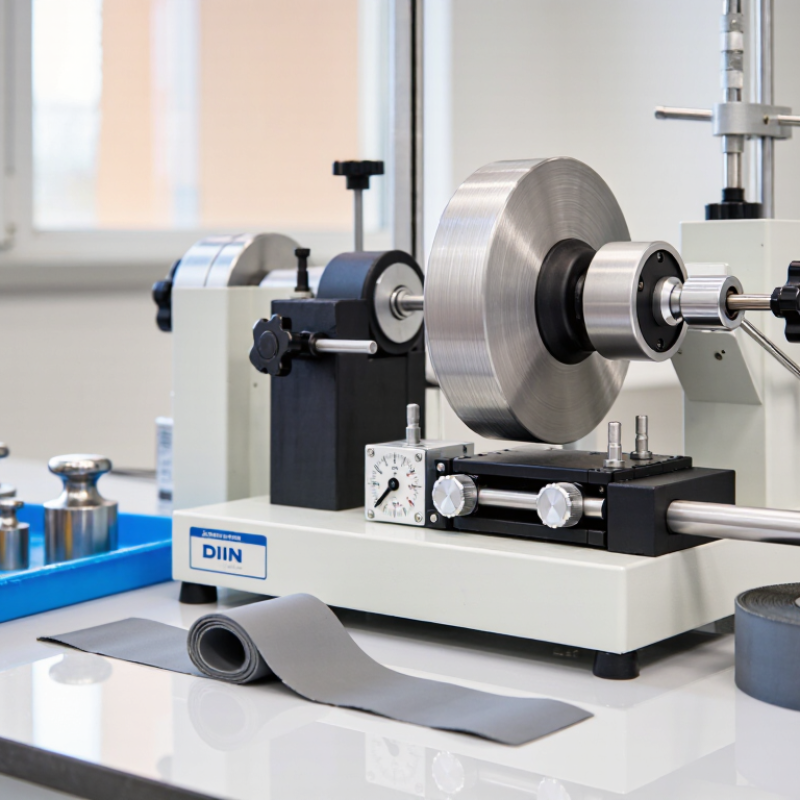
| Applicable test standard | Compliance with DIN 53516 and/or ISO 4649, depending on the laboratory's reporting requirements. | A tester should reproduce the specified method so that results can be compared with customer, regulatory, and historical data. | Request a conformity statement, method description, and evidence that the operating parameters match the selected standard. |
| Specimen dimensions | For ISO 4649 cylindrical specimens: approximately 16 mm diameter and 6–10 mm height, with the exact dimensions controlled by the applicable method. | Incorrect specimen geometry can change contact pressure and produce non-comparable abrasion values. | Confirm the supplied specimen holder, cutter, and height-control accessories are suitable for the required dimensions. |
| Test load | Common ISO 4649 conditions include a 10 N nominal load; some procedures use 5 N. The selected load must match the test method. | Load directly affects contact pressure, wear rate, and the measured volume loss. | Check load accuracy, calibration capability, and whether interchangeable weights or a verified loading system are included. |
| Abrasive sheet | A standardized abrasive sheet, commonly specified as approximately 60-grit abrasive paper for the relevant DIN/ISO procedure. | Abrasive grain size, backing, surface condition, and batch variation strongly influence wear results. | Check the required abrasive specification, traceable replacement material, secure sheet mounting, and easy replacement procedure. |
| Abrasive drum and test path | A rotating drum with a controlled linear abrasion distance; ISO 4649 commonly uses a 40 m sliding distance. | A consistent test path is necessary for repeatable wear volume calculations. | Verify drum diameter, surface speed, distance control, automatic stopping, and protection against abrasive-sheet slippage. |
| Drum speed | Approximately 0.32 m/s is commonly specified for ISO 4649 testing; the exact requirement should follow the selected method. | Speed affects frictional heating, abrasion behavior, and test duration. | Look for closed-loop speed control, displayed test speed, and documented speed accuracy over the complete test cycle. |
| Result calculation | Capability to report mass loss and calculated volume loss in mm³, using specimen density and, where required, a reference compound. | Volume loss allows more meaningful comparison between compounds with different densities. | Confirm the instrument software supports density entry, reference calibration, formula documentation, data export, and manual verification. |
| Reference compound correction | Support for a reference material or reference compound when required by the applicable ISO/DIN procedure. | Reference correction helps compensate for changes in abrasive aggressiveness between test sheets or test periods. | Check whether reference-test records, correction factors, acceptance limits, and trend reports can be maintained. |
| Load and speed accuracy | The instrument should provide documented measurement accuracy and repeatable control of load, speed, and travel distance; acceptance limits must be defined by the laboratory method. | A nominal setting alone does not demonstrate that the actual test conditions remain within tolerance. | Ask for factory test data, calibration points, adjustment procedures, and recommended verification checks. |
| Repeatability and reproducibility | The tester should support consistent specimen positioning, fixed loading, stable drum motion, and controlled abrasive-sheet installation. | Mechanical consistency reduces operator-to-operator variation and improves interlaboratory comparison. | Conduct a repeatability study using a homogeneous material and review results with control charts before routine use. |
| Specimen preparation | Provision for accurate cutting, parallel specimen faces, controlled specimen height, and secure mounting without damaging the test surface. | Preparation errors can be mistaken for material abrasion differences. | Evaluate cutter quality, holder alignment, trimming tools, and the time required to prepare multiple specimens. |
| Measurement workflow | A clear workflow for weighing specimens before and after testing, measuring density, and calculating volume loss. | Reliable results depend on the complete measurement chain, not only on the abrasion machine. | Check compatibility with a calibrated balance, documented density measurement, barcode or sample ID entry, and electronic records. |
| Safety and dust control | Guarded rotating parts, emergency stop, stable enclosure, and provision for safe removal of rubber debris and abrasive dust. | Abrasion testing produces particles and involves moving mechanical components. | Inspect guarding, emergency-stop access, ventilation or extraction connection, cleaning method, and operator instructions. |
| Calibration and maintenance | Documented verification procedures for load, speed, travel distance, specimen alignment, and reference-material performance. | Regular verification protects long-term measurement reliability and supports quality-system audits. | Confirm availability of calibration instructions, spare parts, abrasive-sheet replacements, service documentation, and maintenance schedules. |
| Data integrity | Secure storage of test conditions, sample identification, raw measurements, calculations, operator details, and result history. | Traceable records are essential for laboratories working under formal quality systems. | Check audit-trail functions, user permissions, backup options, timestamping, PDF/CSV export, and compatibility with the laboratory information system. |
| Best overall selection criterion | Choose the tester that demonstrates full method compliance, verified mechanical accuracy, repeatable results, complete calculation support, and strong service documentation. | The most advanced interface cannot compensate for inaccurate load, speed, specimen alignment, or abrasive control. | Prioritize witnessed demonstrations, reference-material trials, documented uncertainty, calibration support, and total operating cost over appearance alone. |

.svg)