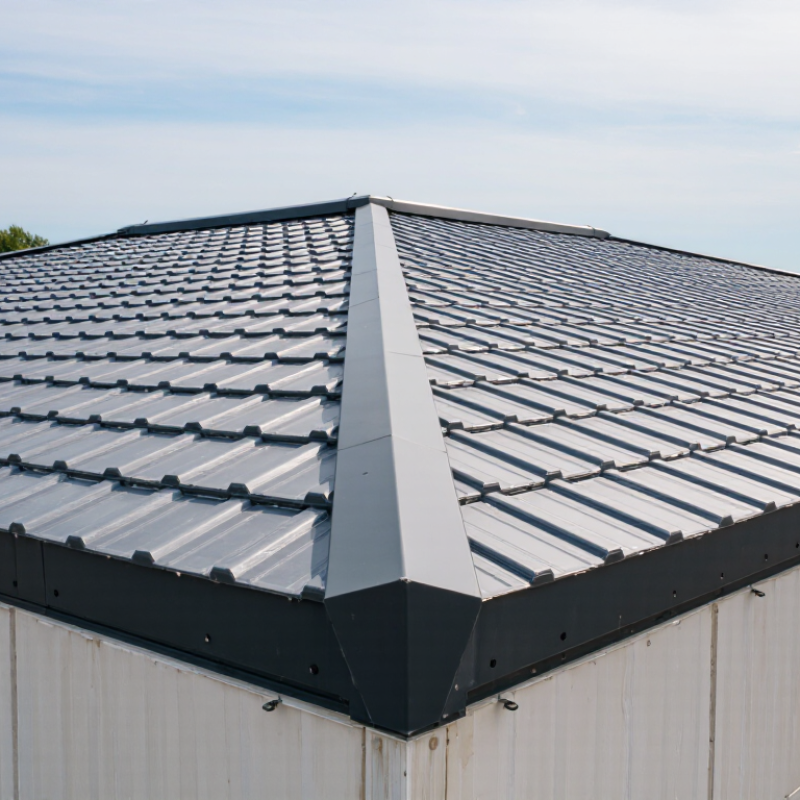
| 1 | Heavy-Gauge Interlocking Steel Shingle | Galvanized or aluminum-zinc-coated steel; approximately 0.028–0.040 in (0.71–1.02 mm) | 150–190 mph | Excellent when the coating, cut edges, fasteners, and flashing are properly protected | Low thermal expansion compared with aluminum; light-colored finishes can reduce roof-surface temperature | 40–70 years, depending on coating, installation, and maintenance | High-wind regions, hail-prone areas, hurricanes, and roofs requiring high impact resistance |
| 2 | Stone-Coated Interlocking Steel Shingle | Coated steel panel, commonly about 0.017–0.026 in (0.43–0.66 mm), with mineral granules bonded to the surface | 120–190 mph | Good to excellent; granular surfaces can protect the coating, but exposed cut edges and fasteners require correct detailing | Granular finishes reduce glare and provide moderate solar reflectance; steel has relatively low movement from temperature changes | 30–60 years | Windy, sunny, tropical, and mixed climates where a textured appearance is preferred |
| 3 | Stainless-Steel Interlocking Shingle | Corrosion-resistant stainless steel; approximately 0.019–0.024 in (0.48–0.61 mm) | 140–190 mph | Excellent resistance to salt spray, moisture, and industrial atmospheres; avoid incompatible metals that may cause galvanic corrosion | Low maintenance and stable performance across wide temperature ranges; finish selection affects solar gain | 50–80+ years | Coastal locations, severe weather zones, industrial areas, and long-life projects |
| 4 | Aluminum Interlocking Shingle | Aluminum sheet, typically 0.032–0.040 in (0.81–1.02 mm) | 120–160 mph | Excellent natural resistance to atmospheric corrosion and salt air; softer than steel and more vulnerable to denting | Higher thermal expansion than steel; light colors and reflective coatings can lower solar heat absorption | 40–60 years | Marine, humid, and coastal climates where low weight and salt-air resistance are important |
| 5 | Aluminum-Zinc-Coated Steel Shingle | Steel substrate with an aluminum-zinc alloy coating; approximately 0.023–0.029 in (0.58–0.74 mm) | 120–160 mph | Good to excellent atmospheric corrosion resistance; avoid direct contact with copper, lead, and treated wood without suitable separators | Stable steel substrate with lower movement than aluminum; cool-color coatings can improve solar performance | 35–60 years | General residential and commercial use in temperate, hot, and moderately coastal environments |
| 6 | Galvanized-Steel Interlocking Shingle | Zinc-coated carbon steel; approximately 0.023–0.029 in (0.58–0.74 mm) | 110–150 mph | Good in normal atmospheres; performance depends strongly on zinc coating mass, paint system, edge treatment, and drainage | Low thermal movement relative to aluminum; painted finishes determine solar reflectance and heat absorption | 25–50 years | Inland, suburban, and moderate-climate projects with controlled installation costs |
| 7 | Architectural Copper Shingle | Cold-rolled copper sheet, commonly specified by weight at approximately 16–20 oz/ft² | 110–150 mph | Excellent atmospheric durability; develops a protective patina, but must be isolated from incompatible metals | High thermal conductivity and significant movement require carefully designed clips, seams, and ventilation | 60–100+ years | Coastal, historic, premium architectural, and long-life applications |
| 8 | Architectural Zinc Shingle | Rolled zinc sheet, typically about 0.027–0.032 in (0.68–0.82 mm) | 110–150 mph | Excellent resistance to normal atmospheric exposure; requires compatible underlayments, fasteners, and drainage details | Relatively high thermal movement; expansion joints and sliding clips are important on larger roof areas | 50–80+ years | Temperate, urban, and architectural projects emphasizing longevity and natural patination |
| 9 | Painted Aluminum Shingle | Pre-finished aluminum, commonly 0.024–0.032 in (0.61–0.81 mm) | 110–140 mph | Good to excellent in wet and marine air; finish quality and resistance to denting are key considerations | Higher expansion and contraction than steel; high-reflectance finishes are useful in hot climates | 30–50 years | Lightweight roofs, coastal renovations, warm climates, and projects with structural-load limitations |
| 10 | Economy Thin-Gauge Steel Shingle | Pre-finished steel, approximately 0.019–0.023 in (0.48–0.58 mm) | 110–130 mph | Moderate to good; requires high-quality coating, sealed penetrations, adequate ventilation, and regular inspection | Low thermal expansion; darker colors can substantially increase roof-surface temperatures in strong sunlight | 20–40 years | Budget-sensitive projects in low-to-moderate corrosion and wind environments |

.svg)