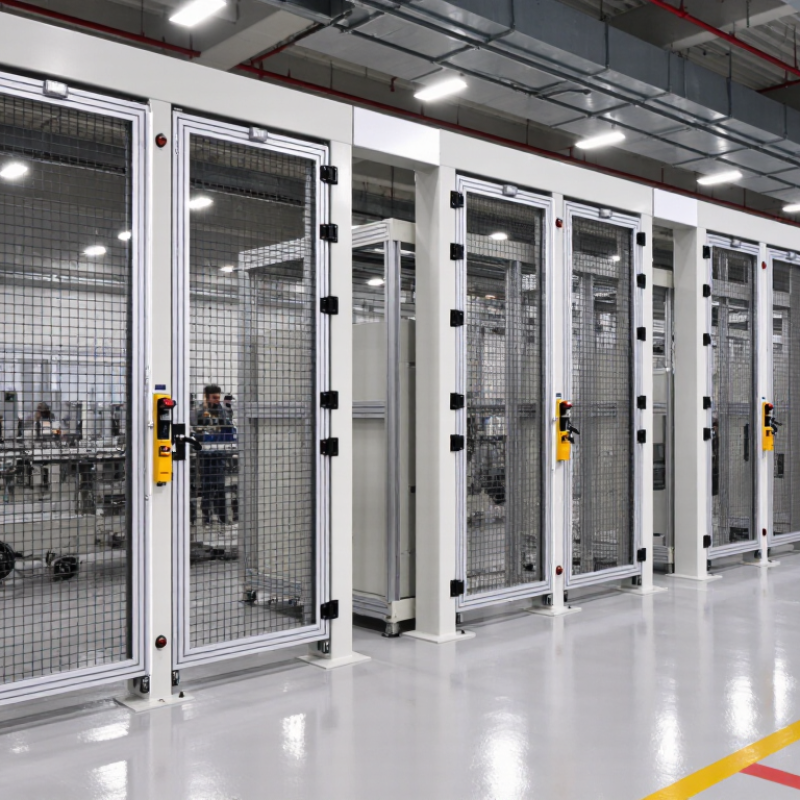
| What a safety guard gate is | A movable section of a machine guard that provides controlled access to a hazardous area. It is commonly used as part of a perimeter guarding system. | Access points around machinery, production cells, automated equipment, and robot work areas. | Confirm that the gate integrates with the overall machine risk assessment and guarding layout. |
| Hinged swing gate | A gate that opens around hinges. It may open inward or outward, depending on the layout and risk assessment. | Machine enclosures and access points where there is enough space for the gate to swing. | Check opening direction, hinge strength, clearances, latch arrangement, and whether access needs to be monitored by an interlocking device. |
| Sliding gate | A gate that moves horizontally along a track rather than swinging into the surrounding area. | Installations with limited swing clearance or access openings suited to a sliding arrangement. | Review track protection, operating force, end stops, resistance to misalignment, and the effect of dirt or debris on movement. |
| Vertical lift gate | A gate that travels vertically to open or close. Its movement and supporting arrangement must be suitable for the installation. | Applications where horizontal space is limited and the machine layout permits vertical travel. | Assess movement hazards, secure support, prevention of unintended falling, and safe access during maintenance. |
| Interlocked access gate | A movable guard fitted with an interlocking device. Depending on the safety design, opening the gate can initiate a stop function or prevent hazardous operation. | Areas where people need access to hazards that cannot be adequately controlled by a fixed guard alone. | Check the required safety function, device suitability, resistance to foreseeable bypass, and integration with the machine control system. |
| Common application areas | Safety guard gates are used wherever a guarded area needs an access opening for operation, inspection, cleaning, or maintenance. | Manufacturing lines, packaging equipment, material-handling systems, robotic cells, and machine enclosures. | Make sure the gate and surrounding guards suit the hazards, access frequency, work process, and site environment. |
| Guard construction | Frames and infill can be made from materials such as steel mesh, sheet metal, or other suitable materials. The appropriate choice depends on the hazards and installation conditions. | Indoor or outdoor machine guarding and industrial access points. | Consider strength, corrosion resistance, visibility, cleanability, impact exposure, and compatibility with adjacent guard panels. |
| Safety distances and openings | Guard height, openings, and distance from hazards should be selected to prevent access to danger zones, based on the relevant risk assessment and applicable requirements. | All installations where a person could reach through, over, under, or around a guard. | Ask for documented design calculations or drawings where needed; do not rely on a single standard dimension for every machine. |
| Standards and design references | Relevant international references can include ISO 14120 for guards, ISO 14119 for interlocking devices associated with guards, ISO 13857 for safety distances, and ISO 13849-1 for safety-related parts of control systems. | Machine-guard design, interlocking selection, access-distance assessment, and safety-control design. | Verify the current applicable editions, local legal requirements, and whether the supplier can provide information supporting the intended design. |
| Installation and maintenance | A suitable gate should be installed, aligned, inspected, and maintained in accordance with its design and the machine’s safety procedures. | Commissioning, routine inspection, cleaning, and repair of guarded machinery. | Check installation instructions, replacement-part availability, inspection guidance, and support for commissioning and troubleshooting. |
| How to evaluate a manufacturer | Compare the supplier’s engineering capability, product documentation, customization process, quality controls, and delivery and service arrangements. | Shortlisting suppliers for a new machine, factory upgrade, or replacement guarding project. | Request drawings, material details, relevant test or inspection records, lead-time information, warranty terms, and references for comparable applications. |

.svg)