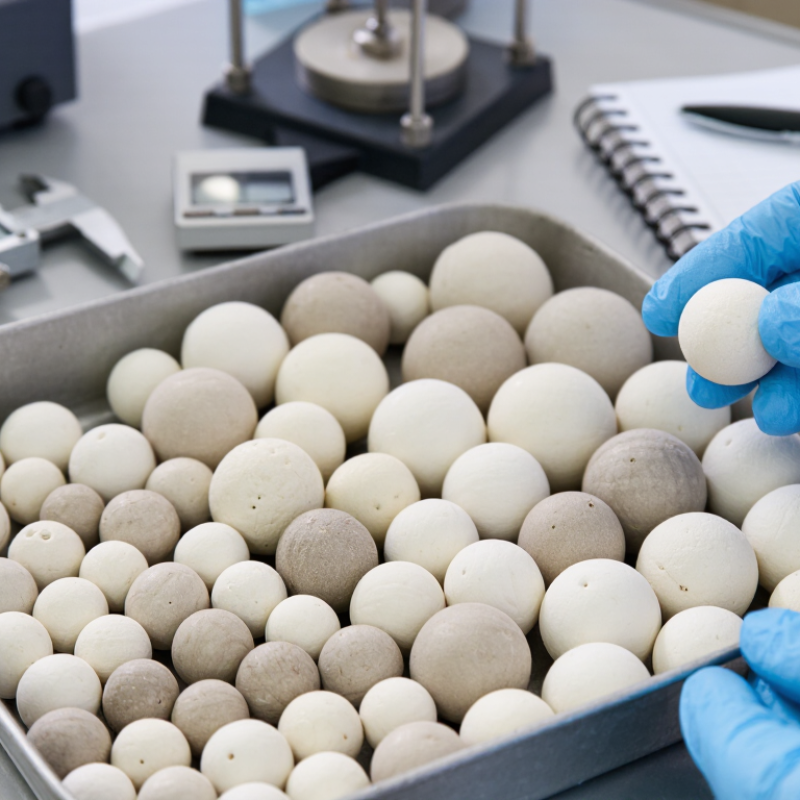
| 1 | Match the material to the process chemistry | High-alumina ceramic balls
Suitable for demanding chemical and thermal environments. | Alumina content commonly ranges from approximately inert ceramic grades at about 20–30% Al2O3 to high-alumina grades above 90% Al2O3.
Typical service temperature: about 1,000–1,500°C, depending on grade and system design. | Catalyst support beds, refinery reactors, petrochemical processing, gas treatment, and heat-transfer systems. | Request the exact chemical composition, resistance to acids and alkalis, operating-temperature limit, and compatibility with the process fluid. |
| 2 | Select the right ball size and grading | Inert packing balls
Available as support balls, saddle-shaped media, or spherical packing in several sizes. | Common nominal diameters include approximately 3, 6, 10, 13, 19, 25, 38, 50, and 75 mm.
Smaller balls provide more contact area; larger balls generally reduce pressure drop. | Reactor bed support layers, catalyst protection, absorption towers, drying systems, and gas-liquid contact equipment. | Compare the required bed depth, vessel diameter, pressure-drop limit, catalyst particle size, and supplier size tolerance. |
| 3 | Compare density, strength, and wear resistance | Dense alumina and zirconia balls
Used where low wear, high impact resistance, or high grinding efficiency is important. | Alumina density is commonly about 3.0–3.8 g/cm3; zirconia is typically about 5.7–6.1 g/cm3.
Zirconia generally offers higher density and lower contamination in fine grinding applications. | Ceramic and mineral grinding, pigments, coatings, electronic materials, and pharmaceutical powder processing. | Ask for bulk density, true density, crushing strength, abrasion or wear data, and the recommended mill speed and filling ratio. |
| 4 | Check porosity and water absorption | Porous ceramic support balls
Designed to provide surface area and void volume in catalytic or biological processes. | Open porosity varies by formulation and firing method; dense grades may have very low water absorption, while porous grades are intentionally more absorbent.
Void fraction in a packed bed is often approximately 35–45%, depending on ball size distribution and packing method. | Catalyst support, biofilm carriers, wastewater treatment, air stripping, and gas purification equipment. | Confirm apparent porosity, water absorption, specific surface area, pore-size distribution, and resistance to pore blockage. |
| 5 | Evaluate thermal-shock performance | Cordierite and heat-resistant ceramic balls
Selected for repeated heating and cooling cycles. | Cordierite has a low coefficient of thermal expansion, commonly around 1–3 × 10⁻⁶/K, depending on composition.
Performance depends on ball diameter, wall thickness, porosity, and heating or cooling rate. | Regenerative thermal oxidizers, thermal storage beds, kiln systems, furnace packing, and high-temperature air treatment. | Request thermal-expansion data, thermal-shock test conditions, maximum continuous temperature, and evidence of cracking after cycling. |
| 6 | Confirm dimensional consistency and surface finish | Precision ceramic balls
Used when stable flow, uniform packing, or controlled contact is required. | Key controls include diameter tolerance, roundness, sphericity, surface roughness, chips, cracks, and visible inclusions.
Tighter tolerances are normally required for precision grinding and metering applications than for general reactor support. | Flow-control components, precision grinding, valve seats, laboratory equipment, and uniform reactor-bed packing. | Define inspection methods, sampling quantity, permitted defects, packaging protection, and acceptance criteria before placing the order. |
| 7 | Plan logistics, documentation, and lifecycle cost | Export-grade ceramic filler balls
Any ceramic composition supplied for international industrial use. | Compare product cost by kilogram and by installed volume, expected service life, replacement interval, freight weight, and packaging density.
Ceramic balls are non-combustible, but they require protection from impact and contamination during transport. | Global shipments for refineries, chemical plants, environmental systems, grinding lines, and thermal-process equipment. | Verify certificate of analysis, safety data where applicable, packing list, country-of-origin documents, moisture protection, pallet configuration, and delivery terms. |

.svg)