| Product definition | Confirm what “compound” means for the project, such as a steel grating panel combined with a plate, nosing, frame, or other component. Record materials, dimensions, connections, and intended use. | Project drawings and technical specification; applicable local building and safety requirements. | Approved drawings, bill of materials, panel layout, and written scope of supply. | Check that quotations describe the same configuration and include all required accessories and fabrication. |
| Steel grade and traceability | Specify the required steel grade, product form, and mechanical-property requirements. Ensure material can be traced from the certificate to the production batch. | ASTM A36/A36M may apply to carbon structural steel; ASTM A1011/A1011M covers hot-rolled steel sheet and strip. Confirm suitability for the actual component and contract. | Material test certificates showing grade, heat or batch number, and reported properties. | Check that certificates match the specified grade and that identification remains traceable during fabrication. |
| Load capacity and deflection | Define span, support conditions, load type and magnitude, load position, and acceptable deflection. Point loads and uniformly distributed loads can produce different results. | Project design criteria and applicable building code. ISO 14122-2 addresses safety requirements for permanent means of access, including working platforms and walkways, where applicable. | Calculations or certified load tables that state assumptions, panel orientation, span, loading, and deflection. | Reject load claims that omit test or calculation conditions; verify that support and installation details match the design. |
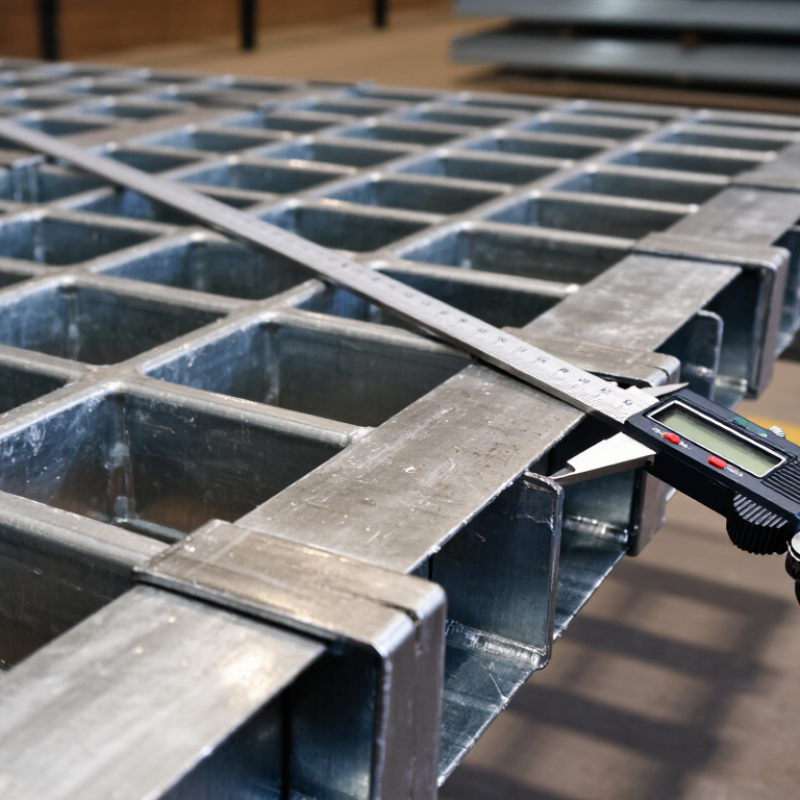
| Dimensions and fabrication | Set panel length and width, bearing-bar depth and spacing, cross-bar spacing, cut-outs, edge treatment, and dimensional tolerances in the purchase specification. | Approved drawings and the contract’s stated tolerances; use any referenced grating standard only when its scope matches the product. | Inspection records, calibrated measurement tools, and sample-panel dimensional reports. | Compare measured panels with approved drawings, including cut-outs, squareness, edge details, and fit-up. |
| Welding and assembly | Define the joining method, weld locations, workmanship requirements, and inspection scope. Requirements depend on the design and service conditions. | Contract-specified welding procedures and acceptance criteria; ISO 5817 may be referenced for quality levels of imperfections in fusion-welded joints when appropriate. | Welding procedure documentation, welder qualification records where required, and visual or other inspection reports. | Look for consistent joints and documented inspection; agree in advance on any non-destructive testing requirements. |
| Hot-dip galvanizing | State the required coating process, appearance criteria, inspection method, and any project-specific coating requirements. Coating thickness requirements depend on the applicable standard and material details. | ISO 1461 covers hot-dip galvanized coatings on fabricated iron and steel articles; ASTM A123/A123M covers zinc coatings on iron and steel products. Specify which applies. | Coating inspection report with the standard used, measurement results, and batch identification. | Check coverage and finish against the agreed acceptance criteria; clarify repair procedures for damaged areas. |
| Surface and safety details | Specify whether a plain or slip-resistant surface is needed, along with edge protection, kick plates, nosings, and any applicable opening or fall-protection requirements. | Project risk assessment and local regulations; ISO 14122-2 may be relevant to permanent platforms and walkways. | Drawings, product samples, and documented surface or safety-feature specifications. | Confirm surface features suit the environment and that safety requirements are addressed in the complete installation. |
| Quality management and inspection | Review documented controls for incoming materials, fabrication, inspection, nonconforming products, and final release. Certification alone does not establish product compliance. | Use the quality-system requirements stated in the contract and verify their scope and validity directly with the issuing body where needed. | Quality plan, inspection and test plan, calibration records, and sample production inspection reports. | Confirm inspection stages, acceptance criteria, record retention, and the process for corrective action. |
| Packing, delivery, and documentation | Agree on panel identification, packing method, corrosion protection during transport, delivery terms, and required document package. | Purchase contract, shipping requirements, and destination-country import rules. | Packing list, inspection release, material certificates, coating records, and installation or handling guidance as agreed. | Check that delivered quantities and identifiers match the order and that documents are complete before shipment. |

.svg)