China Top 10 Ceramic Conical Burr Coffee Grinder Suppliers
China’s ceramic coffee-grinder industry is gaining attention as home brewing becomes more precise, portable, and design-conscious. The International Coffee Organization reported global coffee consumption of approximately 177.3 million 60-kilogram bags in 2022/23. Meanwhile, the National Coffee Association’s 2024 survey found that 67% of American adults had consumed coffee during the previous day. These figures suggest stronger demand for dependable grinding equipment, including the Ceramic Conical Burr Coffee Grinder.
Ceramic conical burrs offer useful advantages. They resist corrosion, generate relatively little heat, and can support consistent particle sizing when properly engineered. However, ceramic is not automatically superior. Poor alignment, weak adjustment systems, or unsuitable materials can still produce uneven grounds. James Hoffmann has said, “The grinder is arguably more important than the espresso machine.” That observation remains practical when comparing Chinese suppliers, not merely repeating product claims.
This guide examines China’s top ten Ceramic Conical Burr Coffee Grinder suppliers through manufacturing experience, burr design, quality control, customization, export capability, and after-sales support. Public market reports, supplier information, and product evidence provide the foundation. Some performance claims remain difficult to verify without independent testing. That limitation matters. A polished catalog cannot replace measured retention, grind consistency, durability tests, and real user feedback. The strongest suppliers should therefore be judged by evidence, not impressive language alone.
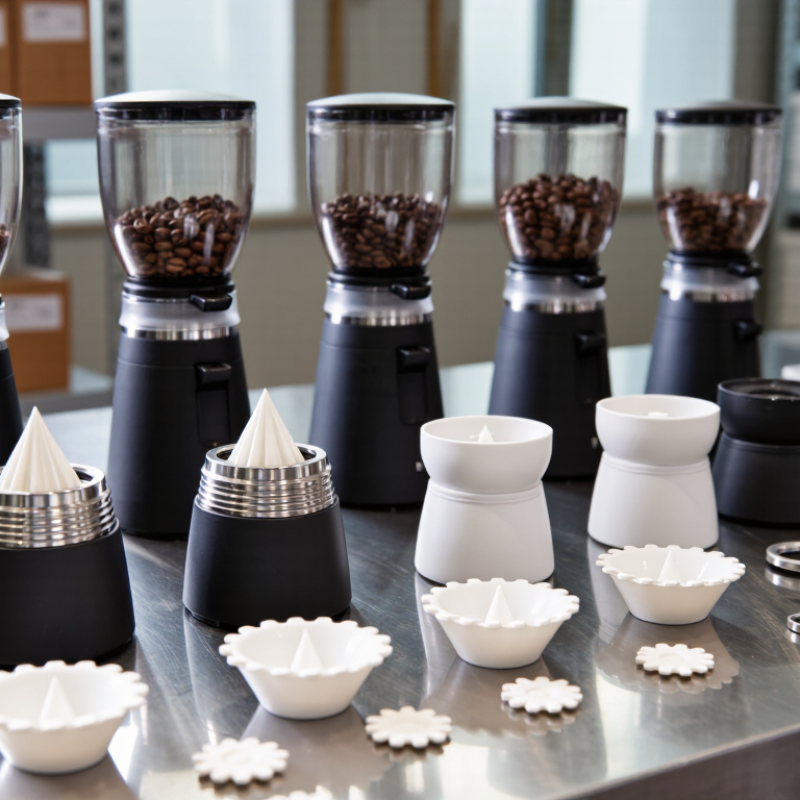
What Is a Ceramic Conical Burr Coffee Grinder?
What Is a Ceramic Conical Burr Coffee Grinder?
A ceramic conical burr coffee grinder uses two cone-shaped grinding surfaces to crush coffee beans. One burr remains fixed, while the other rotates around it. Beans enter through the center and move outward as the burrs narrow. This gradual action creates grounds for espresso, pour-over, French press, and other brewing methods.
Ceramic burrs resist rust and remain stable during repeated use. They also produce less heat than many high-speed metal systems. Lower heat can help protect delicate coffee aromas, although grind speed and motor design matter too. A grinder with poor alignment may still create uneven particles. That assumption is easy to miss. Uniform grounds usually depend on burr geometry, calibration, motor control, and cleaning habits.
For buyers comparing ceramic conical burr coffee grinder suppliers, practical testing matters more than attractive specifications. Check the burr diameter, adjustment range, material certificates, food-contact safety records, and replacement-part availability. Ask for particle-size tests across several settings. Request noise, durability, and heat measurements under realistic workloads. A small home grinder may perform well with 20 grams of beans, but struggle during continuous commercial use. Ceramic can chip if hard foreign objects enter the grinding chamber. It is durable, not indestructible. I would also inspect the retention inside the chamber, because leftover grounds can affect freshness and measurement accuracy. Supplier communication matters when calibration changes between production batches.
Key Criteria for Evaluating Chinese Grinder Suppliers
China Top 10 Ceramic Conical Burr Coffee Grinder Suppliers
Evaluating Chinese ceramic conical burr grinder suppliers requires more than comparing catalog prices. Start with burr material, hardness, alignment, and grinding consistency. Ask for laboratory data, not only attractive product photos. A reliable supplier should explain ceramic composition, burr dimensions, motor limits, and expected service life. Request samples from different production batches. One sample can hide uneven quality.
Factory capability matters. Review machining equipment, assembly lines, inspection records, and worker training. Check whether each grinder receives tests for noise, heat, rotation stability, and particle distribution. Ask for batch traceability through serial numbers or inspection codes. Food-contact materials should have suitable test documentation for your target market. Certifications must be verified with issuing bodies. Paperwork alone proves little.
Communication reveals professional discipline. Notice how quickly the supplier answers technical questions and reports defects. Clear drawings, tolerance tables, packaging tests, and replacement-part plans reduce later disputes. Confirm minimum order quantities, sample charges, lead times, and warranty procedures in writing. A video call can show storage conditions and final inspection practices, but an independent factory audit offers stronger evidence. No factory is flawless. I would still record small issues, such as loose adjustment rings or inconsistent packaging, because repeated “minor” faults can damage customer trust. Cheap pricing may reflect efficient production, or weaker inspection. Check carefully.
Key Criteria for Evaluating Chinese Ceramic Conical Burr Coffee Grinder Suppliers
This procurement benchmark assigns practical evaluation weights to the criteria most relevant to ceramic conical burr grinder sourcing. Quality consistency, burr performance, compliance, customization capability, production reliability, and after-sales support should be verified through samples, factory audits, documentation, and order-history checks.
Profiles of China’s Top 10 Ceramic Burr Grinder Suppliers
China’s top ten ceramic burr grinder suppliers often serve different buyer needs. One focuses on compact manual grinders for travel use. Another develops larger burr sets for cafés and tasting rooms. Several suppliers provide OEM production, custom colors, and private packaging. Their workshops commonly combine ceramic forming, stainless steel shafts, and molded polymer housings.
A strong supplier should explain burr diameter, grinding range, shaft alignment, and adjustment steps. Factory experience matters here. Fine ceramic surfaces can produce consistent particles, but poor assembly may create wobble. Some suppliers show torque tests, salt-spray checks, and repeated adjustment trials. Others offer sample approval before bulk production. That detail builds trust. It also deserves verification.
The remaining profiles include suppliers specializing in gift sets, export packaging, replacement burrs, and low-volume customization. A reliable team should provide clear lead times and traceable inspection records. Ask for grind samples, not only polished product photos. Check whether the handle remains stable after several hundred turns. Small faults become obvious then. Product claims can sound stronger than field results. I would compare two samples from separate production batches before making a purchasing decision. Supplier websites help, but direct technical answers matter more.
Comparison of Products, Materials, Prices, and Production Capacity
China Top 10 Ceramic Conical Burr Coffee Grinder Suppliers
Comparing China’s top ten suppliers requires more than checking catalog photos. Manual grinders usually feature ceramic conical burrs, stainless steel shafts, aluminum bodies, or reinforced engineering plastics. Ceramic burrs resist rust and create moderate heat during grinding. Stainless steel burrs often provide sharper cutting and easier adjustment, but they can increase unit cost. Small details matter. Check burr alignment, handle movement, thread quality, and container sealing.
Typical FOB prices range from 4 to 18 US dollars for basic manual models. Customized designs may reach 20 to 45 dollars, depending on materials, packaging, and order quantity. Electric models usually cost more because of motors, batteries, safety controls, and testing requirements. Prices can look attractive at low minimum order quantities, but tooling and sample fees may appear separately. That detail is easy to miss.
Production capacity varies widely. Small factories may produce 5,000 to 20,000 units monthly, while established facilities can report 30,000 to 100,000 units. These figures should be checked through production records, machine lists, and recent shipment evidence. I would request three samples from different batches. Compare grind consistency after repeated use, not after one demonstration. Supplier claims are useful, but they are not proof. My own evaluation would also consider defect rates, replacement parts, inspection procedures, and communication speed. A polished sample can hide weak mass production.
How to Select the Right Chinese Supplier for Your Business
Selecting a Chinese supplier for a ceramic conical burr coffee grinder requires more than comparing quoted prices. Review the supplier’s factory experience, production equipment, and quality control records. Ask for burr material details, hardness data, grinding adjustment range, and expected service life. A reliable supplier should explain these points clearly, not hide behind general claims.
Request physical samples before discussing large orders. Test the grinder with light, medium, and dark roasted beans. Check particle consistency, adjustment movement, handle comfort, and cleaning access. Measure the grinder’s output over several uses. Small differences can reveal assembly problems. I once overlooked a loose axle during a quick sample review. That mistake changed my inspection checklist.
A serious supplier should provide inspection procedures, traceable batch numbers, and practical packaging tests. Confirm minimum order quantities, lead times, replacement parts, payment terms, and export documents in writing. Factory audits or independent inspections can verify information that sales materials cannot prove. Ask whether the supplier can maintain the same burr alignment across repeated production batches. Communication quality also matters. Slow replies may become costly when specifications change. A supplier may offer a low price, yet inconsistent ceramic burrs can create returns and damage your reputation. Discuss corrective actions before signing. Include measurable tolerances, sample approval rules, and responsibilities for defective units. Be cautious with impressive factory photos; production evidence is more useful.

.svg)


