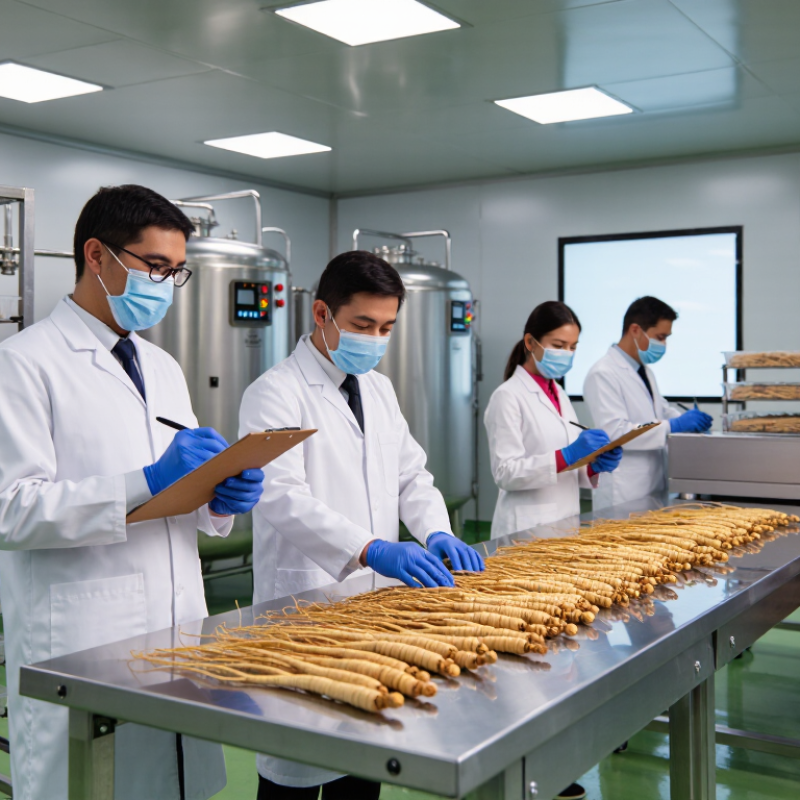
| 1. Botanical Identification | Plant material | Panax ginseng C.A. Meyer root, commonly supplied as cultivated Asian ginseng root. | Botanical identity, plant part, country or region of origin, harvest documentation, and supplier traceability. | Approved raw-material specification and traceability code. | Verified |
| 2. Raw Root Receiving | Incoming condition | Roots are inspected for foreign matter, visible mold, abnormal odor, insect damage, and excessive breakage. | Visual inspection, moisture testing, packaging integrity, and sampling according to a documented receiving procedure. | Incoming inspection report and retained sample. | Checked |
| 3. Cleaning and Sorting | Physical preparation | Soil and foreign materials are removed. Roots are sorted and washed using potable or suitably treated process water. | Foreign-matter control, water quality, sanitation records, and prevention of cross-contamination. | Cleaned and graded roots ready for drying or cutting. | Controlled |
| 4. Drying | Moisture reduction | Clean roots are dried under controlled conditions until they reach a stable moisture level suitable for storage and milling. | Drying temperature, time, final moisture, odor, color, and protection from excessive heat or rehydration. | Dried ginseng root with a recorded moisture result. | Recorded |
| 5. Cutting and Milling | Particle preparation | Dried roots are sliced or milled to increase surface area and improve contact with the extraction solvent. | Particle-size consistency, metal detection, equipment cleanliness, and batch identification. | Prepared root pieces or coarse powder. | Controlled |
| 6. Solvent Extraction | Extraction medium | Food-grade water, ethanol, or a water–ethanol mixture may be selected according to the target ginsenoside profile and intended use. | Solvent identity, solvent-to-material ratio, extraction time, temperature, and number of extraction cycles. | Filtered liquid extract containing soluble ginseng constituents. | Monitored |
| 7. Filtration and Concentration | Extract clarification | Solid residues are removed by filtration. The liquid extract is concentrated under controlled conditions, commonly using vacuum to limit thermal exposure. | Clarity, concentration solids, temperature, vacuum conditions, and prevention of excessive degradation. | Concentrated ginseng extract. | Monitored |
| 8. Standardization | Marker compounds | The concentrate may be adjusted or blended to meet a declared total ginsenoside specification, such as a buyer-defined percentage. | HPLC or validated chromatographic testing for ginsenosides; specification limits must be agreed before production. | Standardized liquid concentrate with a batch assay. | Assayed |
| 9. Spray Drying | Powder conversion | The standardized concentrate is atomized into a stream of hot air to produce a free-flowing extract powder. | Inlet and outlet temperatures, feed rate, carrier use if applicable, powder recovery, and thermal stability. | Dry ginseng extract powder. | Controlled |
| 10. Blending and Sieving | Uniformity | Powder is blended for homogeneity and passed through a defined sieve to remove agglomerates and achieve consistent handling properties. | Blend uniformity, particle-size distribution, bulk density, flowability, and foreign-particle control. | Uniform standardized extract powder. | Verified |
| 11. Finished-Product Testing | Identity and purity | Testing commonly includes appearance, odor, moisture, assay of declared ginsenosides, microbiological limits, and contaminant screening. | Microbial count, pathogens where applicable, heavy metals, pesticide residues, residual solvents, and applicable legal limits. | Certificate of analysis and release decision. | Released |
| 12. Packaging and Storage | Protection and shelf life | Powder is packed in clean, food-contact-compatible containers or lined bags and protected from moisture, heat, light, and strong odors. | Net weight, seal integrity, lot number, manufacture date, retest or expiry information, and storage conditions. | Finished packed goods with batch traceability. | Traceable |
| 13. Global Buyer Documentation | Export support | Documentation may include product specification, certificate of analysis, ingredient statement, allergen statement, safety data where required, and packing list. | Consistency between product labels, batch records, shipping documents, and destination-market requirements. | Export document package prepared for buyer review. | Documented |
| 14. Storage and Shipment | Logistics conditions | Store in a cool, dry, clean area in sealed packaging. Shipment conditions should minimize humidity, heat, physical damage, and contamination. | Warehouse temperature and humidity records, stock rotation, pallet condition, and transportation inspection. | Shipment released with traceable lot information. | Managed |

.svg)