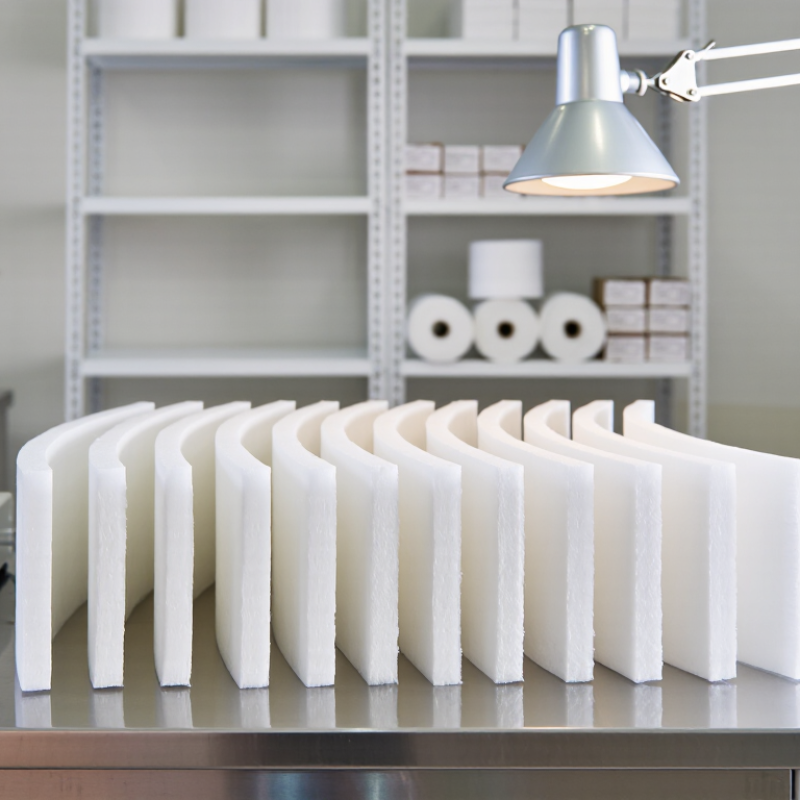
| 1 | Product construction | Confirm whether the product is ceramic-fiber paper, an aerogel-containing composite, or a layered assembly. Request a composition statement and product datasheet. | Check that the stated composition, product name, datasheet, sample, and purchase specification describe the same construction. | ________________ |
| 2 | Service temperature | Request the manufacturer’s stated maximum service temperature and the conditions or test basis for that value. | Do not treat a classification or short-term exposure temperature as a guaranteed continuous-use temperature. Confirm suitability for the actual atmosphere, load, and operating cycle. | ________________ |
| 3 | Thermal conductivity | Request conductivity values at specified mean temperatures, with specimen thickness, density, conditioning, and test method stated. | Compare like-for-like test conditions. For suitable flat specimens, methods such as ASTM C177 or ASTM C518 may be applicable; confirm the method’s suitability for the product and temperature range. | ________________ |
| 4 | Thickness and tolerance | Request nominal thickness, permitted tolerance, measurement procedure, and available roll or sheet dimensions. | Measure samples at multiple points using an agreed procedure and compare the results with the written purchase specification. | ________________ |
| 5 | Bulk density and uniformity | Request target density, tolerance, specimen dimensions, and the method used to calculate density. | Check sample mass and dimensions using a documented procedure; assess variation across the sheet or roll rather than relying on a single measurement. | ________________ |
| 6 | Permanent linear change | Request test temperature, exposure duration, atmosphere, specimen details, and measured dimensional change after heating. | Compare results only when test conditions match. ASTM C356 is a method for measuring permanent linear change of preformed high-temperature thermal insulation; confirm applicability to the specific paper or composite. | ________________ |
| 7 | Mechanical integrity | Request tensile or handling-strength data, test direction, specimen conditioning, and any stated limits for dusting or edge damage. | Inspect representative samples and agree on an application-relevant test method and acceptance criteria before ordering. | ________________ |
| 8 | Moisture and packaging | Request moisture or conditioning information, packaging specification, storage guidance, and protection against water ingress during shipment. | Inspect packaging on receipt and document any wet, crushed, torn, or contaminated material. Agree how moisture-related claims will be assessed. | ________________ |
| 9 | Batch traceability and quality records | Request a sample certificate of analysis, lot identification format, inspection records, and a process for handling nonconforming products. | Verify that sample documents identify the product and batch and that delivered packaging can be traced to the corresponding quality records. | ________________ |
| 10 | Sample-to-order consistency | Request pre-production or production samples, a signed specification, and written confirmation of change-control procedures. | Retain an approved reference sample and compare it with incoming goods for dimensions, appearance, packaging, and agreed test results. | ________________ |

.svg)