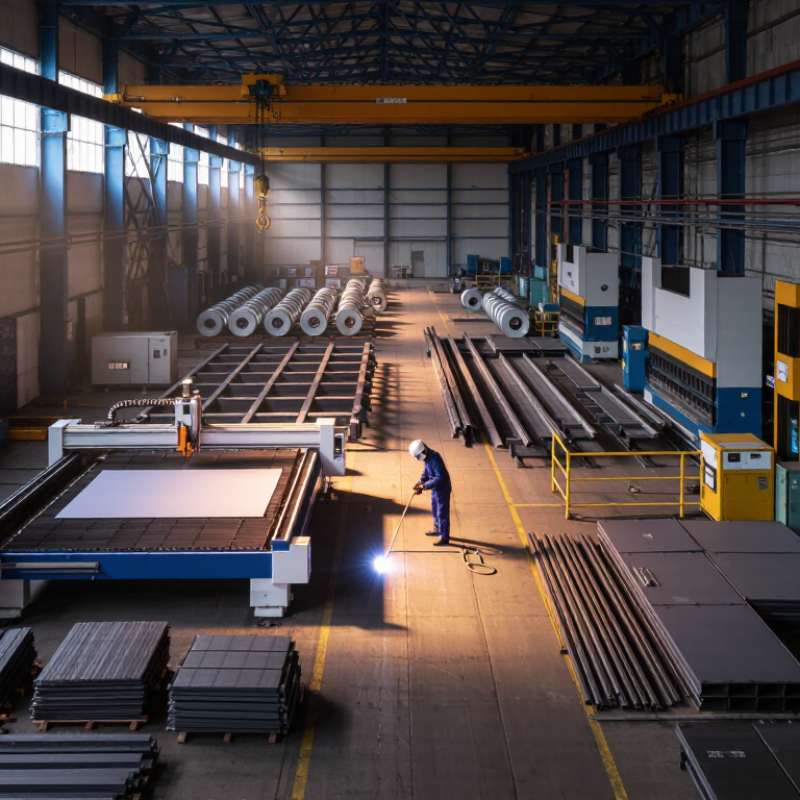
| CNC Fiber Laser Cutter | High-speed profiling of sheet, plate, tube, and structural sections using a focused laser beam. | Carbon steel, stainless steel, and aluminum; commonly about 0.5–25 mm for sheet and plate, depending on laser power, assist gas, and process settings. | Typical positioning accuracy is approximately ±0.03–0.10 mm on well-maintained industrial systems. | Very high for thin and medium-gauge parts; supports nesting and rapid changeovers. | Laser power Bed size Tube-processing options Assist-gas consumption Automatic nozzle and focus control | Enclosures, brackets, machinery components, architectural parts, and high-mix sheet-metal work. |
| CNC Plasma Cutting System | Thermal cutting of conductive metals by using a high-temperature plasma arc. | Carbon steel, stainless steel, and aluminum; commonly about 1–50 mm, with heavier cutting possible using industrial high-current systems. | Typical cut quality is suitable for structural and general fabrication; precision depends on amperage, torch height control, and table condition. | High for medium and thick plate; generally faster and less costly than oxy-fuel on many steel plate jobs. | Amperage Torch height control Fume extraction Piercing capacity Consumable life | Structural frames, base plates, industrial platforms, brackets, and medium-to-heavy plate fabrication. |
| Oxy-Fuel Cutting Machine | Uses fuel gas and oxygen to cut ferrous plate through combustion and oxidation. | Primarily carbon steel; commonly about 6–300 mm, subject to torch design, gas setup, and preheating requirements. | Suitable for robust plate cutting; kerf width and heat-affected zone are generally greater than with laser or plasma. | Economical for very thick carbon-steel plate and large straight cuts, but slower for intricate profiles. | Gas infrastructure Plate thickness Preheat time Heat distortion control Flame-safety systems | Heavy structural steel, bridges, pressure-related components, shipbuilding, and thick plate preparation. |
| CNC Press Brake | Bends sheet and plate by applying controlled force between a punch and die. | Thin sheet to heavy plate; common capacities range from about 40 to 3,000 tonnes, with working lengths from roughly 1 to 8 m. | Modern CNC systems can commonly achieve repeatability around ±0.01–0.05 mm under suitable operating conditions. | High for repeat production; automated backgauges and angle measurement reduce setup and correction time. | Bending force Working length Axis configuration Tooling system Automatic angle correction | Panels, cabinets, channels, frames, brackets, HVAC parts, and precision formed components. |
| Mechanical or Hydraulic Plate Shear | Produces straight cuts by shearing sheet or plate between upper and lower blades. | Thin sheet to approximately 25 mm plate, depending on machine capacity, blade geometry, and material strength. | Provides straight, repeatable cuts with minimal programming for rectangular blanks. | Very high for repetitive straight cuts; usually more efficient than thermal cutting for simple blanks. | Maximum thickness Cutting length Backgauge accuracy Blade adjustment Safe material handling | Rectangular blanks, simple strips, ductwork, panels, and preparation before bending or welding. |
| CNC Tube and Section Cutting Machine | Cuts round, square, rectangular, and structural tube with programmed hole and contour features. | Tube and profile sizes vary widely; common systems process approximately 20–350 mm outside dimensions. | Supports repeatable hole placement and compound cuts; accuracy depends on tube clamping, rotation control, and calibration. | Reduces secondary drilling, marking, and manual fitting operations. | Tube diameter Profile geometry Rotary axis Automatic loading Part identification | Frames, handrails, furniture structures, automotive components, and modular steel assemblies. |
| Plate or Section Rolling Machine | Forms cylindrical, conical, or curved components by passing material through adjustable rolls. | Sheet and plate from light gauge to more than 100 mm on heavy-duty systems, depending on machine configuration. | Forming accuracy depends on minimum diameter, roll geometry, material yield strength, and springback compensation. | Efficient for repeated curved parts; setup time can be significant for low-volume work. | Maximum plate width Rolling thickness Minimum diameter Pre-bending capability Cone-forming function | Tanks, ducts, pressure-related fabrications, columns, rings, and curved architectural structures. |
| MIG/MAG Welding System | Joins steel using a continuously fed wire electrode and shielding gas. | Carbon steel, stainless steel, and some aluminum alloys; suitable for thin sheet through heavy structural sections with appropriate wire and current. | High deposition rates with good operator productivity; joint quality depends on fit-up, shielding, settings, and welder skill. | Generally the most versatile high-productivity welding process for steel fabrication. | Duty cycle Wire diameter Gas consumption Pulse capability Fume extraction | Frames, machinery, general fabrication, structural assemblies, and repetitive weldments. |
| TIG Welding System | Produces controlled arc welds using a non-consumable tungsten electrode and separate filler metal when required. | Thin stainless steel, aluminum, carbon steel, and specialty alloys; commonly selected for precise work from about 0.5–6 mm. | Excellent control and clean weld appearance, but typically lower deposition rate than MIG/MAG or submerged arc welding. | Best for quality-critical, thin-wall, visible, or difficult-to-weld joints rather than bulk production. | AC/DC output High-frequency start Pulse control Gas purity Operator qualification | Food-processing equipment, thin stainless assemblies, precision components, and visible architectural welds. |
| Submerged Arc Welding System | Uses a continuously fed wire beneath a granular flux blanket for deep-penetration welding. | Medium and heavy carbon-steel plates, commonly for thicknesses above approximately 6 mm. | Consistent weld profiles and high deposition rates when the joint is long, accessible, and properly aligned. | Very high for long straight seams and repetitive heavy fabrication. | Travel speed Flux recovery Joint accessibility Wire configuration Heat input control | Beams, columns, pressure-related components, large vessels, and long structural seams. |
| Robotic Welding Cell | Automates repeatable welding operations using a robot, positioner, power source, sensors, and safety enclosure. | Suitable for repeatable assemblies with consistent joint access, fit-up, and part presentation. | High repeatability; actual weld quality still depends on joint preparation, fixturing, programming, and process control. | Strong for medium-to-high volumes and stable product families; less suitable for constantly changing one-off parts. | Annual part volume Fixture repeatability Offline programming Seam tracking Cell safety | Repeated frames, brackets, chassis, supports, and standardized structural assemblies. |
| Shot-Blasting or Abrasive-Blasting System | Removes mill scale, rust, paint, and contaminants while preparing steel for coating or further processing. | Flat plate, beams, tubes, fabricated assemblies, and irregular steelwork, depending on chamber or conveyor design. | Surface cleanliness is commonly specified using recognized preparation grades such as Sa 2, Sa 2½, or Sa 3. | Continuous systems provide high throughput for standardized profiles and plate. | Abrasive recovery Dust collection Surface profile Conveyor capacity Environmental controls | Pre-paint preparation, corrosion protection, structural steel, tanks, and fabricated assemblies. |
| CNC Drilling and Beam Line | Marks, drills, slots, copes, and processes structural sections with programmed positioning. | Angles, channels, beams, hollow sections, and heavy structural profiles; capacity depends on machine throat and spindle design. | Improves hole-location consistency and reduces manual layout and secondary drilling. | High for repeated structural members and connection patterns. | Profile range Spindle power Automatic tool change Marking capability Material handling | Building frames, bridges, platforms, towers, warehouses, and heavy structural steel. |
| Automated Material-Handling System | Stores, moves, loads, unloads, and tracks raw materials and completed parts. | Sheet, plate, tube, profiles, pallets, and fabricated components, depending on storage design and load rating. | Reduces manual handling and improves traceability when connected to production-control software. | Improves machine utilization by reducing loading, searching, and internal transport delays. | Load capacity Storage density Barcode or RFID tracking Machine integration Floor-space needs | High-mix production, lights-out preparation, centralized stock control, and facilities with limited floor space. |
| Digital Production-Control and Quality System | Connects quotations, nesting, work orders, machine data, inspection records, and material traceability. | Applicable across cutting, forming, welding, finishing, inventory, and inspection processes. | Performance is measured through real-time production status, revision control, nonconformance tracking, and recorded inspection data. | Supports better scheduling, fewer data-entry errors, and faster response to engineering changes. | CAD/CAM integration Machine connectivity Cybersecurity Traceability Operator usability | Multi-process fabrication shops requiring repeatability, compliance documentation, and production visibility. |

.svg)