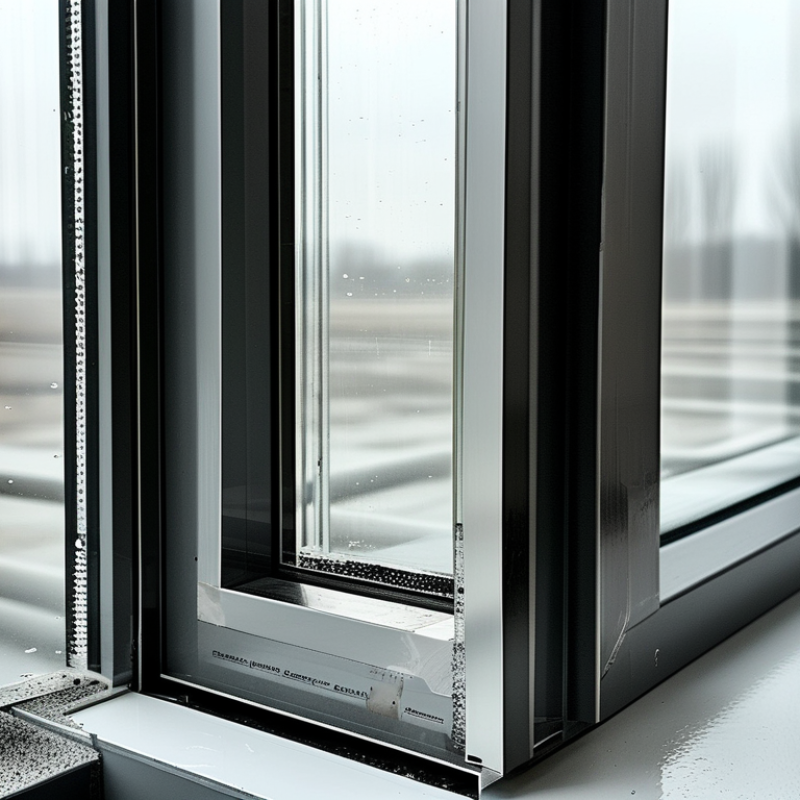
| Non-Thermal-Break Aluminum | None | Approximately 5.0–7.0 W/m²·K | Aluminum conducts heat directly from the exterior to the interior. Condensation risk is comparatively high in cold conditions. | Mild climates, unconditioned spaces, interior partitions, and low-cost applications | Low; generally unsuitable for high-performance building envelopes | Use only where thermal insulation is not a major requirement. Check local energy codes before specifying. |
| Basic Thermal-Break Aluminum | 14–18 mm | Approximately 2.5–3.5 W/m²·K | Polyamide separators reduce direct heat flow, but the limited break width and profile geometry restrict overall insulation. | Warm and mixed climates; residential and light commercial windows | Moderate; better than non-thermal-break profiles | Confirm the complete window Uw, not only the profile Uf. Glass selection remains highly influential. |
| Enhanced Thermal-Break Aluminum | 20–30 mm | Approximately 1.8–2.5 W/m²·K | A wider polyamide thermal barrier and improved internal chambers reduce conductive and convective heat transfer. | Mixed climates and energy-conscious residential projects | Good; can support low-energy window assemblies when paired with suitable glazing | Evaluate thermal-break continuity at corners, mullions, meeting rails, hardware zones, and drainage paths. |
| High-Performance Thermal-Break Aluminum | 30–40 mm or more | Approximately 1.2–1.8 W/m²·K | Deep insulated cavities, multiple chambers, and optimized insulating components significantly reduce heat transfer through the frame. | Cold climates, passive-design projects, and high-performance commercial buildings | Very good; suitable for demanding thermal-efficiency targets when correctly installed | Check tested whole-window values, condensation resistance, air leakage, installation details, and compatibility with triple glazing. |
| Thermally Improved Sliding Profile | 18–35 mm, depending on the design | Approximately 1.8–3.0 W/m²·K | Thermal barriers improve frame insulation, but sliding tracks, interlocks, and larger air gaps can reduce performance compared with hinged systems. | Warm and mixed climates; large openings where ventilation and access are important | Moderate to good; depends strongly on interlock design and weather sealing | Prioritize air-tightness, water resistance, insulated meeting stiles, and tested performance for the selected opening size. |
| High-Performance Hinged / Casement Profile | 30–40 mm or more | Approximately 1.2–2.0 W/m²·K | Continuous thermal breaks combined with compression seals generally provide strong resistance to air leakage and heat transfer. | Cold climates and buildings with strict energy targets | Very good to excellent; often more efficient than comparably sized sliding systems | Verify sash-to-frame sealing, corner joints, hardware installation, glass edge spacers, and installation quality. |
| Aluminum Profile with Insulating Foam or Additional Inserts | 25–45 mm or more | Approximately 1.0–1.8 W/m²·K | Low-conductivity foam or insulating inserts reduce heat flow through hollow chambers and improve the effective frame performance. | Cold climates and projects requiring enhanced thermal performance | Excellent potential, provided the inserts remain continuous and do not interfere with drainage or hardware | Request verified calculations or test reports. Assess fire behavior, moisture resistance, durability, and repairability of inserts. |

.svg)