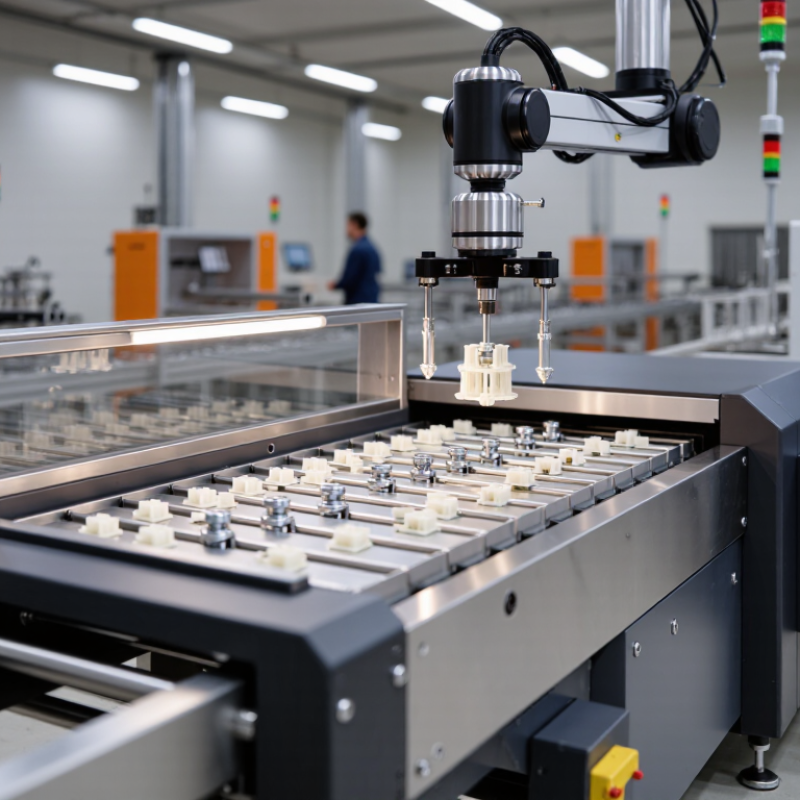
| Risk assessment and system boundaries | Assess the complete application—not only the robot—including feeding equipment, end effector, workpieces, conveyors, operator tasks, and foreseeable misuse. | Document hazards, operating modes, people exposed, risk-reduction measures, and residual risks for setup, production, recovery, cleaning, and maintenance. | ISO 10218-2; ISO 12100 |
| Robot and cell integration | Confirm that the robot, feeder, tooling, safety devices, and control system are integrated as a coordinated robot application. | Review integration documentation, safety functions, operating instructions, and validation records for the completed cell. | ISO 10218-1; ISO 10218-2 |
| Access prevention and safeguarding | Identify access points and protect people from hazardous robot motion, pinch points, ejected parts, and moving feeder components. | Check guard construction, openings, access doors, and safety-device coverage against the risk assessment. Verify that reaching around, over, or under safeguards does not create an unprotected route. | ISO 10218-2; ISO 14120; ISO 14119 |
| Safety distances and presence sensing | Where scanners, light curtains, or other presence-sensing devices are used, account for approach direction, stopping time, and the possibility of reaching into the hazard zone. | Record the calculation and verify the installed protective distance using measured stopping performance and the device manufacturer’s instructions. | ISO 13855; ISO 13857 |
| Safety-related control functions | Set the required performance of each safety function from the risk assessment. Consider guard interlocking, protective stops, enabling devices, and safe speed or position functions where applicable. | Document the required and achieved performance level or safety integrity level, architecture, diagnostic measures, and validation results. | ISO 13849-1; IEC 62061 |
| Emergency stop | Provide accessible emergency-stop devices for the application and ensure that activating one initiates the intended stop response. | Test each device, confirm that reset does not restart the cell, and verify that emergency stop is treated as a complementary protective measure—not a substitute for guarding. | ISO 10218-2; ISO 13850 |
| Setup, teaching, and recovery | Review how authorized personnel enter the cell for teaching, fault recovery, jam clearing, and adjustment. Consider reduced-speed operation and enabling controls where required. | Verify mode selection, access control, stop behavior, and restart conditions. Ensure personnel can perform necessary tasks without bypassing safeguards. | ISO 10218-1; ISO 10218-2 |
| Collaborative operation | If people may share space with the robot, define the intended collaborative method and assess the robot, tool, workpiece, and application together. | Validate the selected protective measures and operating conditions. A collaborative-rated robot alone does not make the entire application safe for human contact. | ISO 10218; ISO/TS 15066 |
| Feeder, tooling, and workpiece hazards | Check for sharp or hot parts, stored energy, entanglement, ejected components, and pinch or crush points created by feeders, grippers, and transfer mechanisms. | Confirm that guarding, interlocks, safe loading methods, and instructions cover hazards beyond the robot’s reach and motion envelope. | ISO 10218-2; ISO 12100 |
| Electrical equipment and isolation | Assess electrical hazards and energy sources, including pneumatic or hydraulic energy, during servicing and fault recovery. | Verify electrical protection, isolation points, identification, and documented procedures for preventing unexpected start-up and releasing stored energy. | IEC 60204-1; ISO 14118 |
| Validation and change management | Reassess safety when changing the robot program, feeder layout, tooling, workpiece, speed, or protective-device configuration. | Keep test records for safety functions and stopping performance, plus updated risk assessments, drawings, instructions, and training records. | ISO 10218-2; ISO 12100 |

.svg)