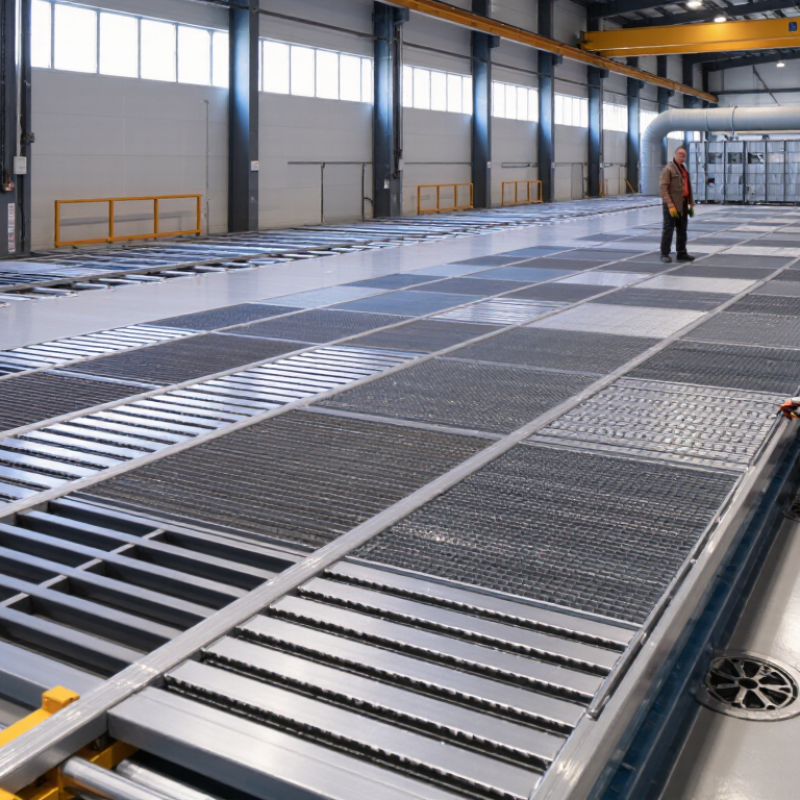
| General industrial platforms | Welded carbon-steel grating with load bars typically spaced at 30–40 mm centers.
Serrated load bars are preferred where improved slip resistance is required. | Confirm panel span, support direction, design load, allowable deflection, bearing width, cut-outs, and fixing locations.
Common design checks include pedestrian loads, equipment loads, and maintenance trolley loads. | ANSI/NAAMM MBG 531 ISO 14122-2
Verify structural calculations and project-specific load requirements with the responsible engineer. | Hot-dip galvanizing is commonly selected for outdoor or humid industrial service.
Confirm coating requirements, surface preparation, drainage, and repair treatment for damaged areas. | Inspect annually for corrosion, loose fasteners, bent bearing bars, damaged welds, and blocked drainage.
Replace components showing substantial section loss or permanent deformation. | Standard panel sizes and common bearing-bar arrangements are generally easier to source internationally.
Confirm metric or imperial dimensions before fabrication. |
| Heavy industrial and process areas | Heavy-duty welded grating with deeper load bars, closer spacing, or additional support members.
Use removable panels where frequent access to valves, pumps, and equipment is expected. | Check concentrated wheel loads, impact loads, equipment feet, vibration, thermal movement, and deflection limits.
Avoid selecting grating solely by panel thickness. | ANSI/NAAMM MBG 531 ISO 14122-2
Obtain load tables, fabrication tolerances, welding details, and calculation records for approval. | Galvanized steel is suitable for many outdoor applications, but chemical exposure may require stainless steel or a specialist coating system.
Confirm compatibility with process chemicals and cleaning agents. | Establish a documented inspection schedule based on operating severity.
Check high-traffic zones, support connections, lifting points, and areas exposed to spills. | Heavy sections may increase transport weight and handling cost.
Request packing drawings, lifting instructions, corrosion-protection documentation, and spare-panel availability. |
| Wet, oily, or high-slip-risk areas | Serrated steel, stainless-steel, or aluminum grating with serrated top surfaces.
Consider close-mesh panels where small tools or objects could fall through. | Confirm slip-resistance requirements, opening size, heel-safe requirements, drainage capacity, and footwear or contamination conditions.
Serrations improve grip but do not eliminate the need for housekeeping and suitable footwear. | ISO 14122-2 AS 1657
Where required, obtain project-specific slip testing and confirm that the selected opening size meets safety requirements. | Use galvanized steel for general atmospheric exposure; use stainless steel or aluminum when the environment and chemical compatibility justify it.
Avoid dissimilar-metal contact without suitable isolation. | Clean oil, mud, salts, and process residue before deposits become slippery or corrosive.
Inspect drainage paths and clean blocked openings. | Small-mesh and serrated products may have fewer standard stock options than conventional grating.
Confirm availability before finalizing the design. |
| Coastal, marine, and offshore environments | Stainless-steel or suitably protected steel grating selected according to chloride exposure, structural demand, and fire or safety requirements.
Serrated surfaces are commonly considered for wet walkways. | Evaluate chloride concentration, splash-zone exposure, tidal conditions, windborne salt, temperature, drainage, and galvanic corrosion risk.
Confirm the required service life and inspection access. | ISO 14122-2 ASTM A123/A123M
For stainless steel, verify the specified grade, welding procedure, passivation requirements, and corrosion design basis. | Hot-dip galvanized carbon steel may be suitable for some marine exposures, subject to the project corrosion assessment.
Stainless steel selection must consider chloride concentration and crevice corrosion; do not assume every stainless grade is suitable for seawater. | Inspect more frequently than in mild inland environments.
Remove salt deposits, examine crevices and fasteners, and check coating breakdown at cut edges and welds. | Require seaworthy packaging, moisture protection, traceability, and clear material certificates.
Allow additional time for special alloys, testing, and export documentation. |
| Food, pharmaceutical, and hygienic facilities | Stainless-steel grating with smooth or lightly textured surfaces, open drainage paths, and cleanable geometry.
Select removable sections where sanitation access is needed. | Confirm hygienic design, cleanability, temperature range, chemical exposure, drainage, load capacity, and compatibility with cleaning procedures.
Avoid unnecessary crevices and inaccessible dirt traps. | ISO 14122-2 Project hygiene specification
Verify material certificates, weld quality, surface finish, passivation, and cleaning-agent compatibility. | Stainless steel is often preferred where frequent washdown or aggressive cleaning chemicals are present.
The selected grade must be checked against the actual chemical and temperature exposure. | Use routine washdown and visual inspection for residue, staining, damaged welds, and surface deterioration.
Replace damaged sections that cannot be effectively cleaned. | Request certificates of material origin, weld procedures, surface-finish details, and packaging suitable for clean installation.
Confirm whether protective films must be removed before commissioning. |
| Public walkways and commercial buildings | Architectural steel or aluminum grating with controlled openings, suitable edge trims, and concealed or tamper-resistant fixings where required.
Select a finish that matches the visual and maintenance objectives. | Confirm pedestrian loading, accessibility, heel-safe opening dimensions, trip hazards, wheelchair compatibility, drainage, fire strategy, and visual tolerances. | ISO 14122-2 AS 1657
Also check local building, accessibility, and fire regulations applicable to the installation location. | Powder coating, anodizing, or galvanizing may be considered depending on substrate, exposure, appearance, and repair requirements.
Confirm coating adhesion and color-maintenance expectations. | Use routine cleaning and inspect fasteners, edges, trip points, coating damage, and corrosion around drainage locations.
Replace loose or damaged panels promptly in public areas. | Coordinate shop drawings, sample approvals, color or finish approval, and site measurements before production.
Protect visible surfaces during transport and installation. |
| Water-treatment and utility facilities | Galvanized steel, stainless steel, or aluminum grating selected according to chemical exposure, wetness, structural load, and access frequency.
Use removable panels around tanks, channels, and service equipment. | Check exposure to chlorine compounds, acids, alkalis, humidity, ultraviolet radiation, and submerged or splash conditions.
Confirm drainage, support corrosion allowance, and safe removal methods. | ISO 14122-2 ASTM A123/A123M
Require chemical compatibility review and documented material and coating specifications. | Select protection based on the actual chemical environment rather than humidity alone.
Stainless steel or non-ferrous materials may be appropriate in specific zones, but galvanic compatibility must be assessed. | Inspect after chemical spills, flooding, or abnormal process events.
Check support members and fasteners, which may deteriorate before the visible walking surface. | Confirm local access restrictions, lifting equipment, customs documents, and replacement-panel identification.
Keep a small quantity of critical spare panels where shutdown access is difficult. |
| Projects requiring rapid replacement | Modular panels with standardized widths, bolted clips, lifting handles, and clearly identified installation locations.
Use interchangeable panel layouts where practical. | Confirm panel weights, lifting points, removable-panel clearances, fastener accessibility, and replacement tolerances.
Record final installed dimensions for future maintenance. | ISO 14122-2 Project inspection plan
Verify that replacement panels retain the original load rating and support arrangement. | Match replacement material and coating to the existing structure, or isolate dissimilar metals when a different material is unavoidable. | Maintain an asset register showing panel identification, location, material, dimensions, load rating, and installation date.
Inspect fixings after every replacement. | Standardize panel dimensions and connection details across project phases where possible.
Store approved drawings and spare-part data in a shared digital format. |

.svg)