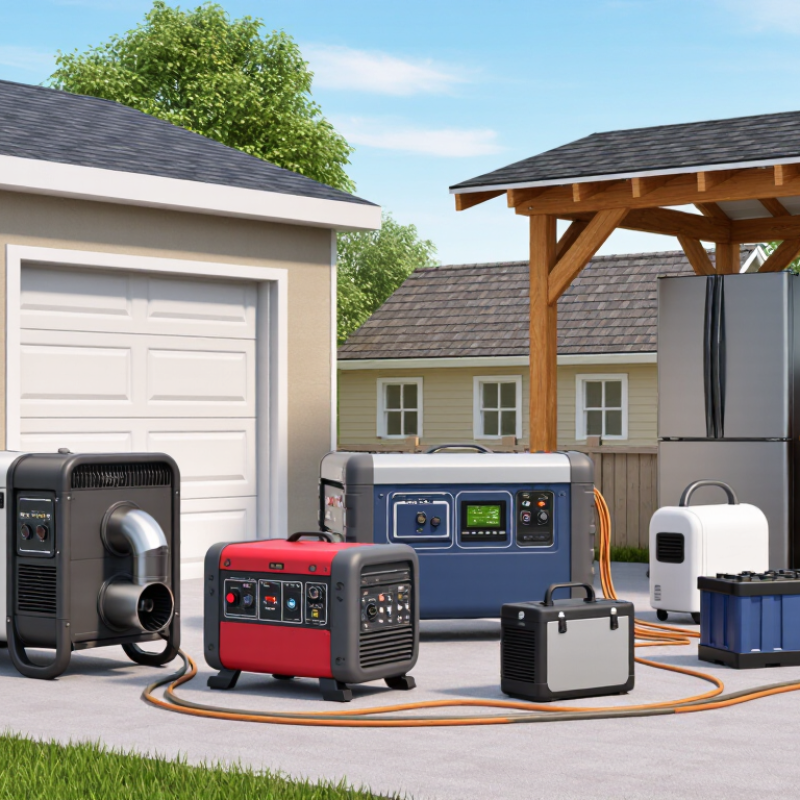
| Conventional portable generator | Approximately 1–15 kW | Usually gasoline; some models use other fuels | Temporary home backup, small job sites, outdoor events, and emergency power for selected appliances or tools | Portable, widely available, and suitable for intermittent use | Check starting watts as well as running watts. Fuel must be stored safely, and the unit must operate outdoors, away from doors and windows, because exhaust contains carbon monoxide. |
| Inverter generator | Approximately 1–7 kW per unit; some models can be connected in parallel | Usually gasoline; dual-fuel versions are also available | Recreational vehicles, camping, mobile work, quiet residential backup, and sensitive electronics | Often quieter and more fuel-efficient at partial loads than conventional portable units; produces regulated electrical output | Confirm the rated output, not just the peak rating. Parallel operation requires compatible equipment and does not remove outdoor-operation or carbon-monoxide precautions. |
| Dual-fuel portable generator | Commonly approximately 2–15 kW | Typically gasoline and propane | Home emergency backup, remote sites, and users who want a choice of fuel during supply disruptions | Fuel flexibility can be useful when one fuel is unavailable; propane can be stored for longer periods than gasoline when handled correctly | Output may differ by fuel, and propane operation can produce less power on some models. Check the manufacturer’s ratings and follow local fuel-storage rules. |
| Diesel standby or prime-power generator | From tens of kW to several MW, depending on configuration | Diesel fuel | Commercial facilities, construction sites, data centers, industrial operations, and remote locations requiring substantial or extended backup power | Available in a wide range of capacities and commonly used for demanding loads and longer operating periods | Plan for fuel storage and replenishment, routine load testing, maintenance, noise, exhaust, and applicable air-quality requirements. Confirm whether the unit is rated for standby, prime, or continuous duty. |
| Natural-gas standby generator | Commonly from roughly 10 kW to multi-megawatt systems | Natural gas from a utility connection or an approved supply system | Homes, offices, healthcare facilities, and commercial sites with a suitable gas supply and automatic backup requirements | Can start automatically when paired with appropriate controls and a transfer switch; avoids on-site liquid-fuel refilling during normal operation | Availability depends on gas infrastructure and supply pressure. Confirm local installation rules, site-specific output, and whether fuel service is expected to remain available during the emergency scenario. |
| Propane standby generator | Commonly from roughly 10 kW to several hundred kW | Liquefied petroleum gas (propane) stored in an approved tank | Homes and smaller commercial sites without natural-gas service, including locations needing automatic backup | On-site fuel storage can provide an alternative where pipeline gas is unavailable; suitable for automatic standby setups | Size the tank for expected load and runtime. Propane output, delivery access, cold-weather conditions, and local tank-clearance rules should be considered. |
| Battery energy storage system (comparison option) | Power and stored energy vary by system; specified separately in kW and kWh | Electricity from the grid, on-site generation, or other approved charging sources | Short-duration backup, peak-load support, solar self-consumption, and sites seeking quiet operation with no on-site combustion | Quiet operation and rapid response; can be paired with a generator to reduce generator run time in a hybrid system | A battery is not a fuel-burning generator. Check usable energy in kWh, maximum output in kW, recharge options, backup configuration, and expected runtime at the actual load. |

.svg)