| Primary purpose | To carry current while providing improved strength, heat resistance, creep resistance, or controlled electrical resistance compared with commercially pure copper. | Used when ordinary copper cannot provide the required mechanical durability or operating-temperature performance. |
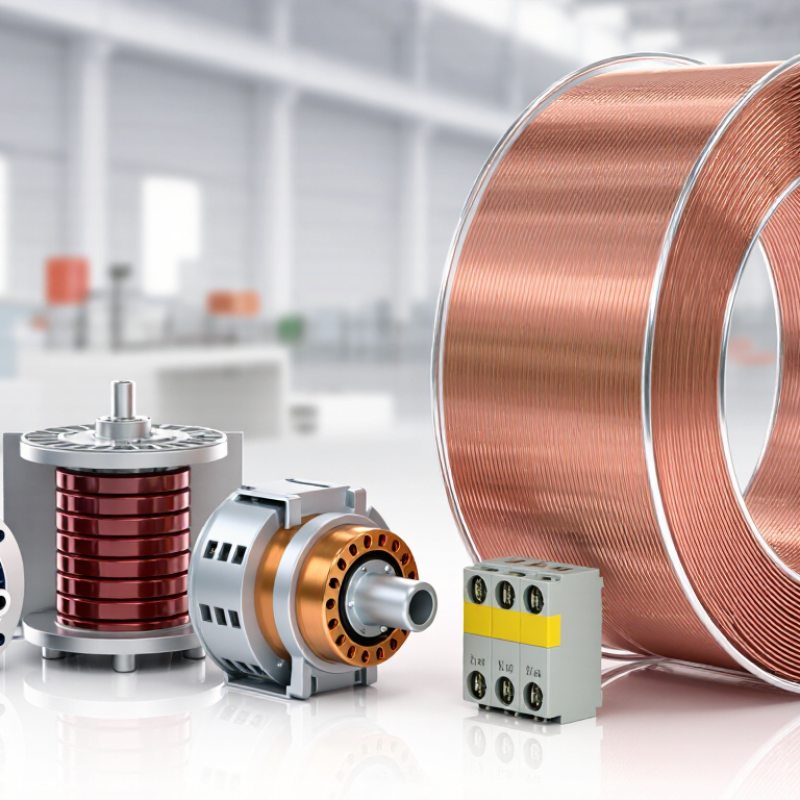
| Electrical machines | Winding conductors for motors, generators, alternators, and traction machines. | The alloy can improve resistance to vibration, centrifugal force, thermal cycling, and conductor deformation in rotating equipment. |
| Transformers and inductors | Round or rectangular enamelled wire used for primary, secondary, and magnetic-component windings. | Higher-strength conductor grades can help maintain dimensional stability during winding, clamping, and thermal cycling. |
| Common alloy families | Copper-silver (Cu-Ag), copper-chromium-zirconium (Cu-Cr-Zr), copper-magnesium (Cu-Mg), copper-tin (Cu-Sn), and copper-nickel (Cu-Ni). | Each alloy family balances conductivity, tensile strength, elongation, temperature capability, and manufacturability differently. |
| Cu-Ag winding wire | Typically retains high copper conductivity while providing better softening resistance than unalloyed copper; exact properties depend on silver content and temper. | Suitable for high-current or high-temperature windings where conductivity and resistance to thermal softening are both important. |
| Cu-Cr-Zr winding wire | A precipitation-strengthened copper alloy; electrical conductivity is commonly lower than pure copper but mechanical strength and softening resistance are substantially higher. | Used for demanding coils, high-current conductors, and applications exposed to elevated temperature, vibration, or electromagnetic forces. |
| Cu-Ni winding wire | Electrical resistivity increases with nickel content; conductivity is therefore much lower than that of pure copper. | Used where predictable resistance, thermal stability, or resistance-wire behavior is more important than maximum current-carrying capacity. |
| Conductor cross-section | Round wire is common; rectangular and square profiles are also produced for high slot-fill and high-current windings. | The selected shape affects packing density, heat dissipation, bending behavior, and the amount of copper that fits into a winding slot. |
| Typical insulation | Enameled insulation based on polyester, polyesterimide, polyamide-imide, or related high-temperature systems; insulation class may include 155, 180, 200, or 220. | The coating provides turn-to-turn electrical isolation and must withstand voltage, abrasion, solvents, heat, and winding stress. |
| Raw material preparation | High-purity copper is combined with controlled quantities of alloying elements, commonly by melting and continuous casting or billet casting. | Chemical composition and cleanliness must be controlled because inclusions and composition variation can reduce conductivity, ductility, and coating quality. |
| Hot working | Cast billets or rods are hot rolled or otherwise reduced to produce a smaller copper-alloy rod suitable for wire drawing. | Hot working refines the structure, reduces the cross-section, and prepares the alloy for controlled cold deformation. |
| Cold drawing | The rod passes through progressively smaller dies until the required wire diameter or profile is reached. | Drawing improves dimensional accuracy and surface finish but increases work hardening, so intermediate annealing may be required. |
| Heat treatment | Annealing restores ductility; precipitation-hardening alloys may receive solution treatment, quenching, and aging under controlled conditions. | Heat treatment establishes the required balance between tensile strength, elongation, conductivity, and resistance to softening. |
| Enamelling process | The cleaned wire passes through repeated coating and curing stages until the specified insulation thickness and electrical performance are obtained. | Multiple thin layers generally provide more uniform coverage and better resistance to pinholes, abrasion, and winding damage. |
| Quality checks | Typical checks include diameter, electrical resistance, conductivity, tensile strength, elongation, surface condition, insulation breakdown voltage, and coating continuity. | Testing confirms that the finished winding wire meets the required electrical, mechanical, dimensional, and thermal specifications before use in a coil. |

.svg)