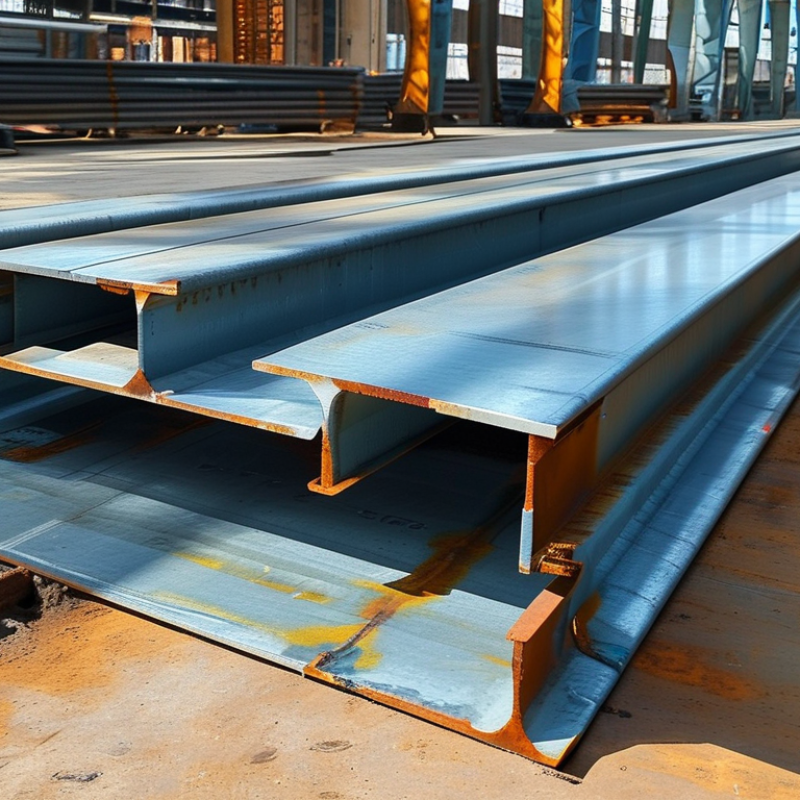
| Product Definition | A galvanized steel I beam is an I-shaped structural steel section protected by a zinc coating, commonly applied through hot-dip galvanizing after fabrication. | The I-shaped geometry provides efficient resistance to bending, while the zinc coating helps protect exposed steel surfaces from atmospheric corrosion. |
| Structural Geometry | The section consists of two flanges connected by a central web. Flanges mainly resist bending stresses; the web primarily transfers shear and maintains the spacing between flanges. | The geometry offers a high strength-to-weight ratio for beams, platforms, frames, supports, bridges, and industrial structures. |
| Common Steel Grades | Structural grades vary by specification and market. Common minimum yield-strength levels include approximately 235 MPa, 275 MPa, 345 MPa, and 355 MPa. | Designers should select the grade according to the governing structural standard, loading conditions, welding requirements, and local material availability. |
| Zinc Coating Method | Hot-dip galvanizing immerses prepared steel in molten zinc, producing a metallurgically bonded zinc-iron coating. | The process covers external surfaces and many edges more consistently than conventional paint application, provided the member is properly vented and drained. |
| Typical Coating Thickness | For structural steel thicker than 6 mm, ISO 1461 specifies a minimum average coating thickness of 85 micrometres and a minimum local thickness of 70 micrometres for fabricated articles. | Actual requirements depend on the selected coating standard, steel thickness, surface condition, chemistry, inspection method, and project specification. |
| Corrosion Protection | Zinc protects steel through barrier protection and sacrificial or galvanic action. In many outdoor environments, the coating develops a stable protective patina over time. | This can reduce routine repainting and maintenance compared with unprotected carbon steel, although service life depends on the environment and coating thickness. |
| Approximate Density | Steel has a density of approximately 7,850 kg/m³. A galvanized member has a slightly higher mass because of the zinc coating. | Structural calculations, lifting plans, transport documents, and foundation loads should use the actual calculated or certified mass of the finished member. |
| Dimensional Availability | I-beam depth, flange width, web thickness, flange thickness, length, and mass per metre vary by regional section series and applicable standards. | Before procurement, confirm section designation, tolerances, straightness, hole locations, cut lengths, and compatibility with local design codes. |
| Typical Applications | Common applications include exterior building frames, mezzanines, equipment supports, walkways, industrial platforms, agricultural structures, warehouses, and infrastructure components. | Galvanized I beams are particularly useful where members are exposed to rain, humidity, condensation, or intermittent wetting. |
| Environmental Suitability | Suitability depends on atmospheric exposure, humidity, chloride concentration, sulfur compounds, temperature, abrasion, and contact with other materials. | Marine, heavily industrial, buried, immersed, or chemically aggressive conditions may require duplex protection, additional design measures, or a project-specific corrosion assessment. |
| Fabrication Considerations | Vent and drain holes may be required in hollow or enclosed portions. Welding, cutting, drilling, and grinding can locally remove zinc and require approved repair procedures. | Plan fabrication details before galvanizing to minimize distortion, trapped solutions, uncoated areas, and post-treatment repairs. |
| Inspection Criteria | Inspection may include visual appearance, coating thickness measurement, dimensional checks, surface condition, adhesion-related requirements, and verification against the specified standard. | Consistent inspection records support international quality control, acceptance documentation, and traceability without relying on a particular supplier or brand. |
| Global Project Advantage | Galvanized I beams combine a standardized structural form with factory-applied corrosion protection and broad compatibility with international steel design practices. | They can simplify maintenance planning and improve durability, provided the section, steel grade, coating standard, and installation details are coordinated with local regulations. |

.svg)