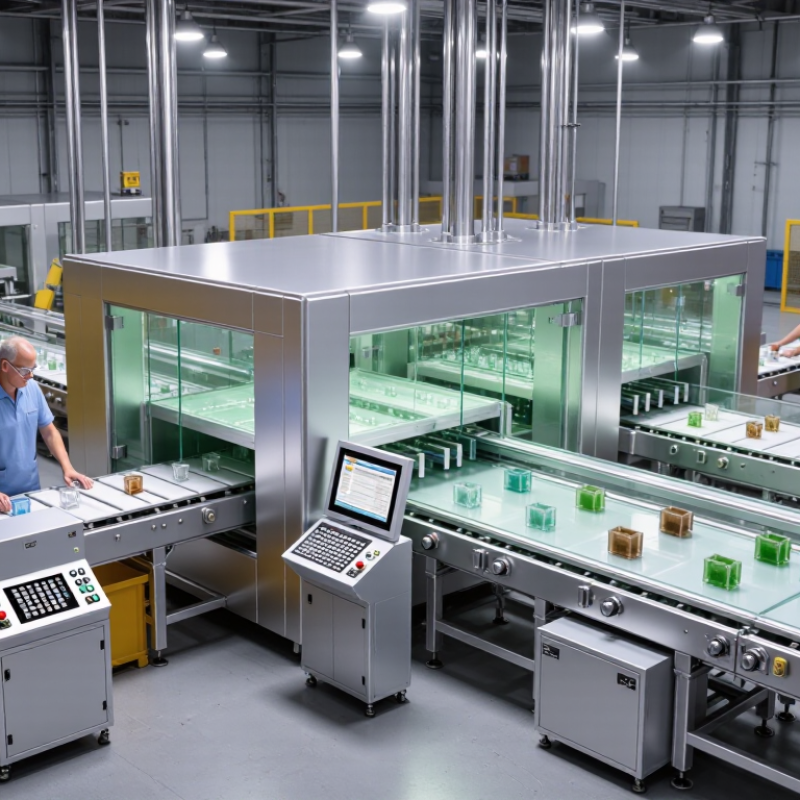
| 1. Match capacity to your actual throughput | Confirm the required feed rate in tonnes per hour and the operating hours per day. Capacity depends on factors such as particle-size range, feed consistency, contamination, and the number of sorting stages. | Ask for rated and demonstrated throughput for material similar to yours, including the assumed size range, feed conditions, and target product quality. | Compare the proposed rate with your measured peak and average feed rates. Request a trial using representative material rather than relying on a nominal rating alone. |
| 2. Define feed material and size range | Identify whether the feed is container glass, cullet, or another glass stream, and document its particle-size distribution, moisture, color mix, and likely contaminants. | Request the machine's accepted particle-size range and limitations for fines, oversized pieces, labels, ceramics, stones, metals, and other expected contaminants. | Check that upstream screening and cleaning can prepare the feed within the machine's stated operating range. Confirm how out-of-range material will be handled. |
| 3. Verify sorting performance for your target | Clarify the sorting objective, such as separating colors or removing non-glass contaminants. Purity and recovery are different performance measures and can involve trade-offs. | Ask for test results showing the feed composition, product purity, recovery, sample size, and test method. Specify the contaminants or color fractions that matter to your process. | Agree on measurable acceptance criteria and conduct a material trial. Ensure results are reported using definitions that both buyer and supplier understand. |
| 4. Check optical and system compatibility | Confirm that the sensor and sorting configuration suits the colors, particle sizes, and contaminants in your feed. Check interfaces with conveyors, screens, feeders, and plant controls. | Request the sensor configuration, available data and control interfaces, required feed presentation, and the inputs and outputs needed for integration. | Have the supplier review a process-flow diagram and confirm integration requirements, including conveyor speed, transfer points, and control signals. |
| 5. Measure the site layout before ordering | Allow for the machine footprint, infeed and discharge conveyors, access for cleaning, maintenance clearances, and safe operator access. | Request dimensioned general-arrangement drawings, service-clearance requirements, machine weight, lifting points, and installation requirements. | Check the proposed layout against doorways, ceiling height, floor loading, existing equipment, and access routes for delivery and maintenance. |
| 6. Confirm utilities and operating conditions | Check electrical supply, compressed-air demand where applicable, ambient conditions, dust control, and local installation requirements. | Request utility specifications, including voltage and frequency options, power demand, air pressure and consumption, and environmental limits. | Compare the specifications with site capacity and local standards. Confirm that any required air treatment, extraction, or electrical protection is included in the project scope. |
| 7. Review maintenance, testing, and support | Assess routine cleaning, wear parts, sensor protection, spare-parts availability, training, and the support needed across operating shifts. | Request a maintenance schedule, recommended spare-parts list, warranty terms, training plan, and the procedure for performance testing after installation. | Agree on commissioning checks, operator training, service responsibilities, and a documented method for measuring throughput and sorting results at the site. |

.svg)