Food Safety Insights

In Eagle’s Advanced Insights Blog, experts share their know-how by keeping you up-to-date with the latest trends to ensure your inspection equipment keeps your products safe. Eagle is an industry leader when it comes to performance and innovation, and we’ll share the news that’s important to you to enhance your quality assurance program.

Suggest topic you would like to see at:

sale@generalmachinery.org

Top 10 Heavy Duty Pallet Rack Types for Warehouses

Heavy-Duty Pallet Racks are more than steel frames beneath a warehouse ceiling. Their design affects storage density, forklift movement, inventory access, and daily safety. A rack that suits uniform, high-volume pallets may be a poor fit for mixed loads or frequent picking. The right choice depends on the operation—not just the available floor space.

MHI’s 2024 Annual Industry Report found that 55% of surveyed organizations were using robotics and automation, while 67% expected to adopt them within five years. That shift makes rack layout and equipment compatibility increasingly important. Deep-lane systems can store more pallets in less space, while selective racks provide direct access to each pallet. Trade-offs remain. More density can mean less selectivity.

Warehouse-planning expert James A. Tompkins has emphasized aligning facility design with operating needs. A practical paraphrase of that principle is: “Design storage around the work, not the other way around.” It is a useful test, though no single rack type solves every problem. This guide compares ten heavy-duty options, from selective and drive-in racks to push-back and cantilever systems. It considers load access, space use, handling equipment, and suitable applications. Small details matter: pallet overhang, beam height, and aisle width can change how smoothly a system works. The rankings are a starting point, not a substitute for checking actual loads and workflow.

Top 10 Heavy Duty Pallet Rack Types for Warehouses

What Heavy-Duty Pallet Racking Is and How It Works

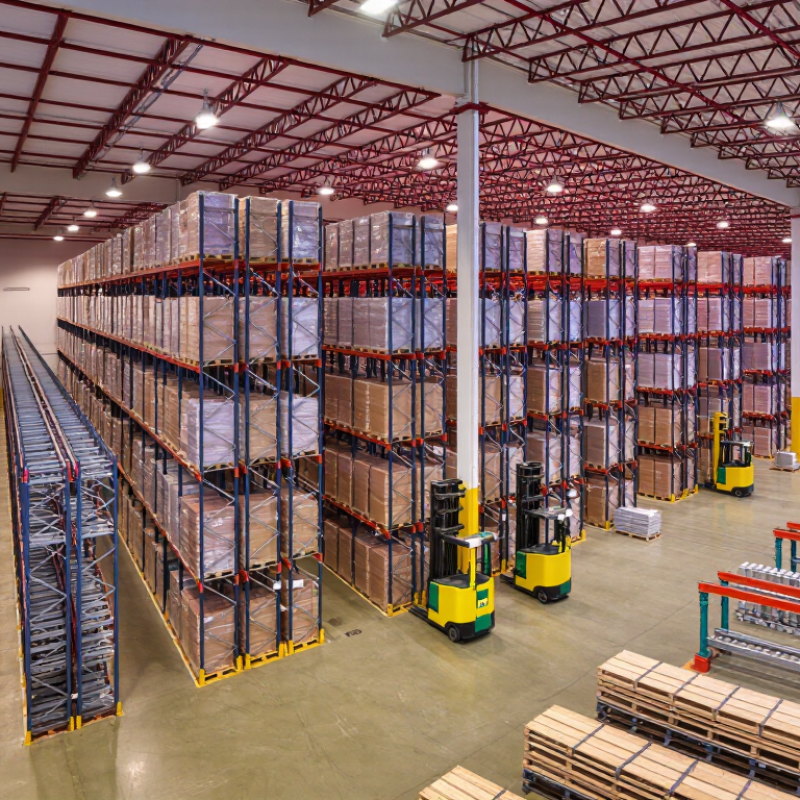
Heavy-duty pallet racking is a steel framework designed to store palletized goods above floor level. Upright frames support horizontal beams, creating bays where forklifts place and retrieve loads. The system uses vertical space, keeps inventory visible, and can make picking more orderly. It is not just steel shelving. Each rack must suit the pallet dimensions, load weight, handling equipment, and warehouse layout.

In common selective racks, every pallet position is directly accessible from an aisle. Other configurations may store pallets more densely, but can limit access to individual loads. Workers typically position pallets on beams, while the frame transfers weight to the floor. Capacity depends on the complete setup, including beam levels, anchoring, and floor conditions. A tidy diagram helps, but it rarely captures every bump, uneven pallet, or change in daily traffic. That deserves attention.

Tips: Confirm pallet size and loaded weight before planning a layout. Keep aisles clear, inspect beams and uprights for visible damage, and report impacts promptly. Never assume a rack’s capacity from appearance alone; use verified specifications and qualified guidance.

Key Factors for Choosing a Warehouse Rack System

Choosing a heavy-duty pallet rack starts with the load, not the catalog. Record each pallet’s weight, dimensions, and overhang. Include the heaviest realistic load, not just the average. A small measurement error can reduce clearance or create an awkward beam fit. Check the floor slab’s condition and capacity with a qualified professional before installation.

Next, match the rack type to inventory flow. Selective racks offer direct access to each pallet and suit varied stock. Double-deep and drive-in systems store more pallets in less aisle space, but need compatible forklifts and tighter stock rotation. Push-back and pallet-flow racks can support higher throughput for grouped products. Cantilever racks handle long, bulky items. More density is not always better.

Map forklift turning paths and measure clear heights, sprinklers, lights, and doorways. Leave room for safe loading and routine inspection. Verify beam and frame ratings for the intended configuration; changing beam levels can alter capacity. Ask installers to document the layout and load limits. Then check connections, anchors, and visible damage on a regular schedule. The overlooked detail? Real pallets are rarely identical, and a layout that looks efficient on paper may slow workers on a busy shift. Test a representative aisle before expanding.

Ten Common Types of Heavy-Duty Pallet Racking

Heavy-duty pallet racking should match pallet turnover, SKU variety, and forklift access. Selective racks offer direct access to every pallet, while double-deep racks store pallets two positions deep but need reach trucks. Drive-in and drive-through systems increase density; the former serves loading from one end, while the latter allows access at both ends. Push-back racks use nested carts, and pallet-flow racks move loads along rollers. Space is finite.

For high-volume lanes, pallet-shuttle systems move loads within deep channels, reducing forklift travel inside the rack. Mobile racks sit on powered bases that open access aisles when needed. Cantilever racks hold long or irregular loads, while structural steel racks suit demanding applications and impact exposure. These are ten common options, not interchangeable solutions. Aisle width, pallet dimensions, rack height, floor capacity, and load ratings all affect safe design.

The MHI 2024 Annual Industry Report says 55% of respondents planned to increase supply-chain technology investment. That trend makes automation-ready layouts worth considering, but added density can complicate access and replenishment.

OSHA’s materials-handling rule requires stored materials to be secured against sliding or collapse. Verify rack capacity with a qualified designer and inspect for bent uprights, damaged beams, and loose anchors. Catalog layouts can look clean; real pallets rarely behave perfectly.

How Rack Designs Compare in Access, Capacity, and Storage Density

Top 10 Heavy Duty Pallet Rack Types for Warehouses

Rack design changes how quickly workers reach a pallet and how much floor space storage consumes. Selective pallet racks offer direct access to every load, making them practical for varied stock and frequent picking. They use more aisles, though. Double-deep racks store pallets in two positions, increasing density but requiring compatible reach equipment and accepting slower access to rear pallets.

Drive-in racks suit many pallets of the same product, with forklifts entering storage lanes. Drive-through racks allow entry from either end, which can support different loading patterns. Both increase density but reduce selectivity. Push-back racks store pallets several deep on carts; pallet-flow racks use inclined rollers to move loads forward. They can speed replenishment, but loading order and pallet condition matter. Small flaws can jam a lane.

Shuttle systems move pallets within deep lanes, while mobile racks shift to open an aisle only when needed. Both can reduce aisle space, with added equipment or operating complexity. Structural pallet racks use robust components suited to demanding environments. Cantilever racks handle long, awkward items rather than standard pallet loads. Real capacity depends on beam spans, upright design, floor conditions, and load weight. It deserves a close check. A layout that looks efficient on paper may slow daily work if aisle widths, forklift turning space, or replenishment routines are overlooked.

Top 10 Heavy Duty Pallet Rack Types for Warehouses — How Rack Designs Compare in Access, Capacity, and Storage Density
Rack Type Pallet Access Typical Storage Density Capacity Considerations Best Suited For Key Trade-Off
1. Selective Pallet Rack Direct access to every pallet; typically 100% selectivity. Low–Medium Capacity is determined by beam ratings, frame height and depth, pallet load, and configuration. Commonly used for heavy unit loads when properly engineered. Warehouses with many SKUs, frequent picking, or varied inventory. Excellent access, but aisles take up more floor area than in high-density systems.
2. Double-Deep Rack Two pallets deep; front pallets must be moved to reach rear pallets. Requires a deep-reach truck. Medium–High Uses standard pallet rack components in a deeper arrangement; all beams, frames, and loads still require configuration-specific ratings. Moderate-SKU operations with multiple pallets per SKU. More positions per aisle, but reduced selectivity and more specialized handling equipment.
3. Push-Back Rack Multiple pallets deep; loading and retrieval generally operate last-in, first-out (LIFO). High Capacity depends on the engineered carts, rails, rack structure, and pallet load; loads must be compatible with the system. High-volume products stored in batches with several pallets per SKU. High density and good access from the aisle, but inventory rotation is generally LIFO.
4. Pallet Flow Rack Usually loaded from one side and retrieved from the other; supports first-in, first-out (FIFO). High Roller lanes and rack structure must be designed for pallet dimensions, load, lane length, and operating conditions. High-throughput, date-sensitive, or batch-controlled inventory. Enables FIFO and dense storage, but requires compatible pallets and routine lane maintenance.
5. Drive-In Rack Forklifts enter the rack structure; commonly operated as LIFO from an aisle at one end. Very High Rack capacity is affected by bay geometry, rail design, impact protection, forklift clearances, and load distribution. Large quantities of a limited number of SKUs with relatively uniform pallets. Strong space utilization, but fewer accessible faces and greater care needed during forklift operation.
6. Drive-Through Rack Forklifts can enter from both ends; can support FIFO when loading and retrieval are managed from opposite sides. Very High Similar structural considerations to drive-in systems; through-aisle layout and operating clearances must be engineered. High-volume products requiring through-flow or more deliberate stock rotation. Offers dense storage and potential FIFO operation, but requires access aisles at both ends.
7. Pallet Shuttle Rack A powered shuttle moves pallets along storage lanes; forklifts typically work at the lane entrance. Very High System limits depend on shuttle and rail ratings, pallet condition, lane design, and rack engineering. Deep-lane storage with many pallets per SKU and frequent movement of full loads. Reduces forklift travel inside lanes, but adds equipment, controls, and maintenance requirements.
8. Mobile Pallet Rack Rack rows move on powered bases to open an aisle where needed; access is available to the selected aisle. High Rack structure and mobile bases must be designed for the loads, floor conditions, seismic requirements, and operating controls. Facilities seeking higher storage density while retaining access to many individual pallet locations. Can reduce the number of permanent aisles, but retrieval requires aisle movement and system controls.
9. Cantilever Rack Open-front access to stored items; arms are accessed from the aisle. Low–Medium Arm and column capacity depends on arm length, load position, column spacing, and whether the load is evenly distributed. Long, bulky, or irregular goods such as lumber, pipe, and metal stock; palletized loads may also be stored where suitable. Handles long loads well, but generally offers less pallet-position density than multi-level pallet rack.
10. Pallet AS/RS (Automated Storage and Retrieval System) Automated cranes or other equipment retrieve pallets through system-controlled storage aisles. Very High Capacity is specific to the system design, storage height, load unit, building conditions, and equipment ratings. High-throughput operations needing dense storage, controlled inventory movement, or reduced manual handling. Can use space efficiently and automate handling, but involves substantial design, integration, and investment requirements.

Comparison notes: Density ratings are relative to conventional selective rack and vary with aisle width, clear height, pallet dimensions, SKU count, and operating rules. “Capacity” is not a universal rating: allowable loads must be confirmed from the rack design and component ratings for the specific installation. FIFO means first-in, first-out; LIFO means last-in, first-out.

Installation, Load Management, and Rack Safety Considerations

Heavy-duty pallet racks work only when their layout matches the loads and handling equipment. Selective racks offer direct access to each pallet, while drive-in, push-back, and pallet-flow systems increase storage density. Cantilever racks suit long materials; double-deep and very narrow aisle layouts need compatible equipment and careful planning.

Before installation, check floor condition, clearances, sprinkler access, and the reach truck’s turning space. A rack can fit on paper and still obstruct a real picking route. Small details matter.

Install frames plumb, connect beams as specified, and anchor uprights where the system design requires it. Do not mix components or improvise repairs; even similar-looking beams may have different capacities. Post clear load signs showing permitted beam and bay limits, and train workers to report damaged uprights or displaced safety pins.

Loads should be stable, centered, and within the rated capacity. Keep heavier pallets in lower positions when the rack design and operating plan allow it. Not always. A low beam is not automatically safe if the pallet is uneven or poorly wrapped.

Inspect regularly, especially after impacts, and isolate damaged sections until a qualified person assesses them. Warehouse conditions change, so review the layout when pallet weights, rack configuration, or equipment changes. One missed impact can matter.

Any Questions? We Are Here for You

Contact Us

Contact Us

Request information

Ask us a question
Service Support

Service Support

Available 24 hours a day, 7 days a week.

Get in Touch
Find a representative

Find a representative

Contact your local representative

View Locations