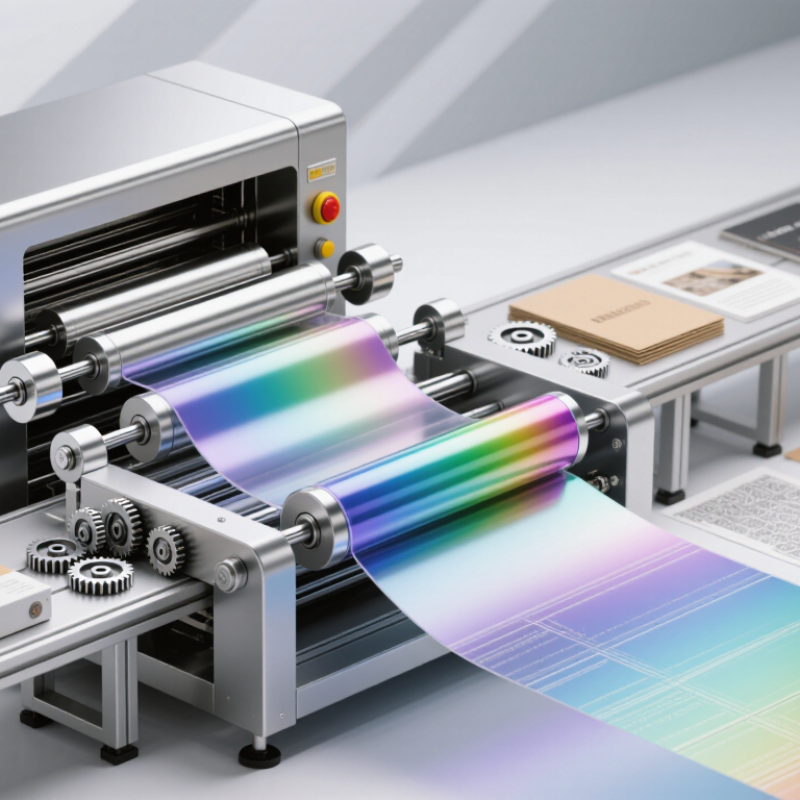
| Foiling Process | Hot foil stamping | Uses a heated die or plate, pressure, and dwell time to transfer a foil layer onto a substrate. Suitable for metallic, pigmented, and many holographic foils. | Choose this process when strong opacity, tactile effects, precise coverage, or compatibility with textured paper and board are important. |
| Foiling Process | Cold foil transfer | Uses adhesive printed or applied on the substrate before the foil is transferred. It normally operates without a heated stamping die. | Suitable for high-volume label and packaging production, fine graphic details, and inline integration with flexographic, offset, or digital printing systems. |
| Foiling Process | Embossed holographic transfer | Transfers a holographic structure that can produce depth, movement, diffraction, or changing visual effects when viewed from different angles. | Select this option for authentication features, decorative packaging, premium covers, security labels, and products requiring a noticeable optical effect. |
| Substrate Compatibility | Paper and paperboard | Common materials include coated paper, uncoated paper, folding carton board, and cover stock. Surface smoothness and coating affect transfer quality. | Verify the machine's pressure range, platen or cylinder format, and feeding system when producing cartons, book covers, invitations, certificates, or premium print products. |
| Substrate Compatibility | Plastic films and synthetic labels | Typical materials include PET, BOPP, PP, and other label films. Surface treatment and adhesive selection are important for reliable adhesion. | Choose a machine and foil system validated for the exact film, coating, ink, and adhesive combination. Testing is essential before production approval. |
| Production Format | Sheet-fed machine | Processes individual sheets. Common advantages include flexible job changes, accurate sheet handling, and suitability for short to medium runs. | A practical choice for commercial print, cartons, book covers, specialty stationery, and varied job sizes where flexibility is more important than continuous web production. |
| Production Format | Web-fed machine | Processes material from a continuous roll. It supports uninterrupted production and is commonly used with roll labels, flexible packaging, and narrow-web printing lines. | Select web-fed equipment for long runs, roll-based materials, inline printing, and reduced sheet handling. Confirm web tension and roll-width requirements. |
| Operating Speed | Short-run and specialty production | Typical output depends on format, foil coverage, substrate, die complexity, and operator setup. Mechanical speed alone should not be used to estimate sellable output. | Prioritize quick setup, recipe storage, low material waste, and accessible tooling when producing frequent small batches or customized work. |
| Operating Speed | High-volume production | Continuous-feed systems can reach substantially higher output than manually loaded sheet systems, but actual production speed is limited by registration, drying, cooling, foil release, and inspection. | Choose high-speed equipment only when the substrate, foil, artwork, and upstream or downstream equipment can maintain stable quality at the required rate. |
| Registration Accuracy | Basic registration control | Uses mechanical guides, marks, or operator adjustments. It can be adequate for larger foil areas and designs with less demanding alignment. | Suitable for general decorative work where small positional variation is acceptable and the production budget is limited. |
| Registration Accuracy | Automatic registration control | Uses sensors, printed marks, servo drives, or camera-based systems to compensate for web or sheet movement and improve foil-to-print alignment. | Recommended for fine text, security patterns, multilayer designs, labels, and packaging requiring consistent alignment across long production runs. |
| Holographic Effect | General diffraction pattern | Creates a visible color-shifting or rainbow-like effect under changing viewing angles. The final appearance depends on lighting, viewing direction, foil structure, and substrate color. | Suitable for decorative packaging, greeting products, promotional print, labels, and premium presentation materials. |
| Holographic Effect | Custom or registered holographic pattern | Uses a defined optical pattern or image that can be positioned relative to printed artwork. Tooling and cylinder or plate preparation may require additional time and cost. | Consider this option for brand protection, event credentials, certificates, high-value packaging, and products that need a distinctive visual or authentication element. |
| Foil Management | Single-roll foil feed | Simpler configuration with fewer adjustment points. It is generally easier to operate and maintain for one foil width or one primary design. | Appropriate for stable production schedules, limited product variation, and applications where minimum setup complexity is preferred. |
| Foil Management | Multiple-roll or variable foil feed | Allows more efficient use of foil across different image areas and may reduce unused foil. Configuration and control requirements are more complex. | Useful for diverse jobs, large foil areas, repeated designs, and production environments focused on reducing foil consumption and material waste. |
| Tooling and Pressure | Flatbed stamping unit | Applies pressure between a flat die and a counter surface. It supports clear coverage and is commonly used for sheet-fed products and relatively simple layouts. | Choose flatbed equipment for cartons, covers, cards, certificates, and jobs requiring strong decorative coverage or combined foil and embossing effects. |
| Tooling and Pressure | Rotary or cylinder-based unit | Uses rotating cylinders or rotary tooling for continuous production. It is well suited to web-fed materials and higher production volumes. | Recommended for labels, narrow-web packaging, continuous rolls, and inline production where stable web transport and repeatable registration are required. |
| Quality Control | Essential inspection functions | Check foil adhesion, pinholes, incomplete transfer, wrinkles, scratches, color consistency, registration, and edge definition. | Select equipment with accessible inspection points and practical sample-taking procedures. Automated vision inspection is valuable for security and high-volume applications. |
| Workflow Integration | Standalone machine | Operates as an independent finishing unit and usually offers greater flexibility for materials produced by different printing processes. | Suitable for job shops, specialty finishers, and operations with multiple printing technologies or changing production requirements. |
| Workflow Integration | Inline machine | Integrated with printing, coating, laminating, die-cutting, or converting equipment to reduce handling and support continuous production. | Choose inline integration when throughput, consistent registration, reduced manual handling, and streamlined roll-to-roll or sheet-to-sheet production are priorities. |
| Main Applications | PackagingLabels | Holographic foil can add shelf impact, decorative contrast, and visual differentiation to folding cartons, flexible packaging, and pressure-sensitive labels. | Confirm food-contact requirements, coating compatibility, rub resistance, die-cutting behavior, and the required level of registration before choosing the machine. |
| Main Applications | Security PrintingAuthentication | Optical patterns can make copying more difficult and can be combined with serial numbers, microtext, UV features, or other authentication methods. | Select a system capable of controlled registration, repeatable tooling, secure artwork handling, inspection, and documented process control. |
| Main Applications | BooksStationeryPremium Print | Common products include book covers, certificates, invitations, greeting cards, folders, and promotional materials. | A sheet-fed hot foil system is often appropriate when the work requires tactile decoration, variable job sizes, embossing, and frequent changeovers. |
| Cost and Efficiency | Total cost of ownership | Consider machine price, dies or cylinders, foil consumption, adhesive or coating, energy, compressed air, maintenance, operator time, waste, and finishing compatibility. | Compare the cost per saleable unit rather than only the purchase price. Request production samples using the actual substrate, artwork, and foil. |
| Final Selection Checklist | Recommended evaluation sequence | Define substrate, sheet or web format, foil coverage, holographic effect, target volume, registration requirement, changeover frequency, and downstream finishing steps. | Choose the machine that matches the complete workflow and validates quality at the required production speed, not simply the machine with the highest advertised speed. |

.svg)