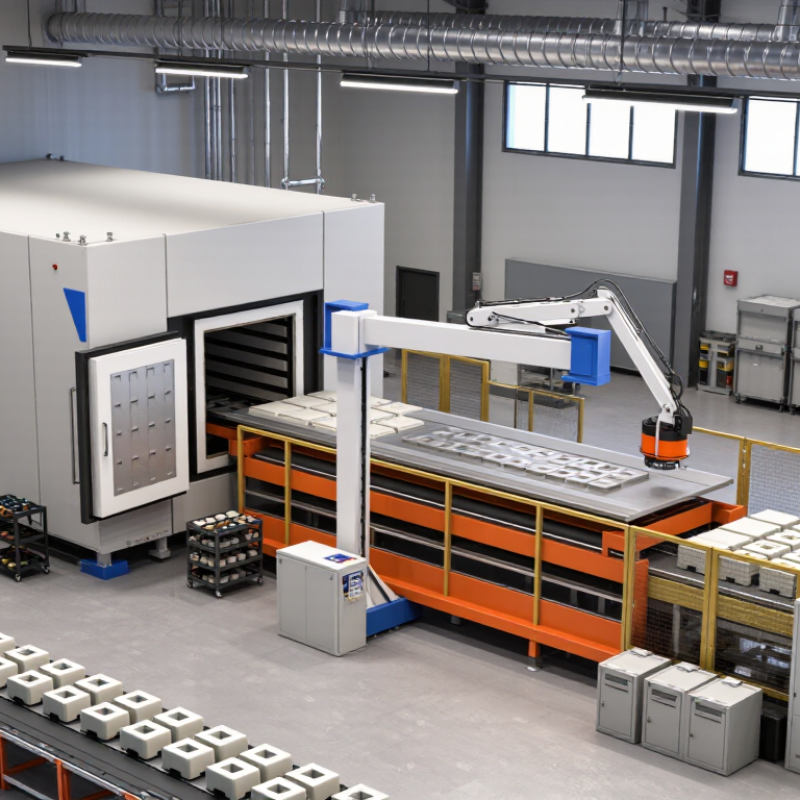
| Machine Configuration | Two independent shuttle stations with separate mold-loading and heating positions | Allows loading, unloading, cooling, and heating activities to overlap, improving utilization. | Review the machine layout, station travel path, interlocks, and maximum mold envelope. | 10% |
| Usable Mold Capacity | Select the platen and oven size from the largest planned mold, including clamps, vents, and clearance. | An undersized work envelope restricts future products; excessive size increases energy and capital cost. | Submit a dimensioned mold drawing and request a written confirmation of usable length, width, and height. | 10% |
| Heating and Temperature Control | Independent burner or electric-zone control, closed-loop temperature monitoring, and recipe storage. | Consistent heating affects wall thickness, warpage, cycle time, and scrap rate. | Request temperature uniformity data, thermocouple locations, control accuracy, and sample production results. | 12% |
| Automation and Process Records | PLC-based controls with recipe management, alarm history, cycle records, and user access levels. | Recorded process data supports repeatability, troubleshooting, audits, and operator training. | Confirm data export options, backup procedures, remote diagnostics, and cybersecurity responsibilities. | 8% |
| Installation and Commissioning | Defined scope covering delivery, positioning, utility connection, calibration, trial production, and operator training. | Unclear installation responsibilities can cause schedule delays and unexpected site costs. | Require a responsibility matrix, commissioning checklist, acceptance criteria, and training hours. | 10% |
| Warranty Coverage | A clearly defined parts and labor warranty, commonly covering at least 12 months after commissioning or 18 months after shipment. | The warranty period and exclusions directly affect early ownership risk. | Check coverage for heaters, drives, controls, sensors, labor, travel, and consequential damage. | 8% |
| Technical Support Response | Named support contacts, documented escalation routes, and remote troubleshooting during operating hours. | Fast diagnosis can reduce downtime when a control, drive, sensor, or burner fault stops production. | Request service-level targets for initial response, remote diagnosis, and on-site attendance. | 12% |
| Spare Parts Availability | Critical electrical, heating, motion, and safety components supported for the expected service life. | Long lead times for proprietary parts can create extended production interruptions. | Obtain a recommended two-year spare-parts list, typical lead times, interchangeability details, and obsolescence policy. | 10% |
| Energy Consumption | Compare measured energy per cycle or per finished part rather than heater nameplate power alone. | Heating efficiency, insulation, cycle duration, and cooling practice materially affect operating cost. | Request test conditions, utility assumptions, batch size, cycle time, and measured kWh or fuel usage. | 10% |
| Maintenance and Serviceability | Accessible components, lubrication points, preventive-maintenance schedules, and standard industrial components where practical. | Simple maintenance lowers labor cost and improves equipment availability over time. | Review maintenance intervals, replacement procedures, access clearances, and required technician skills. | 8% |
| Total Cost of Ownership | Evaluate purchase price, freight, installation, utilities, labor, maintenance, spare parts, downtime, and expected residual value. | The lowest purchase price may not provide the lowest cost per acceptable part. | Build a five- to ten-year TCO model using the same production volume and utility assumptions for every quotation. | 12% |

.svg)