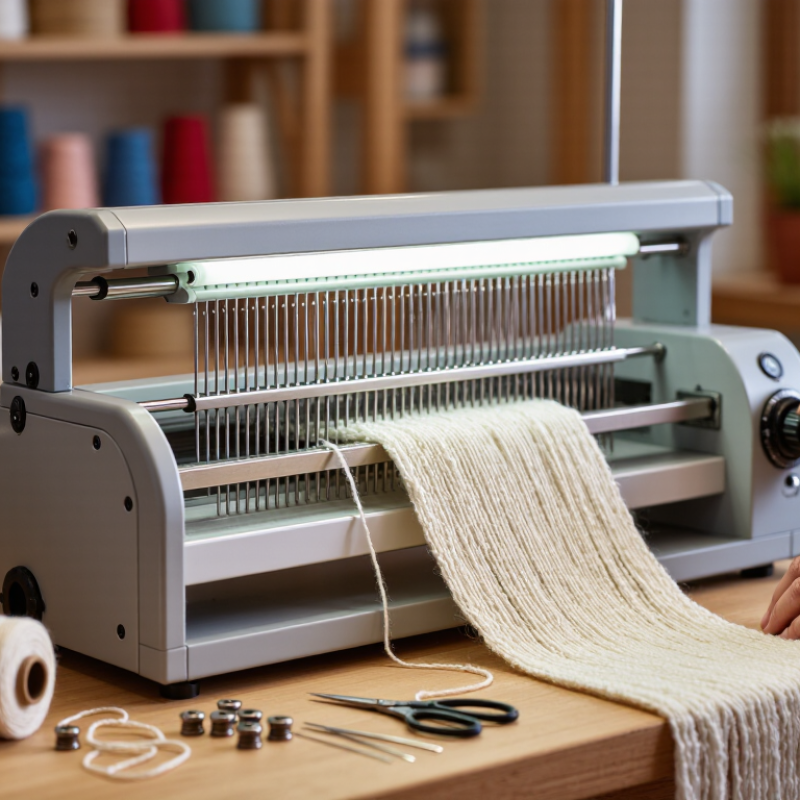
| Needle | Holds and moves the working yarn | Moves vertically through controlled paths in the needle bed | Positions the hook to receive, pull through, or release yarn | Creates one stitch position per active needle |
| Hook | Catches the yarn | Receives yarn while the needle rises or moves into knitting position | Forms the new loop that will be pulled through the previous loop | A new stitch is prepared for knitting |
| Latch | Controls access to the needle hook | Swings open when the hook picks up yarn and closes as the old loop passes over it | Allows the new loop to pass through while preventing the old loop from catching on the hook | A completed knit stitch |
| Needle Bed | Supports and aligns the needles | Keeps needles in evenly spaced channels | Maintains consistent stitch spacing across a row | Uniform fabric width and alignment |
| Cam System | Directs needle movement | Guides needle butts through shaped tracks as the carriage or cam assembly moves | Determines whether needles knit, tuck, slip, or remain inactive | Different stitch structures and pattern effects |
| Carriage | Moves the cam system across the needle bed | Travels from one side to the other and engages selected needles | Coordinates the timing of needle rise, yarn capture, and loop draw-through | One knitted row for each programmed or guided pass |
| Yarn Feeder | Presents yarn to the needles | Keeps the yarn near the needle hooks during carriage movement | Provides the strand needed to form each new loop | Continuous yarn feeding with controlled placement |
| Sinker or Holding Element | Stabilizes the fabric and loops | Holds down or supports the knitted edge while needles draw new loops | Helps prevent unintended lifting of existing stitches | More stable loop formation and fabric control |
| Tension System | Regulates yarn resistance | Applies controlled resistance as yarn travels toward the feeder | Influences how tightly each loop is drawn | Consistent stitch size and fabric density |
| Stitch Size Control | Sets the amount of yarn drawn into a stitch | Changes the depth or distance that needles travel during loop draw-through | Adjusts loop length and therefore fabric tightness | Smaller settings generally produce denser fabric; larger settings produce looser fabric |
| Knit Action | Forms a standard stitch | The needle rises, catches yarn, and draws the new loop through the old loop | Replaces the old loop with a new loop | A conventional knitted stitch |
| Tuck Action | Holds an additional yarn segment on a needle | The needle receives yarn without immediately drawing it through the existing loop | Builds extra yarn into the stitch structure | A thicker or more textured area |
| Slip Action | Moves a needle without forming a new loop | The existing loop remains on the needle while the needle passes through the operating path | Interrupts loop formation at selected positions | Patterned floats, textures, or color effects |
| Transfer Action | Relocates an existing loop | A loop is moved from one needle to another, often using coordinated needle positions | Changes stitch placement without necessarily adding a new loop | Shaping, openwork, cables, or decorative structures |

.svg)