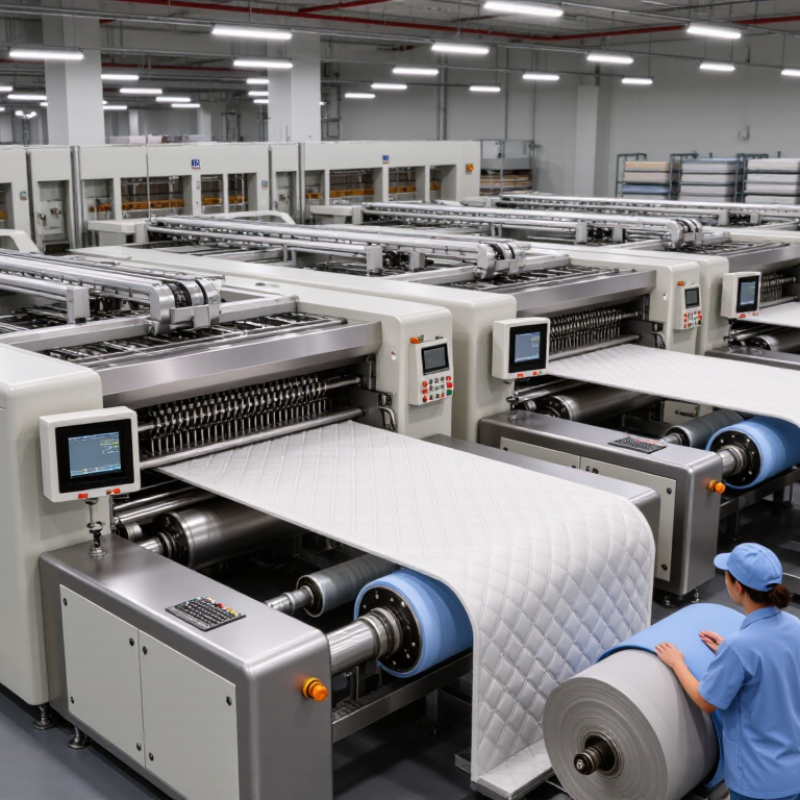
| Multi-Needle Lockstitch Quilting | Multiple parallel needles and bobbins create durable lockstitch quilting lines. | Approximately 2,450–3,200 mm | Approximately 2–8 mm | Commonly up to about 15–25 m/min, depending on pattern, material and machine design. | Mattress panels, borders, ticking fabrics and layered quilted covers. | Strong seam security, consistent stitch formation and broad material compatibility. | Requires correct needle, thread and bobbin-tension settings; thicker stacks reduce speed. |
| Chainstitch Multi-Needle Quilting | Needle-and-looper systems form continuous chainstitches across multiple lanes. | Approximately 2,450–3,200 mm | Approximately 3–8 mm | Often selected for continuous-line production where high throughput is required. | Large mattress panels, comforter-style ticking and continuous roll goods. | Efficient thread consumption and suitability for long, uninterrupted quilting runs. | The stitch can be more vulnerable to laddering if thread tension or fabric handling is incorrect. |
| Computer-Controlled Pattern Quilting | Servo-driven quilting head with digital pattern storage and programmable movement. | Approximately 2,450–3,200 mm | Typically programmable within about 2–8 mm | Output varies substantially with pattern complexity, stitch density and acceleration limits. | Geometric, diamond, wave, floral and customized mattress-cover patterns. | Fast pattern changeover, repeatability and reduced manual marking. | Requires operator training, digital pattern management and regular servo calibration. |
| Continuous Roll-to-Roll Quilting | Fabric, filling and backing are fed continuously through synchronized rollers. | Usually about 2,450–3,200 mm | Commonly about 3–8 mm | Designed for uninterrupted production; actual output depends on material thickness and quilting pattern. | Bulk mattress ticking, quilted rolls and high-volume bedding components. | Reduced handling, consistent fabric tension and improved line productivity. | Needs accurate edge alignment, synchronized feeding and adequate floor space. |
| Single-Piece CNC Quilting | A programmable frame or clamp holds individual panels while the quilting head follows a digital path. | Often up to approximately 2,000–2,800 mm | Approximately 2–8 mm | Generally slower than continuous systems but suitable for flexible, low-to-medium volume production. | Premium covers, smaller production batches and varied panel dimensions. | High design flexibility and reduced tooling requirements for pattern changes. | Panel loading and unloading can become the main production constraint. |
| Servo-Synchronized Feeding | Electronic motors coordinate fabric feed, needle motion and pattern positioning. | Available across narrow and full-width quilting platforms. | Supports programmable stitch lengths, commonly around 2–8 mm. | Improves repeatability rather than defining a fixed production rate. | Elastic ticking, multilayer assemblies and patterns requiring precise registration. | Reduces pattern distortion, fabric slippage and variation between production runs. | Performance depends on encoder accuracy, software settings and preventive maintenance. |
| Automatic Edge Alignment | Sensors or guided feeding systems maintain the position of fabric edges during quilting. | Configured according to the selected machine width. | Compatible with common stitch lengths of approximately 2–8 mm. | Helps maintain production consistency, especially on wide continuous materials. | Wide mattress ticking, border quilting and fabrics with controlled edge margins. | Improves pattern registration and reduces off-center quilting. | Sensors must be kept clean and calibrated for different fabric colors and surfaces. |
| Automated Layer Tension Control | Feed rollers, pressure systems or software adjustments control movement of fabric and filling layers. | Used on both panel and continuous-width equipment. | Usually adjustable to the selected quilting pattern and material stack. | Supports stable output when foam, fiberfill or multiple textile layers are combined. | Thick mattress panels, high-loft fiberfill and mixed-material assemblies. | Helps limit puckering, layer shifting and uneven compression. | Material thickness, compressibility and moisture can affect the required settings. |
| Integrated Cutting and Slitting | Quilting line includes downstream knives, slitters or cross-cutting equipment. | Cutting width is matched to the quilting line and mattress component dimensions. | Not applicable to cutting itself; quilting settings remain programmable. | Reduces separate cutting operations in high-volume roll production. | Pre-sized mattress panels, border strips and continuous quilted components. | Fewer handling steps, improved dimensional consistency and lower labor requirements. | Knife alignment, dust control and safe guarding are essential for reliable operation. |

.svg)