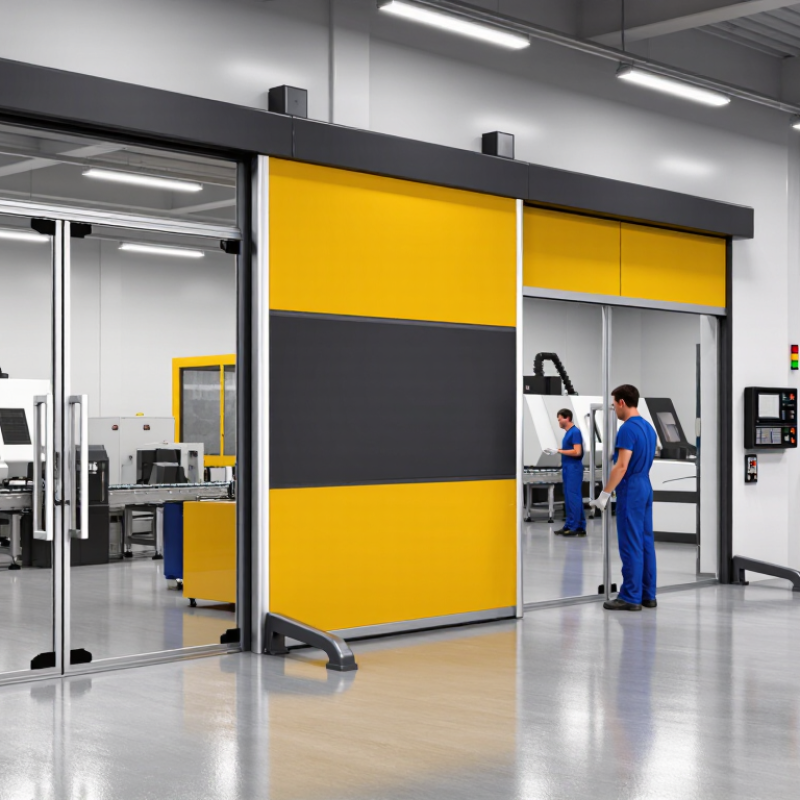
| Door panel | Solid sheet metal, mesh, or impact-resistant transparent panel | Separates people from hazardous machine areas while allowing access when needed. | The panel closes the access opening and forms part of the machine’s physical barrier. | Choose a construction that suits the hazard, visibility needs, environment, and required strength. |
| Frame and fixed guard structure | Steel or aluminum framing attached to the machine or floor | Supports the door and closes gaps around the access opening. | The frame holds the door in alignment and connects the movable guard to the surrounding fixed guard. | Check that the structure is secure and that openings do not provide unintended access to hazards. |
| Hinges or sliding guides | Hinges for swing doors; tracks or rollers for sliding doors | Allow controlled movement between the open and closed positions. | Hinges rotate the door; sliding guides constrain it to move along a defined path. | Inspect for looseness, wear, binding, and alignment that could prevent the door from closing fully. |
| Handle and latch | Manual handle with a mechanical catch or latch | Enable the user to operate the door and keep it closed during normal operation. | The latch holds the door against its frame; on an interlocked door, the safety function is provided by the interlock system, not by the handle alone. | Make the door easy to operate without encouraging users to bypass the guard or safety device. |
| Safety interlock switch or sensor | Mechanical, magnetic, or coded non-contact device | Detects whether the guard is closed and provides a signal to the machine’s safety control system. | When the door opens, the system is designed to initiate the required safe response, such as stopping hazardous motion. The switch or sensor is one part of that system. | Use a suitable safety-rated system and verify its operation as part of the machine’s risk assessment and validation. |
| Guard-locking device (where required) | Locking bolt or other controlled locking mechanism | Keeps the door closed while hazardous motion or another dangerous condition remains. | The lock prevents access until the safety control system permits release. Not every machine guarding door requires guard locking. | Consider the time needed for hazards to stop and whether access could occur before the danger has ended. |
| Safety control system | Safety relay, safety controller, and associated wiring or communications | Processes guard-device signals and controls the machine’s safety-related functions. | It evaluates the door status and triggers the configured response, which may include stopping the machine or preventing a start while the door is open. | Design and validate the complete safety function for the specific machine and hazard; a door sensor alone does not ensure a safe stop. |
| Fasteners and mounting hardware | Bolts, brackets, and other machine-compatible hardware | Secure the door, frame, and safety devices in their intended positions. | Stable mounting helps maintain alignment and reliable operation during repeated use. | Check for missing, loose, damaged, or substituted fasteners during inspection and maintenance. |

.svg)