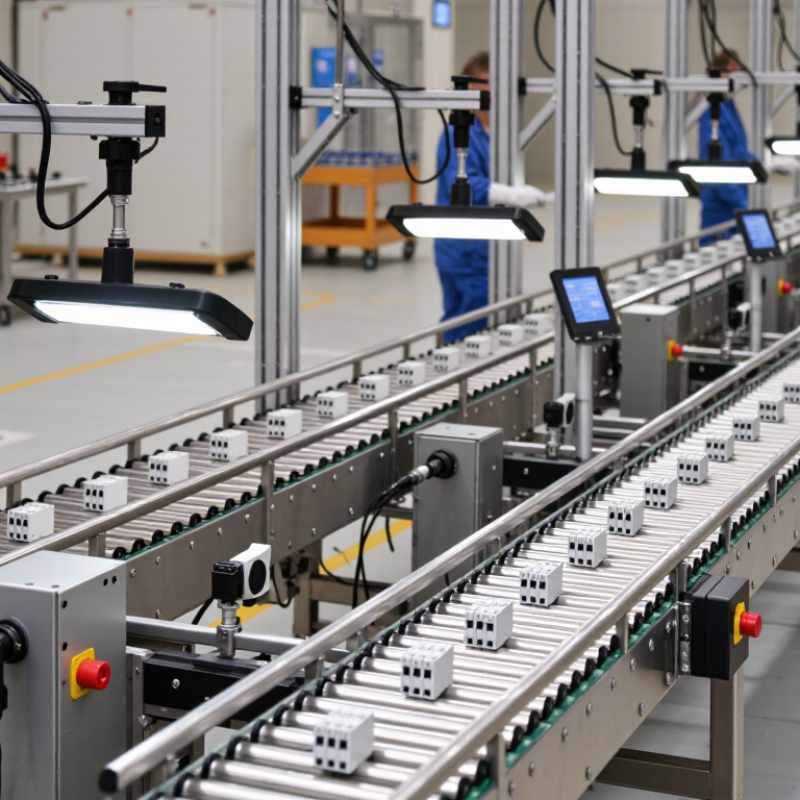
| Equipment Definition | A motor-driven conveyor system that transfers miniature circuit breakers (MCBs) between assembly, inspection, testing, marking, and packaging stations. | Provides controlled product movement and repeatable positioning for automated or semi-automated quality checks. |
| Products Handled | Single-pole, double-pole, triple-pole, and four-pole MCB assemblies, depending on the conveyor fixture and product family. | Changeover tooling may be required for different product widths, pole counts, terminal layouts, or housing dimensions. |
| Common Conveyor Type | Belt, chain, timing-belt, or palletized conveyor with dedicated nests or fixtures. | Palletized and fixture-based systems generally provide better orientation control for vision and electrical test stations. |
| Typical Conveyor Speed | Approximately 5–20 m/min for inspection lines; the final value depends on product size, station cycle time, and required test duration. | Speed must be synchronized with inspection exposure time, actuator response, and safe access requirements. |
| Positioning Accuracy | Typically designed within approximately ±0.5–1.0 mm at a dedicated inspection position, subject to fixture and sensor design. | Consistent positioning improves camera focus, terminal probing, actuator alignment, and repeatability of test results. |
| Product Orientation | The MCB is normally presented with a defined top, front, terminal, and handle orientation using guide rails, nests, or locating pins. | Prevents incorrect images, probe contact errors, reversed products, and missed visual defects. |
| Visual Inspection Points | Housing damage, cracks, flash, color variation, missing components, incorrect markings, handle position, terminal condition, and assembly completeness. | Camera inspection reduces dependence on manual visual checks and creates traceable pass/fail records. |
| Dimensional Inspection | Overall length, width, height, terminal spacing, mounting features, and critical assembly positions are checked against approved product drawings. | Confirms that the MCB can be installed correctly and remains compatible with its intended mounting system. |
| Electrical Inspection | Depending on the product specification, checks may include continuity, dielectric withstand, insulation resistance, contact resistance, and trip-function testing. | Electrical test parameters must be controlled according to the applicable product standard, approved test procedure, and rated design. |
| MCB Protection Functions | MCBs commonly use thermal protection for prolonged overcurrent and magnetic protection for high-current short-circuit conditions. | Inspection and testing help verify assembly quality, mechanism operation, and conformity with the specified trip characteristics. |
| Handle and Mechanism Check | The operating handle, toggle position, latch mechanism, and visual ON/OFF/TRIP indication are checked for correct movement and position. | Detects incomplete assembly, mechanical interference, incorrect indication, or excessive operating resistance. |
| Safety Guarding | Fixed guards, interlocked access doors, emergency-stop devices, electrical enclosures, and clearly identified hazardous zones. | Protects operators from moving parts, electrical test hazards, pinch points, and unexpected machine start-up. |
| Electrical Safety Controls | Protective earthing, overcurrent protection, residual-energy control, guarded test probes, and lockout/tagout procedures. | Electrical testing should be performed only with suitable safeguards, trained personnel, and verified test equipment. |
| Reject Handling | Rejects may be diverted into a locked or clearly identified bin using a pneumatic stop, servo actuator, or controlled chute. | Separates nonconforming products from accepted products and supports later root-cause analysis. |
| Traceability Data | Typical records include product type, lot or serial identifier, station result, test value, timestamp, operator or line ID, and reject reason. | Enables defect investigation, process capability monitoring, audit support, and controlled product release. |
| Throughput Calculation | Theoretical output is approximately 3,600 ÷ cycle time in seconds per product; practical output is lower because of stops, changeovers, rejects, and maintenance. | Station cycle time, conveyor pitch, and buffer capacity should be balanced to avoid bottlenecks. |
| Daily Maintenance | Remove dust and plastic debris, inspect guards and sensors, verify emergency stops, check product nests, and observe abnormal noise or vibration. | Routine checks reduce misfeeds, sensor faults, contamination-related defects, and unplanned downtime. |
| Periodic Maintenance | Inspect belt or chain tension, alignment, bearings, fasteners, drive components, pneumatic connections, cables, and calibration status. | Maintenance intervals should follow equipment condition, operating hours, manufacturer instructions, and site risk assessments. |
| Common Failure Modes | Product jams, belt tracking errors, sensor misalignment, fixture wear, camera contamination, probe wear, communication faults, and actuator failure. | Fault codes, inspection logs, and downtime records help identify recurring problems and prioritize corrective action. |
| Production Applications | Assembly-line transfer, in-process inspection, end-of-line testing, automatic marking, sorting, packing, and controlled buffer storage. | The conveyor connects separate operations into a repeatable production flow while reducing manual handling. |
| Key Performance Indicators | Throughput, first-pass yield, reject rate, false-reject rate, unplanned downtime, mean time between failures, and mean time to repair. | These indicators show whether the conveyor is improving quality, availability, and production consistency. |
| Design Consideration | Conveyor layout should provide adequate access, clear product flow, ergonomic loading, safe maintenance space, and suitable electrical-test separation. | A balanced design improves operator safety, inspection reliability, maintenance efficiency, and overall equipment effectiveness. |

.svg)