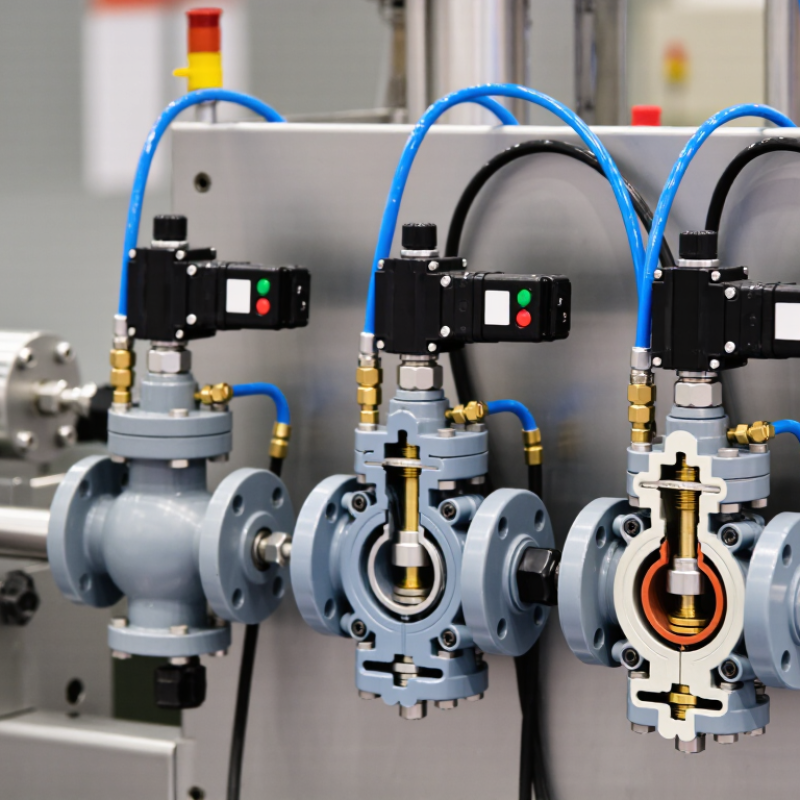
| Directional Control Valve | Directs compressed air to different passages in a pneumatic circuit. | The direction and movement of pneumatic cylinders or air motors. | An internal spool or poppet shifts to connect the supply, actuator, and exhaust ports. | 3/2, 4/2, or 5/2 ports; manually, mechanically, electrically, or pneumatically actuated. | Clamping, gripping, lifting, indexing, and automated motion. | Controls motion direction |
| Solenoid Valve | Uses an electrical signal to switch or regulate an air circuit. | Air flow, actuator operation, and machine sequencing. | An energized electromagnetic coil moves a plunger or pilot mechanism. | Normally closed, normally open, or multi-port designs. | Packaging equipment, assembly lines, and process automation. | Fast electrical control |
| Check Valve | Allows air to flow in one direction only. | Backflow and pressure separation between circuit sections. | Air pressure moves a poppet, ball, or disc away from its seat in the permitted direction. | Inline or angle-body construction. | Pressure-holding circuits, air reservoirs, and flow isolation. | One-way flow |
| Flow Control Valve | Restricts or adjusts the rate of compressed-air flow. | The extension and retraction speed of pneumatic actuators. | An adjustable needle changes the size of the flow passage; many designs provide one-way throttling. | Meter-in or meter-out configurations. | Speed control for cylinders and smooth machine movement. | Controls actuator speed |
| Pressure Regulator | Reduces and maintains downstream air pressure at a selected level. | The operating pressure and force available to downstream devices. | A spring-loaded diaphragm or piston balances downstream pressure against the adjustment setting. | Relieving or non-relieving designs. | Protecting components and setting different pressure zones. | Stabilizes pressure |
| Pressure Relief Valve | Releases air when pressure exceeds a preset limit. | Overpressure protection for pneumatic equipment and circuits. | A spring-loaded element opens when system pressure overcomes the preset force. | Adjustable or fixed pressure settings. | Receiver protection, branch circuits, and safety systems. | Limits overpressure |
| Quick Exhaust Valve | Exhausts air directly from an actuator near its port. | Actuator exhaust time and cylinder operating speed. | A diaphragm or poppet shifts to connect the actuator directly to atmosphere. | Usually installed between a directional valve and actuator. | High-speed cylinders and rapid return movements. | Speeds exhaust |
| Shuttle Valve | Provides an output from either of two pneumatic input signals. | Logic functions equivalent to an OR circuit. | An internal shuttle moves to block one input while connecting the other input to the output. | Two inputs and one output. | Dual-control circuits and alternative start signals. | Pneumatic OR logic |
| Two-Pressure Valve | Provides an output only when both input signals are present. | Logic functions equivalent to an AND circuit. | Internal elements permit output air only when pressure is applied at both inputs. | Two inputs and one output. | Two-hand controls and interlocking sequences. | Pneumatic AND logic |
| Proportional Valve | Adjusts air pressure or flow in proportion to an electrical command. | Actuator force, speed, position, or process pressure. | An electronic controller continuously varies the valve opening or regulated pressure. | Analog or digital command input with feedback options. | Precision motion, tension control, and process automation. | Fine variable control |

.svg)