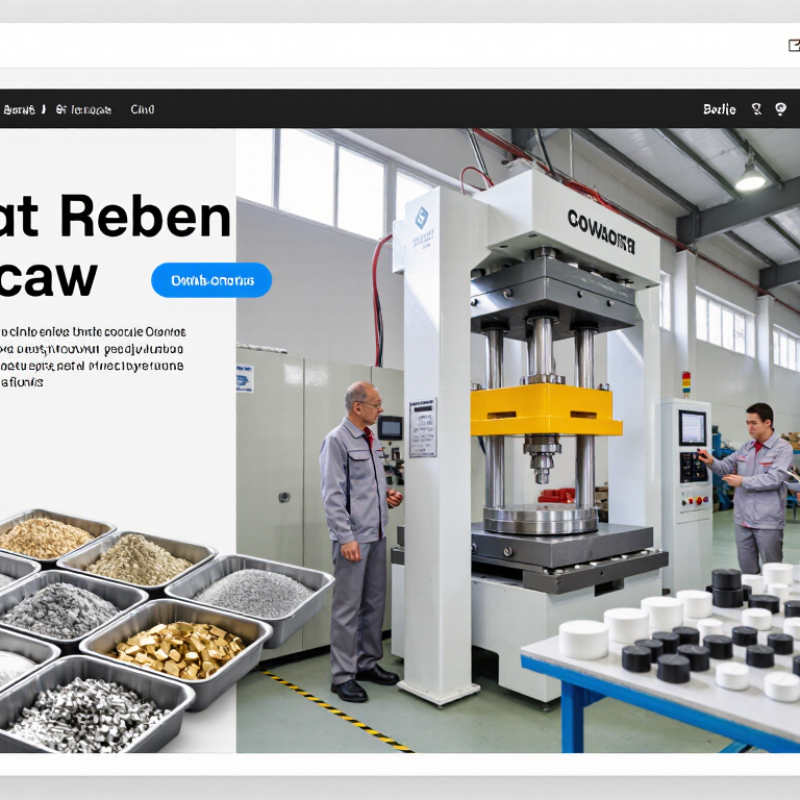
| Primary Function | Compact loose powder into a shaped green compact | A powder pressing machine applies controlled force through a die and punches to form a part before sintering, curing, or another finishing process. |
| Common Powder Materials | Metals, ceramics, graphite, carbides, and composite powders | The powder’s particle size, shape, flowability, moisture content, and lubrication strongly influence filling, compaction, and final density. |
| Main Machine Types | Mechanical, hydraulic, and rotary presses | Mechanical presses are suited to high-speed production, hydraulic presses provide flexible force and dwell control, and rotary presses support continuous multi-station production. |
| Powder Feeding | Gravity feed, shoe feed, or metered feeder | The feed system fills the die cavity with a controlled volume of powder. Consistent filling is essential for uniform part weight and density. |
| Die and Punch Assembly | Die cavity with one or more upper and lower punches | The die defines the outside shape, while the punches apply force and control the compact’s height, geometry, and ejection movement. |
| Typical Compaction Pressure | Approximately 50–1,000 MPa | The required pressure depends on the material, powder characteristics, part geometry, target density, and acceptable defect level. Actual settings must be established by process trials. |
| Press Force Capacity | From several tonnes to several hundred tonnes | Required force is determined by projected part area and compaction pressure. Larger parts and higher-density applications generally require greater press capacity. |
| Filling Stage | Die cavity is filled to a controlled height | The lower punch is positioned to create the required cavity volume, and the powder feed shoe or feeder transfers powder into the die. |
| Compaction Stage | Upper and lower punches move toward each other | Applied pressure rearranges particles, reduces voids, and creates interparticle bonding sufficient for handling the newly formed compact. |
| Dwell Time | Typically milliseconds to several seconds | A short hold at peak pressure can improve density uniformity and allow elastic deformation to stabilize. The correct time depends on the powder and part design. |
| Ejection Stage | Lower punch rises while the die or feed shoe withdraws | The formed compact is carefully pushed out of the die. Controlled ejection helps reduce cracking, chipping, and dimensional damage. |
| Green Compact | Pressed part before final thermal treatment | The green compact has sufficient strength for handling but normally has lower strength and density than the finished component. |
| Density Control | Controlled through pressure, fill height, punch movement, and powder preparation | Uniform density is important because density variations can cause shrinkage differences, cracking, distortion, and inconsistent mechanical properties during later processing. |
| Typical Production Rate | From a few parts per minute to several hundred parts per minute | Production speed varies with press type, part size, number of cavities, powder flowability, inspection requirements, and the time required for filling and ejection. |
| Key Process Variables | Pressure, fill depth, punch speed, dwell time, lubrication, and ejection force | These variables are adjusted to achieve the required dimensions, density distribution, surface quality, production rate, and green strength. |
| Typical Applications | Gears, bushings, filters, cutting inserts, magnets, wear parts, and ceramic components | Powder pressing is useful for producing repeatable shapes with efficient material utilization and limited machining after pressing. |
| Post-Press Operations | Sintering, debinding, curing, sizing, impregnation, or machining | The selected secondary operation depends on the powder system and required final properties. Thermal treatment commonly increases strength and reduces residual porosity. |

.svg)