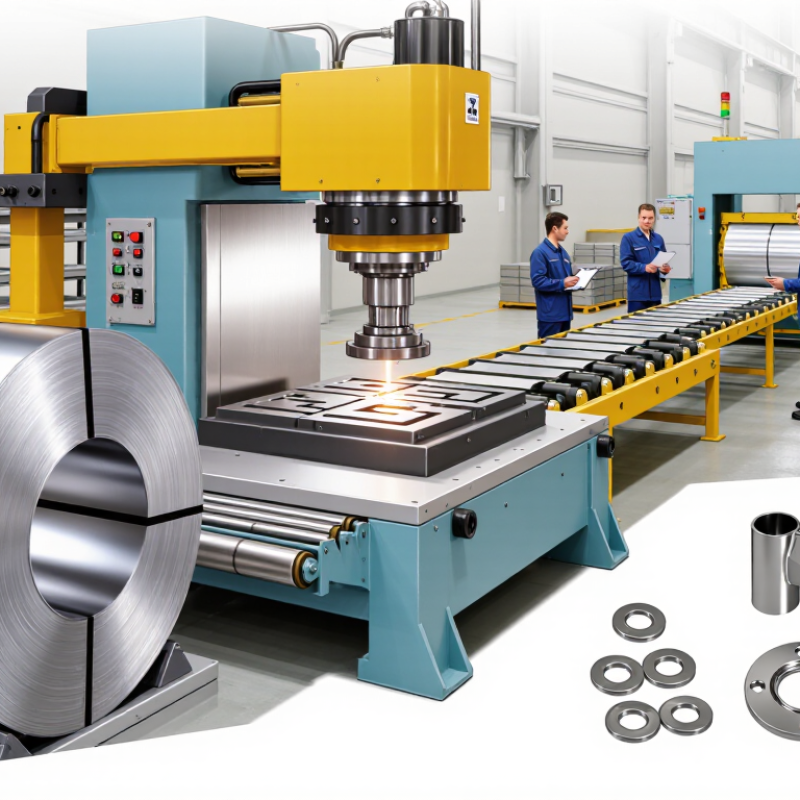
| Definition | Stainless steel stamping is a cold-forming process that uses a press, dies, and controlled force to cut or shape stainless steel sheet, strip, or coil. | Flat blanks can be transformed into two-dimensional or three-dimensional components without melting the material. | Supports repeatable production of accurate metal parts at medium and high volumes. |
| Basic Operating Principle | A punch moves the stainless steel into or through a die. The clearance and tool geometry determine the cut or formed shape. | The operation may include punching, blanking, bending, drawing, embossing, or coining. | Combines forming and cutting operations in a controlled manufacturing sequence. |
| Material Feed | Material may be supplied as individual sheets, narrow strips, or coil stock and positioned manually or by an automated feeder. | Progressive-die lines commonly feed coil stock through multiple stations. | Automated feeding improves throughput and part-to-part consistency. |
| Blanking | Blanking cuts a desired outer profile from sheet or strip, while punching creates internal holes or openings. | Washers, brackets, discs, mounting plates, and perforated panels. | Produces repeatable profiles and openings with minimal secondary cutting. |
| Bending and Forming | The sheet is bent or formed around a die to create angles, channels, ribs, flanges, or other contours. | Clips, covers, brackets, supports, and structural housings. | Adds rigidity and functional geometry without joining multiple pieces. |
| Deep Drawing | A flat blank is drawn into a die to create a hollow part. Multiple drawing stages may be used for deeper shapes. | Cups, cans, housings, containers, sinks, and cylindrical or box-shaped shells. | Creates seamless hollow forms with reduced assembly requirements. |
| Embossing and Coining | Embossing raises or recesses features, while coining applies high localized pressure to improve detail or flatten selected areas. | Identification marks, stiffening ribs, locating features, and detailed impressions. | Improves part identification, stiffness, alignment, or surface detail. |
| Common Stainless Steel Grades | Austenitic, ferritic, and other stainless steel families may be selected according to corrosion resistance, strength, formability, and magnetic requirements. | Common examples include 304 for general corrosion resistance, 316 for improved resistance in chloride-bearing environments, and 430 for ferritic applications requiring moderate corrosion resistance and magnetic response. | Material selection aligns the part with its environment, forming demands, and service requirements. |
| Typical Products | Stamped stainless steel components are used where corrosion resistance, cleanliness, durability, or dimensional repeatability is important. | Electrical enclosures, appliance panels, automotive brackets, medical instrument components, kitchen hardware, filters, clips, terminals, and fastener-related parts. | Supports applications across industrial, transportation, medical, food-service, construction, and consumer equipment sectors. |
| Production Methods | The principal methods include single-hit stamping, progressive-die stamping, transfer stamping, and deep-draw stamping. | Progressive dies perform several operations in sequence; transfer systems move separate blanks between stations. | The method can be matched to part size, geometry, production volume, and allowable tooling investment. |
| Primary Benefits | Stamping offers high repeatability, efficient material usage, fast cycle times, and the ability to produce complex shapes. | Large quantities of uniform components can be produced after the tooling has been developed and validated. | Can reduce labor per part, assembly steps, and unit cost in suitable production programs. |
| Material Performance | Stainless steel provides useful corrosion resistance, strength, durability, and a cleanable surface when the correct grade and finish are selected. | Components can remain functional in humid, corrosive, or high-cleanliness environments, subject to grade and service conditions. | May extend service life and reduce replacement or maintenance requirements. |
| Quality Control | Inspection commonly covers dimensions, hole position, burrs, cracks, surface condition, flatness, and formed geometry. | Tools may include gauges, coordinate measurement equipment, optical inspection, and visual checks. | Helps verify that parts meet engineering drawings and functional requirements. |
| Design Considerations | Designers should account for bend radii, material direction, springback, draw depth, hole spacing, edge distance, burr direction, and access for tooling. | Poorly positioned holes, sharp internal corners, or overly deep forms can increase cracking, distortion, or tooling wear. | Early design-for-manufacturing review improves manufacturability and reduces tooling changes. |
| Potential Limitations | Tooling can require significant upfront cost, and stainless steel may demand careful lubrication, die clearance, and control of work hardening. | Small production runs or highly customized parts may not achieve the same economic advantage as stable, repeated production. | A cost and feasibility review is important before committing to dedicated stamping dies. |
| Post-Stamping Operations | Secondary operations may include deburring, cleaning, heat treatment, welding, tapping, polishing, passivation, or assembly. | Finished parts may receive edge treatment, joining features, or surface conditioning before shipment or assembly. | Completes functional and surface requirements that cannot be achieved in the stamping operation alone. |

.svg)