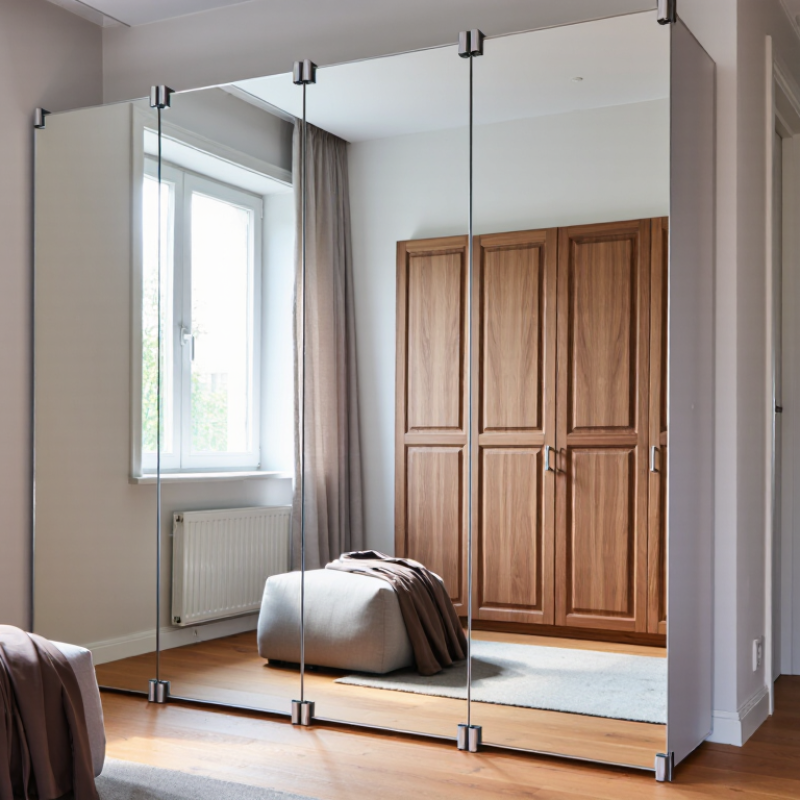
| Meaning | One large freestanding mirror or several tall mirrors arranged together | Creates a full-length reflective surface without necessarily covering an entire wall | Unlike a wall-mounted mirror, a freestanding unit needs a stable base or an appropriate anti-tip restraint. |
| Single full-length design | One rectangular mirror in a floor-standing frame | Commonly around 150–180 cm tall and 40–80 cm wide; actual sizes vary by model | Requires enough floor space for the frame and, if it leans, clearance behind it. |
| Multi-panel arrangement | Two or more tall panels placed side by side | Can create a wider reflection for dressing areas, studios, or shared spaces | Panel alignment and secure support are important; gaps or angled panels can distort the reflected view. |
| Pivoting design | Mirror mounted between two supports on a rotating or tilting frame | Allows the viewing angle to be adjusted; some designs include a storage base | Check that the pivot locks or stays stable at the desired angle. |
| Leaning design | Tall framed mirror that rests against a wall | Often has a simple frame and a broad reflective area | Use an anti-tip strap or other suitable restraint, especially in homes with children or pets. |
| Frame materials | Wood, metal, plastic, or frameless edge treatments | Wood offers a warm appearance; metal can provide a slim profile; plastic is generally lightweight | Choose a finish suited to the room’s humidity and the amount of handling the mirror will receive. |
| Mirror glass and backing | Reflective glass, sometimes with a safety backing film | Glass thickness and backing vary by product and size; safety film can help hold fragments together if glass breaks | Look for product-specific safety information, and handle or move large glass panels with care. |
| Base and support | Hinged easel stand, fixed feet, weighted base, or wall restraint | The support must be appropriate for the mirror’s height and weight | Place the mirror on a level surface and follow the manufacturer’s assembly and securing instructions. |
| Typical uses | Bedrooms, dressing rooms, dance or fitness spaces, and retail fitting areas | Useful for checking a full outfit or reflecting light around a room | Keep the reflective surface clear of direct impacts and avoid placing it where it blocks a walkway. |

.svg)