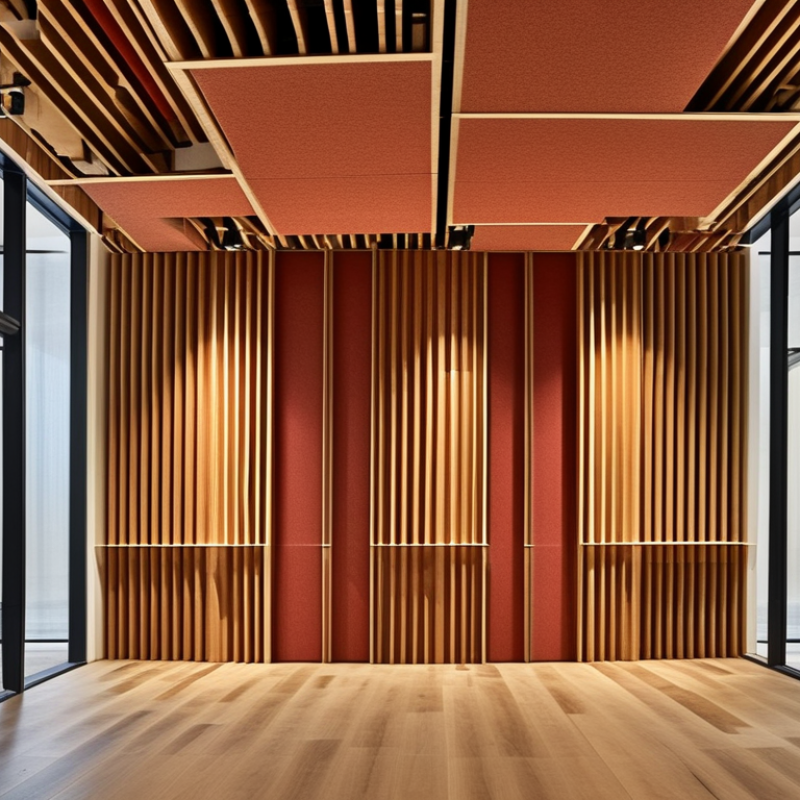
| Product type | Decorative acoustic slat panel | A wall or ceiling panel combining narrow decorative slats with an acoustically absorptive backing layer. |
| Visible slats | MDF, plywood, or solid wood veneer-faced strips | The slats create the linear architectural appearance and provide a durable substrate for the rosewood-style surface finish. |
| Rosewood-style finish | Printed wood grain, engineered veneer, or decorative laminate | Designed to reproduce the reddish-brown color, darker grain lines, and tonal variation associated with rosewood without requiring solid rosewood construction. |
| Core board | Medium-density fiberboard or comparable engineered wood | Provides dimensional stability, consistent machining, and a smooth surface for coating or veneer application. |
| Acoustic backing | Polyester fiber, mineral wool, or recycled fiber board | The porous backing absorbs a portion of incident sound energy and reduces reflections from hard wall surfaces. |
| Common overall thickness | Approximately 20–25 mm | The final thickness depends on the slat depth, backing board thickness, and whether an additional mounting layer is included. |
| Slat width | Approximately 25–40 mm | Narrower slats create a finer rhythm, while wider slats produce a stronger and more prominent linear pattern. |
| Open-joint spacing | Approximately 10–15 mm | The gaps expose portions of the acoustic backing and allow sound to reach the absorptive layer. |
| Standard panel size | Commonly about 2400 × 600 mm | Other dimensions can be manufactured, but the actual panel size should be confirmed before layout planning and installation. |
| Acoustic performance | Often approximately NRC 0.45–0.85 | Performance varies significantly with backing material, cavity depth, mounting method, room conditions, and test standard. A laboratory report is required for a verified rating. |
| Sound absorption principle | Porous absorption behind spaced slats | Sound enters the joints, travels through the air gaps, and is dissipated as it passes through the fibrous or porous backing. |
| Surface protection | Clear lacquer, water-based coating, UV coating, or laminate overlay | The protective layer helps resist abrasion, staining, and color change. It does not make the panel suitable for prolonged outdoor exposure unless specifically rated. |
| Color appearance | Warm reddish-brown to deep brown | Color may differ between printed finishes, engineered veneers, and natural wood veneers. Samples should be reviewed under the intended lighting. |
| Typical applications | Offices, meeting rooms, hospitality interiors, home theaters, studios, and living spaces | Suitable for interior feature walls and ceilings where visual warmth and reverberation control are both required. |
| Installation method | Adhesive, screws, clips, or battens | The fixing method depends on the substrate, panel weight, access requirements, and whether an air cavity is needed to improve low-frequency absorption. |

.svg)