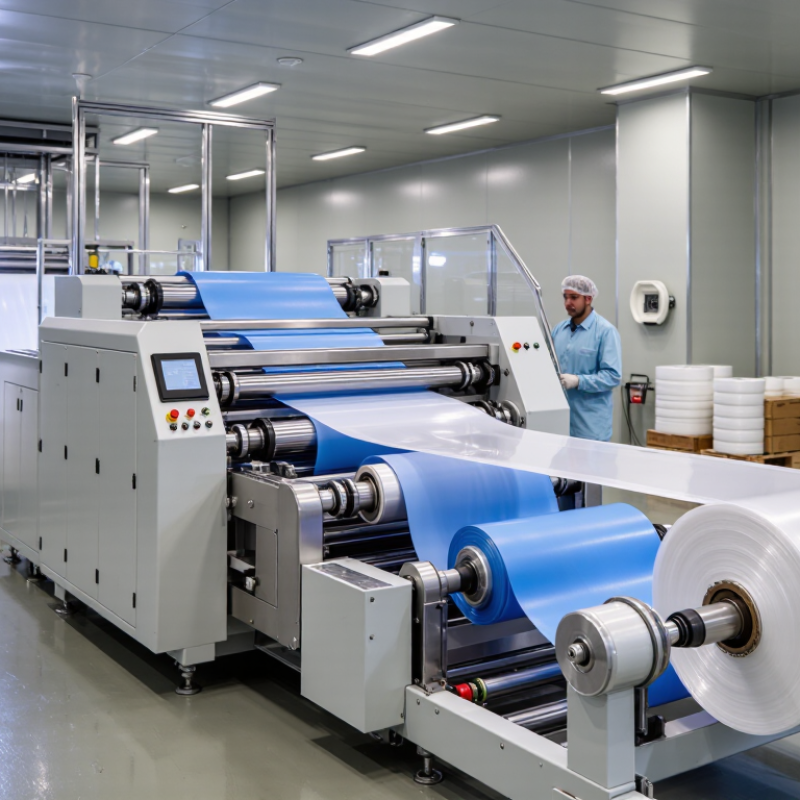
| 1 | Hot-Melt Web and Film Laminator | Nonwoven PP PET spunbond Glass fiber | EVA hot-melt film
Polyamide hot-melt film
Reactive polyurethane film | Filter media to support layer, scrim, foam, or protective facing | Heated nip lamination with pressure-controlled rollers | Web width: approximately 300–2,000 mm
Line speed: approximately 5–60 m/min
Bonding temperature: commonly 80–180°C, depending on adhesive | HVAC panels, cabin-air filters, prefilters, industrial dust filters | Check adhesive coat weight, open time, thermal damage risk, and release-liner handling. |
| 2 | Hot-Melt Spray Lamination Line | Meltblown PP Spunbond PP Synthetic fiber media | EVA hot-melt
APAO hot-melt
Pressure-sensitive hot-melt | Distributed adhesive layer between porous filter webs | Slot, spiral, or fiberized spray application followed by nip bonding | Web width: approximately 400–2,400 mm
Line speed: approximately 10–120 m/min
Adhesive add-on: often controlled in the low-to-medium g/m² range | Air-filtration rolls, surgical-mask media assemblies, disposable filter composites | Evaluate spray uniformity, overspray control, adhesive viscosity, and media pressure drop. |
| 3 | Ultrasonic Filter-Media Laminator | PP nonwoven PET nonwoven Composite laminates | No added adhesive in many designs
Thermoplastic bonding layer when required | Thermoplastic media-to-media or media-to-frame contact points | High-frequency mechanical vibration creates localized melt bonds | Frequency: commonly around 20–35 kHz
Bond width: generally localized rather than full-area
Suitable for intermittent or continuous web bonding | Face masks, compact air filters, edge sealing, separator attachment | Best for thermoplastic components; control horn pressure, amplitude, energy, and dwell time. |
| 4 | Thermal Calender Laminator | Thermoplastic nonwoven Bicomponent fiber web Polyester media | No separate adhesive when fibers are thermally bondable
Low-melt powder or web may be added if necessary | Fiber-to-fiber consolidation or media-to-carrier bonding | Heated engraved or smooth rollers apply heat and pressure | Web width: approximately 500–3,200 mm
Line speed: approximately 10–150 m/min
Temperature: commonly 90–220°C | Prefilters, automotive intake media, protective layers, dust-collection media | Consider basis weight, embossing pattern, porosity retention, nip pressure, and roller temperature. |
| 5 | Pleat-Creasing and Hot-Melt Bead Lamination Machine | Synthetic meltblown Glass-fiber paper Cellulose filter paper | EVA or polyolefin hot-melt beads
Polyurethane hot-melt for selected applications | Pleat separators, support mesh, or adjacent pleat surfaces | Pleating followed by controlled adhesive-bead dispensing and setting | Pleat height: commonly 10–80 mm
Adhesive bead diameter: often approximately 0.5–3 mm
Output depends on pleat pitch and filter length | Panel filters, cartridge filters, automotive air filters, HEPA-style modules | Verify bead placement, separator spacing, pleat stability, and adhesive compatibility with the media. |
| 6 | Membrane-to-Support Lamination Machine | PTFE membrane PES membrane PVDF membrane Polypropylene support | Acrylic pressure-sensitive adhesive
Polyurethane adhesive
Thermoplastic adhesive film | Microporous membrane to nonwoven, mesh, or porous backing | Low-tension web handling with controlled nip pressure and optional heat | Web width: approximately 200–1,600 mm
Line speed: approximately 1–40 m/min
Low web tension is used to protect fragile membranes | Water-treatment cartridges, laboratory filtration, sterile vent filters, gas filtration | Prioritize pore protection, extractables, chemical resistance, dimensional stability, and cleanroom suitability. |
| 7 | Solvent-Based or Water-Based Adhesive Coating Laminator | Cellulose paper Glass fiber paper Polyester fabric | Water-based acrylic
Solvent-based polyurethane
Acrylic or rubber pressure-sensitive adhesive | Continuous adhesive film between filter media and carrier layers | Gravure, reverse-roll, knife-over-roll, or slot-die coating followed by drying | Coating width: approximately 300–2,000 mm
Line speed: approximately 5–80 m/min
Drying temperature depends on solvent or water removal requirements | Industrial liquid filters, composite air media, protective filter laminates | Assess drying capacity, VOC controls, residual moisture, adhesive migration, and coating-weight accuracy. |
| 8 | Impulse Heat-Sealing and Edge-Lamination Machine | PP nonwoven PE film Thermoplastic mesh | No added adhesive for compatible thermoplastics
Heat-sealable coating or film where required | Perimeter seams, pockets, sleeves, and edge reinforcements | Heated sealing bars or impulse wires apply localized heat and pressure | Seal width: commonly 2–20 mm
Cycle time: typically fractions of a second to several seconds
Suitable for cut-sheet or assembled filter parts | Bag filters, dust bags, respirator components, disposable filter packs | Control seal temperature, pressure, dwell time, cooling, and seam peel strength. |
| 9 | Rotary Screen Adhesive Printing Laminator | Nonwoven media Filter paper Foam support Mesh | Hot-melt adhesive
Water-based acrylic
Reactive polyurethane adhesive | Patterned adhesive bonding between media and reinforcement layers | Rotary screen printing deposits dots, lines, or grid patterns before nip bonding | Pattern width: approximately 300–1,800 mm
Line speed: approximately 5–60 m/min
Pattern open area is adjusted to balance bond strength and airflow | Air filters, acoustic filter composites, separator-backed media | Compare pattern repeatability, adhesive penetration, open area, and pressure-drop impact. |
| 10 | Continuous RF or Dielectric Laminator | PVC-coated filter fabrics TPU films PU-coated textiles | Thermoplastic coating already present on the substrate
TPU or PVC bonding film | Thermoplastic-coated fabric to film, seam, or reinforcement layer | Radio-frequency energy heats polar thermoplastic layers for localized bonding | Bonding frequency: commonly in the industrial RF range near 27 MHz
Bond width: commonly 2–30 mm for seams or patterned areas
Best suited to RF-responsive thermoplastics | Reusable industrial filter bags, coated technical textiles, liquid-filter housings and sleeves | Confirm dielectric compatibility, electrode design, field uniformity, safety shielding, and seam strength. |

.svg)