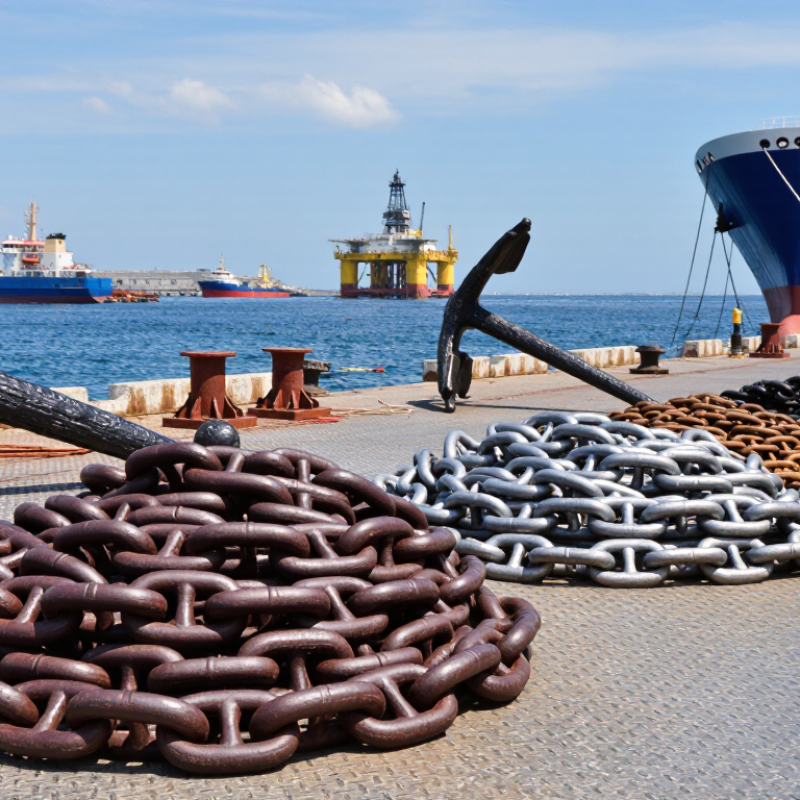
| Stud-link chain | Each link has a crossbar, or stud, across its center. Commonly supplied in calibrated sizes for windlasses. | Commercial ships, larger vessels, and many offshore applications. | The stud helps the link retain its shape under load and reduces the risk of link deformation. Widely used in vessel anchoring systems. | Confirm the chain diameter, grade, certification, and calibration match the windlass and the vessel’s equipment requirements. |
| Studless chain | Links have no crossbar. Strength, weight, and dimensions depend on the specified standard and chain grade. | Selected marine mooring systems and applications where a studless design is specified. | A simpler link form can be useful where the system is designed around studless chain. | Do not assume it is interchangeable with stud-link chain. Check the required breaking load, connection hardware, and windlass compatibility. |
| Short-link calibrated chain | Shorter links made to specified dimensions; calibrated versions are intended to engage compatible windlass gypsies. | Small craft and yachts equipped with a chain windlass. | Designed for consistent engagement with a matching gypsy and commonly used in anchor rodes. | Standards and dimensions vary. Match the chain to the gypsy specification rather than relying on nominal diameter alone. |
| Long-link chain | Uses longer links than short-link chain and is generally supplied for applications that do not require a short-link windlass profile. | Some small-vessel anchor rodes or general-purpose marine uses without a chain gypsy. | Can be suitable for simple systems where the chain is handled without a windlass gypsy. | Often will not run correctly through a short-link chain gypsy. Verify handling equipment and rated capacity before use. |
| High-strength chain | A strength category, not a link shape. Available in different configurations and grades; designations depend on the applicable standard. | Vessels needing a specified strength-to-weight performance, when permitted by the equipment design. | May provide a higher rated strength for a given chain size compared with lower-strength options, depending on the grade and standard. | Check the exact grade, proof and breaking-load data, certification, and windlass approval. A higher-strength chain is not automatically compatible with existing equipment. |
| Stainless-steel chain | Chain made from corrosion-resistant stainless steel; link form and mechanical properties vary by product and specification. | Some smaller vessels and applications where appearance or corrosion resistance is a priority. | Can offer good resistance to corrosion in suitable marine conditions. | Corrosion resistance does not determine strength. Verify alloy, rated load, inspection requirements, and compatibility with the anchor system; stainless chain may cost more than galvanized alternatives. |

.svg)