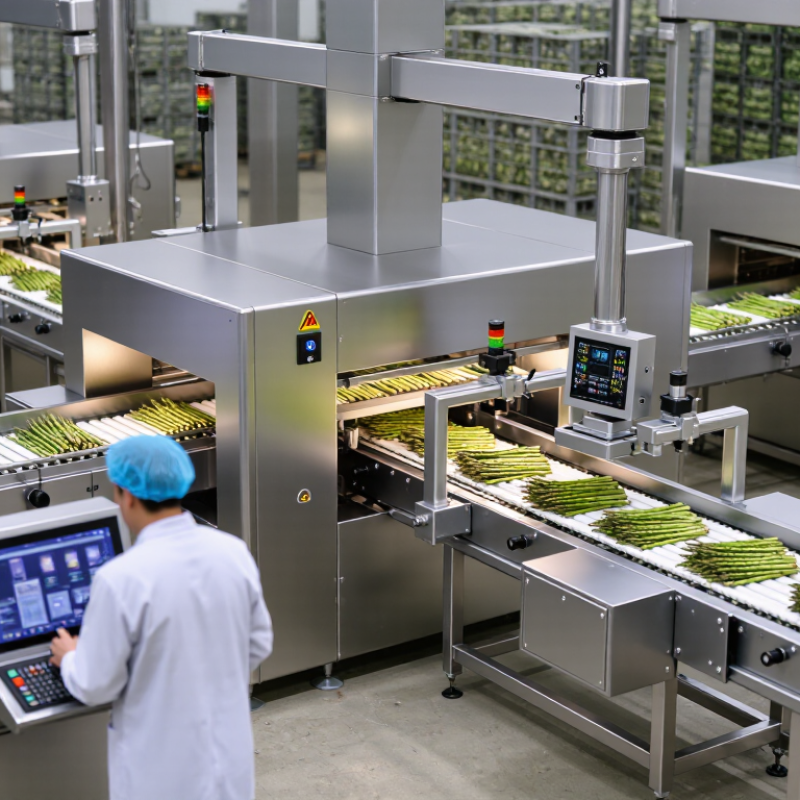
| Applications | Incoming raw asparagus inspection | Detection of foreign material, soil, stones, leaves, damaged pieces, and severe discoloration | Reduces manual inspection workload before grading and packing |
| Color sorting | Separates green, pale, purple, yellowed, and visibly brown asparagus according to configured color thresholds | Supports consistent product grades and improves pack appearance |
| Defect and quality sorting | Typical defects include broken tips, open tips, mold, bruising, excessive curvature, thin sections, and mechanical damage | Helps protect premium grades from contamination by lower-quality pieces |
| Size and diameter grading | Common commercial groups may include thin, medium, and thick stalks; exact limits should follow the buyer’s specification | Improves pack uniformity and simplifies pricing by grade |
| Final packing-line verification | Checks visible defects and grade consistency after trimming, washing, or bundling | Provides an additional quality-control checkpoint before shipment |
| Sorter Configuration | Inspection technology | Visible-spectrum cameras are commonly used for color and surface defects; near-infrared or multispectral sensing may assist with selected foreign-material or quality applications | The sensor package should match the defect types, product color, and moisture condition |
| Feeding method | Belt, chute, or roller feeding; controlled spacing and stable product orientation improve image quality | Poor alignment or overlapping stalks can reduce recognition accuracy |
| Nominal throughput | Often specified by the equipment supplier in kilograms per hour or pieces per minute; actual capacity depends on stalk size, spacing, defect rate, and sorting criteria | Request a throughput test using the buyer’s own asparagus samples rather than relying only on catalog figures |
| Ejection mechanism | Air-jet ejection is widely used for lightweight food products; mechanical gates may be used in certain grading layouts | Ejection timing and air pressure affect good-product loss and defect removal efficiency |
| Product condition | Fresh, clean, and consistently oriented asparagus generally provides more stable results than wet, muddy, or heavily overlapping product | Pre-cleaning, dewatering, and singulation may be needed before optical inspection |
| Control system | Recipe-based settings, touchscreen operation, defect libraries, sensitivity adjustment, and production statistics are common requirements | Simple recipe changeover helps operators manage different varieties, seasons, and customer specifications |
| Maintenance | Daily cleaning | Remove asparagus residue, dust, soil, and water from belts, chutes, guards, reject channels, and accessible optical windows after each production shift | Residue and water droplets can obstruct sensors and cause unstable classification |
| Camera and lighting inspection | Check lens covers, protective glass, LED illumination, image uniformity, and focus according to the maintenance manual | Clean and stable imaging is essential for detecting subtle color and surface differences |
| Air system service | Inspect compressor output, filters, regulators, tubing, valves, and nozzle blockage; use dry, filtered compressed air | Unstable pressure or blocked nozzles can cause missed rejects or excessive good-product ejection |
| Conveyor and mechanical parts | Check belt tracking, tension, rollers, bearings, fasteners, guards, and product-contact surfaces at scheduled intervals | Mechanical vibration and irregular feeding can reduce sorting consistency |
| Calibration and recipe verification | Verify calibration after cleaning, component replacement, software updates, or major changes in product condition | Prevents gradual drift in color thresholds, defect recognition, and ejection timing |
| Hygiene and safety | Use food-processing-compatible materials and cleaning procedures; isolate power and compressed air before servicing | Supports food safety, operator safety, and compliance with the facility’s sanitation program |
| Buying Considerations | Sample testing | Provide representative samples covering different varieties, sizes, colors, moisture levels, and defect types | A sample test is the most reliable way to assess detection, throughput, and good-product retention |
| Performance indicators | Evaluate defect removal rate, false-reject rate, good-product recovery, repeatability, and actual throughput | A high nominal capacity is not sufficient if product loss or missed defects is excessive |
| Line integration | Confirm compatibility with washers, dewatering units, graders, conveyors, weighing systems, packing machines, and reject collection | Correct infeed and discharge design prevents bottlenecks and product damage |
| Cleaning and environmental rating | Check enclosure protection, washdown limitations, corrosion resistance, drainage, and approved cleaning chemicals | The correct protection level depends on whether the sorter is installed in a dry, damp, or washdown area |
| Utilities | Confirm electrical supply, compressed-air quality and consumption, operating temperature, floor space, and required clearance | Utility mismatches can prevent stable operation and increase installation costs |
| Service and spare parts | Ask about response time, remote support, technician availability, recommended spare parts, software support, and training | After-sales capability directly affects seasonal uptime and maintenance cost |
| Total cost of ownership | Consider purchase price, installation, integration, compressed-air use, labor savings, maintenance, spare parts, downtime, and expected service life | The lowest initial price may not provide the lowest long-term cost per sorted kilogram |

.svg)