| Tabletop glass type | Tempered safety glass should be specified for most dining, occasional, and coffee tables. Typical tabletop thickness is approximately 8–12 mm, depending on size, support structure, and design. | Tempered glass provides higher resistance to thermal and mechanical stress than ordinary annealed glass and breaks into smaller granules when fractured. | Glass specification sheet, thickness tolerance, tempering records, and applicable safety test reports. |
| Common table dimensions | Standard dining-table height is generally around 740–760 mm. Coffee tables are commonly around 400–500 mm high, while side tables are often approximately 450–650 mm high. | Correct proportions improve comfort, compatibility with chairs, and suitability for regional furniture assortments. | Engineering drawings showing overall dimensions, glass overhang, load-bearing points, and dimensional tolerances. |
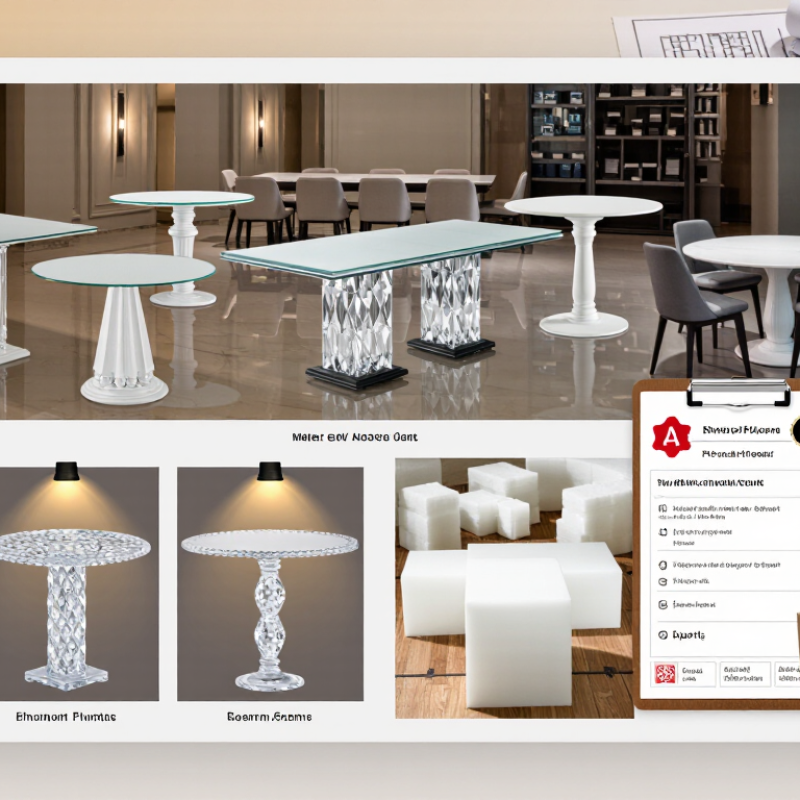
| Crystal decorative components | Clarify whether “crystal” means lead-free crystal glass, cut glass, acrylic crystal, or decorative glass elements. Require the material description to be stated clearly in product documents. | Material terminology affects product positioning, safety declarations, customs descriptions, and customer expectations. | Material composition statement, product specification, color and clarity approval sample, and chemical compliance declaration where required. |
| Edge processing | For furniture tabletops, polished, beveled, pencil-polished, or rounded edges are commonly used. Sharp unprocessed edges should not be accepted for consumer furniture. | Proper edge finishing reduces handling injuries, chipping, and damage during transport and installation. | Edge profile drawing, pre-shipment inspection photographs, and sample approval record. |
| Structural stability | The base should resist rocking, twisting, and progressive loosening under intended use. Load capacity must be stated for the complete assembled table rather than for the glass alone. | Crystal-style tables often combine heavy glass with decorative metal or stone bases, making joint quality and center-of-gravity control important. | Static-load test results, assembly instructions, base material specification, and anti-slip component details. |
| Applicable safety standards | For Europe, review EN 12521 for domestic tables and EN 12150 for thermally toughened soda-lime silicate safety glass. For the United States, confirm relevant requirements such as ANSI Z97.1 and CPSC 16 CFR Part 1201 where applicable. Australia and New Zealand commonly reference AS/NZS 2208 for safety glazing. | The required standard depends on the product construction, intended use, and destination market. Compliance should be confirmed before mass production. | Accredited laboratory reports, standard edition, test scope, product model reference, and traceable sample information. |
| Surface finish and coating | Metal frames may use powder coating, electroplating, brushed finishes, or other specified treatments. Finish requirements should include color reference, gloss level, adhesion, and corrosion expectations. | Decorative finishes strongly influence perceived quality and must remain consistent across production batches. | Approved finish sample, color standard, coating specification, adhesion test, and corrosion test report when required. |
| Packaging protection | Use corner protection, separated glass surfaces, impact-absorbing material, moisture protection, and a rigid outer carton or wooden crate when the shipment risk requires it. | Glass and crystal-style components are vulnerable to edge impact, vibration, abrasion, and compression during international transportation. | Packaging specification, drop-test or vibration-test evidence, carton marks, pallet plan, and photographs of the packed product. |
| Container utilization | Request a verified loading plan based on packed dimensions. A standard 40-foot container has greater internal volume than a 20-foot container, but actual quantity depends on carton size, stacking rules, and product weight. | Accurate loading calculations help buyers compare landed cost and reduce unused container space. | Master-carton dimensions, gross and net weight, cartons per pallet, loading diagram, and verified packing list. |
| Minimum order quantity | MOQ varies by design, finish, packaging, and customization. Standard models generally allow lower trial quantities than fully customized tables or special glass shapes. | A practical MOQ should match the buyer’s sales forecast, warehouse capacity, and cash-flow plan. | Written quotation showing MOQ by model, color, size, packaging option, and customization level. |
| Sample and approval process | Approve a physical sample or controlled pre-production sample before bulk manufacture. Critical points include glass clarity, tint, edge finish, base color, weld quality, and assembly fit. | A signed or digitally recorded approval sample provides a clear quality reference for production and inspection. | Sample approval form, approved material swatches, technical drawing, inspection checklist, and change-control record. |
| Quality-control checkpoints | Use incoming-material inspection, in-process checks, assembly inspection, final visual inspection, dimensional verification, and packaging inspection. | Multiple checkpoints reduce defects that may be difficult or expensive to correct after export. | Quality-control plan, inspection report, defect classification, corrective-action procedure, and independent pre-shipment inspection option. |
| Export documentation | The supplier should provide a commercial invoice, packing list, transport document, origin information where required, and product-specific compliance documents. | Complete documentation supports customs clearance, freight booking, and destination-market compliance. | Sample commercial invoice, packing list, shipping terms, production lead-time schedule, and export-document checklist. |
| Best supplier fit by buyer type | Retail buyers should prioritize packaging and repeatability; hospitality buyers should prioritize durability and service support; project buyers should prioritize engineering control, documentation, and delivery coordination. | The lowest quoted price is not always the lowest total cost when breakage, delays, replacements, and compliance risks are included. | Supplier scorecard covering quality, price, lead time, compliance, packaging, communication, and after-sales response. |

.svg)