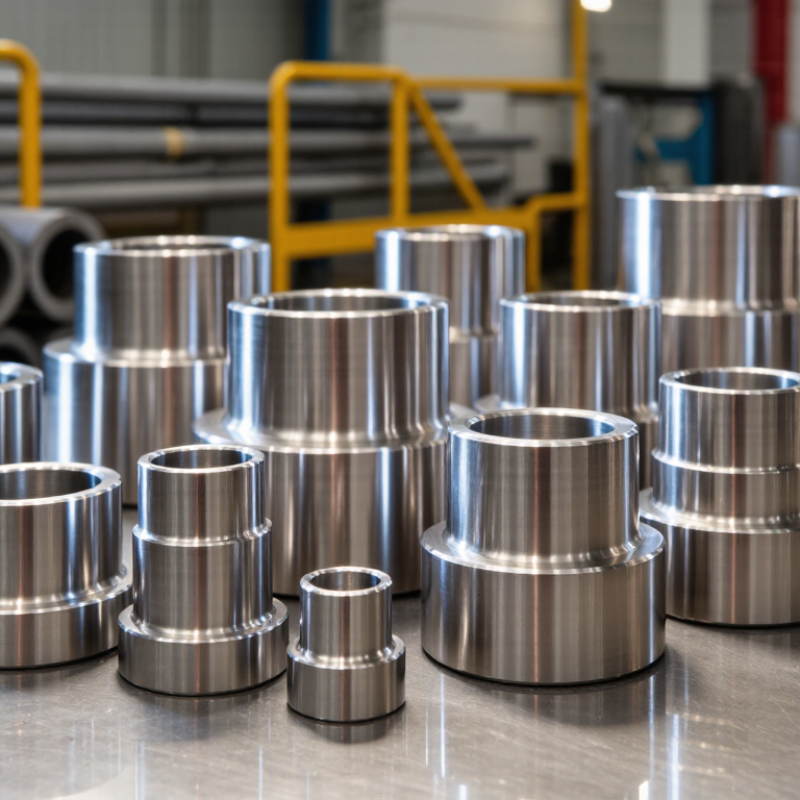
| Definition | Concentric reducer | A butt-welding pipe fitting that connects two different pipe sizes while maintaining a common centerline for both ends. | Used where a symmetrical transition and consistent axial flow path are required. |
| Geometry | Large-end and small-end diameters | The fitting has one larger outside diameter and one smaller outside diameter, with both end axes aligned concentrically. | Suitable for vertical pipe runs, centered equipment connections, and compact symmetric layouts. |
| Size Configuration | NPS × NPS or DN × DN | Common designations identify the nominal size of each end, such as NPS 6 × 4 or DN 150 × DN 100. | The actual outside diameter and wall thickness must be checked against the applicable dimensional standard and pipe schedule. |
| Manufacturing Type | Seamless formed reducer | Produced from seamless tubular material through hot forming, extrusion, pressing, or related forming operations. | Often selected for demanding pressure, temperature, or process-service conditions when a seamless construction is specified. |
| Manufacturing Type | Welded or fabricated reducer | Manufactured from plate, pipe, or formed sections that are longitudinally or circumferentially welded as required by the design. | Common for large diameters, non-standard dimensions, heavy wall thicknesses, or project-specific configurations. |
| Connection Method | Butt-weld ends | The fitting ends are prepared for alignment and welding directly to matching pipe or other butt-welding fittings. | Provides a continuous welded piping system with low external profile and no internal threads. |
| Primary Materials | Carbon steel, stainless steel, and alloy steel | Material selection depends on pressure, temperature, corrosion exposure, fluid compatibility, weldability, and applicable piping rules. | Carbon steel is widely used for general process service; stainless and alloy steels are selected for corrosion resistance or elevated-temperature performance. |
| Dimensional Standard | ASME B16.9 | Covers factory-made wrought butt-welding fittings, including dimensions, tolerances, and related requirements for applicable sizes. | Widely referenced for piping systems designed to ASME and North American engineering practices. |
| European Standard | EN 10253 series | European standards specify requirements for butt-welding pipe fittings, including materials, manufacturing, dimensions, and inspection categories depending on the applicable part. | Appropriate for projects requiring European dimensional and material compliance. |
| Pressure Design | Rating and wall-thickness compatibility | A reducer does not have one universal pressure rating; allowable service depends on material grade, wall thickness, temperature, construction standard, and design code. | Confirm the fitting wall thickness and material against the connected pipe and the governing piping code. |
| Flow Behavior | Centered area transition | The centered conical transition changes flow area along the common axis, generally producing a more balanced geometry than an offset reducer. | Final hydraulic performance depends on taper angle, flow velocity, fluid properties, and the overall piping arrangement. |
| Industrial Application | Oil, gas, petrochemical, and chemical processing | Used to connect process piping with different nominal sizes in hydrocarbon, chemical, utility, and transfer systems. | Material, inspection, welding procedure, and nondestructive examination requirements should follow the project specification. |
| Utility Application | Water treatment, HVAC, and industrial utilities | Used in water, chilled-water, heating-water, compressed-air, and other utility piping where a centered size transition is acceptable. | Corrosion conditions, insulation space, drainage requirements, and maintenance access should be considered during layout. |
| Installation Orientation | Vertical and centered horizontal runs | Concentric reducers are particularly suitable when the pipe centerline must remain unchanged through the transition. | For horizontal liquid lines where drainage or avoidance of liquid accumulation is important, an eccentric reducer may be more suitable. |
| Quality Checks | Dimensions, material, weld quality, and surface condition | Typical verification includes dimensional inspection, material identification, visual examination, and applicable nondestructive testing. | Inspection scope should be defined by the purchase specification, construction code, service severity, and regulatory requirements. |

.svg)