| Food Safety Management | 25% | A documented, independently audited food-safety system covering processing, sanitation, allergen control, pest control, and recall procedures. | Review a current third-party audit or certification, corrective-action records, sanitation schedules, and recall-test results. | Expired certificates, repeated major audit findings, or incomplete corrective-action evidence. |
| Microbiological Safety | 15% | Every lot should meet the microbiological limits required by the destination market. Testing should address pathogens such as Salmonella and Listeria monocytogenes where applicable. | Request lot-specific certificates of analysis from an accredited laboratory and confirm the sampling plan. | Only an annual test report is provided, or results cannot be linked to the shipped lot. |
| Pesticide-Residue Compliance | 10% | Residues must comply with the maximum residue limits of the importing country or region, including any retailer-specific requirements. | Check multi-residue laboratory reports, farm records, approved chemical lists, and the applicable import regulations. | Generic reports with no harvest date, lot number, laboratory identity, or destination-market reference. |
| Traceability and Origin Records | 10% | The supplier should trace product from farm or approved grower group through peeling, packing, cold storage, and shipment. | Conduct a traceability exercise using a random lot code and verify that records can be retrieved promptly. | Lot codes do not connect to raw-material sources, processing dates, or dispatch records. |
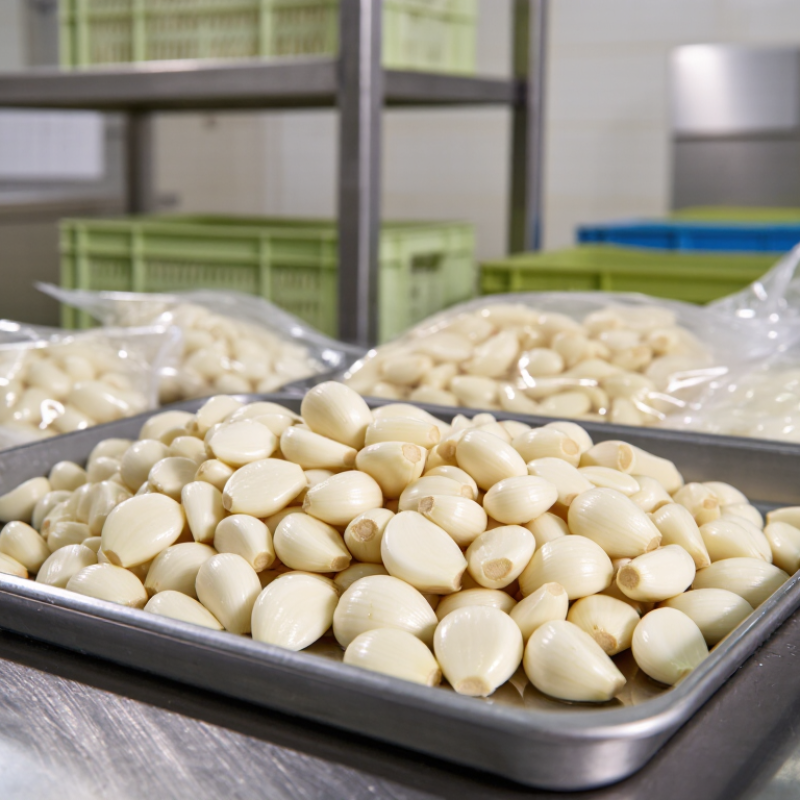
| Appearance and Color | 8% | Cloves should be clean, naturally colored, whole, and free from excessive bruising, sprouting, mold, black spots, and abnormal discoloration. | Inspect pre-shipment samples under consistent lighting and define defect tolerances in the purchase specification. | Visible mold, translucent or water-soaked cloves, excessive yellowing, or inconsistent sorting. |
| Firmness and Freshness | 8% | Cloves should be firm and crisp, without softening, fermentation odor, excessive juice release, or tissue breakdown. | Perform receiving inspection, odor assessment, tactile firmness checks, and condition testing after simulated transport. | Soft texture, sour odor, leaking packs, or rapid deterioration during a short shelf-life test. |
| Clove Size and Sorting Uniformity | 5% | Size grades and acceptable variation should be clearly defined, for example by minimum clove count, weight range, or customer-specific grade. | Use calibrated scales, sieve or count-based checks, and a written tolerance for undersized, broken, or damaged cloves. | Mixed grades, high proportions of broken cloves, or size claims that are not supported by inspection data. |
| Foreign-Material Control | 5% | Product should be free from soil, stones, insects, plastic, metal, and other foreign material; preventive controls should be documented. | Review line-cleaning procedures, foreign-material inspection records, metal-detector checks, and finished-product inspection results. | Frequent packaging fragments, soil contamination, or missing verification records for detection equipment. |
| Processing Water and Sanitation | 4% | Water and ice contacting the product should be suitable for their intended use, with controlled sanitizer concentration and documented monitoring. | Review water-quality tests, sanitation standard operating procedures, sanitizer logs, and corrective actions. | Uncontrolled wash-water reuse, missing water tests, or unexplained changes in sanitizer concentration. |
| Packaging Integrity | 4% | Packaging should be food-contact compliant, sealed effectively, correctly labeled, and suitable for refrigerated distribution. | Check seal strength, leak resistance, material declarations, label accuracy, and pack performance during transport simulation. | Weak seals, condensation-related leakage, incorrect net weight, or labels missing storage instructions. |
| Cold-Chain Control | 3% | Fresh peeled garlic should normally be held and transported under controlled refrigeration; a commonly used operating range is approximately 0–4°C, subject to product and packaging validation. | Review continuous temperature-logger data, loading procedures, vehicle pre-cooling, and receiving-temperature records. | Temperature gaps, warm loading areas, delayed dispatch, or no data logger for temperature-sensitive shipments. |
| Shelf-Life Validation | 3% | The declared shelf life should be supported by product-specific storage trials and should reflect the complete distribution route, not only factory storage. | Request shelf-life study data covering appearance, odor, firmness, microbial results, packaging, and intended storage conditions. | A fixed shelf-life claim is used for every pack format without supporting validation. |
| Supply Capacity and Continuity | 3% | The supplier should demonstrate seasonal availability, realistic weekly capacity, backup raw-material sources, and contingency planning. | Compare production capacity with purchase forecasts and review historical fulfillment, lead times, and peak-season performance. | Capacity is based only on informal estimates or cannot be supported by production and shipment records. |
| Export Documentation | 2% | Commercial invoices, packing lists, lot details, certificates of analysis, health documents, and phytosanitary documents should be accurate when required by the destination. | Conduct a document review before shipment and confirm requirements with the importer, customs broker, and competent authorities. | Inconsistent lot numbers, missing origin information, or documents issued after cargo departure. |

.svg)