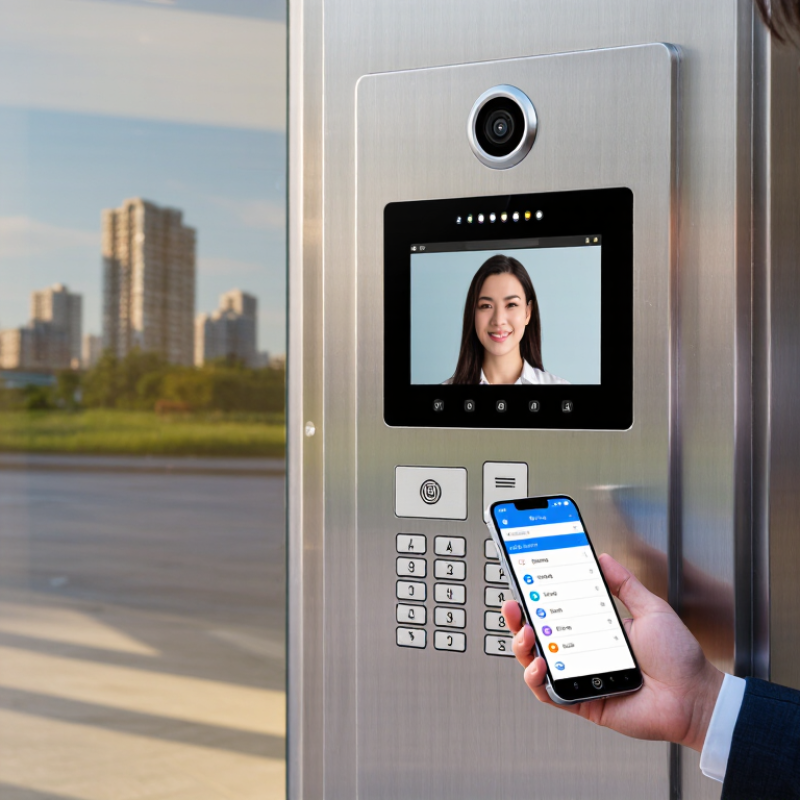
| Video Quality | Supports at least 2 MP video, with H.264 compression and practical low-light performance for entrance monitoring. | H.264 / AVC video coding; resolution should be confirmed by the product datasheet. | Review resolution, frame rate, lens angle, infrared capability, and sample footage under daylight and low-light conditions. |
| Network Interoperability | Provides standards-based network integration instead of relying only on proprietary software. | ONVIF Profile S is commonly associated with video streaming; ONVIF Profile T covers advanced video streaming functions. | Request the exact ONVIF profile, firmware version, supported codecs, API documentation, and interoperability test results. |
| Voice and Call Protocols | Supports two-way hands-free communication and, where required, SIP-based calling for integration with compatible systems. | SIP is standardized by the IETF in RFC 3261; actual feature support varies by device and firmware. | Confirm SIP registration, audio codecs, DTMF support, echo cancellation, and compatibility with the intended PBX or platform. |
| Power and Cabling | Offers Ethernet connectivity and PoE options to reduce separate power wiring in suitable installations. | IEEE 802.3af PoE supplies up to 15.4 W at the PSE; IEEE 802.3at supplies up to 30 W at the PSE. | Check whether the unit is 802.3af or 802.3at compliant and verify maximum power consumption under normal operation. |
| Outdoor Protection | Outdoor models commonly target IP65 or higher, with impact protection specified separately where vandal resistance is needed. | IEC 60529 defines IP ingress-protection ratings; IEC 62262 defines IK impact-protection ratings. | Request test reports or certificates that identify the exact model, test level, test date, and applicable standard. |
| Operating Temperature | Professional outdoor products should publish a defined operating range, commonly around −20°C to +50°C, depending on the model. | The stated range is product-specific and should not be assumed from the enclosure rating alone. | Compare the datasheet range with the installation site's minimum and maximum recorded temperatures. |
| Access-Control Functions | Supports controlled door release with configurable relay output, exit input, tamper monitoring, and event records where required. | Electrical interfaces and relay ratings are model-specific; fail-safe and fail-secure behavior must be configured correctly. | Check relay voltage/current ratings, lock compatibility, emergency override behavior, and wiring diagrams. |
| Cybersecurity | Uses unique credentials, encrypted management access, controlled services, signed or verified firmware, and a documented vulnerability-response process. | Security capabilities should be assessed against the intended deployment risk and applicable customer requirements. | Ask for password policy, HTTPS/TLS support, update policy, vulnerability disclosure contact, and firmware lifecycle information. |
| Manufacturing Quality | Maintains documented quality controls, traceable production batches, inspection records, and repeatable testing before shipment. | ISO 9001 certification can indicate a quality-management system, but it does not replace product testing. | Request current certificates, sample inspection records, serial-number traceability, and factory or third-party audit results. |
| Compliance Documentation | Provides market-specific compliance documents rather than using one generic declaration for every region. | Common market requirements may include CE for the European Economic Area and FCC requirements for applicable U.S. devices. | Verify the document holder, model number, applicable directives or rules, test standards, and validity of the documentation. |
| Customization Capability | Can adapt firmware, user interface, mounting accessories, languages, logo placement, or system interfaces without compromising core reliability. | Customization scope, minimum order quantity, tooling cost, and engineering fees are project-specific. | Request a written specification, prototype approval process, change-control procedure, and ownership terms for custom software. |
| Testing and Reliability | Performs functional, network, audio, video, environmental, and aging tests appropriate to the final installation conditions. | Test methods and acceptance limits should be documented rather than represented only by general marketing claims. | Review sample test reports, failure-rate data where available, burn-in procedures, and warranty-return analysis. |
| Warranty and Support | Provides a clearly written warranty, defined response times, firmware support, replacement procedures, and technical documentation in English. | Warranty duration and service levels are contractual terms and should be confirmed before purchase. | Evaluate escalation channels, spare-parts availability, remote troubleshooting, repair turnaround, and end-of-life notification policy. |
| Project Delivery Capability | Maintains stable component sourcing, realistic lead times, packaging controls, and documented procedures for pilot orders and volume production. | Lead time, minimum order quantity, and production capacity vary by product configuration and order volume. | Request a production schedule, approved-bill-of-materials process, pre-shipment inspection plan, and delivery-performance records. |

.svg)