In Eagle’s Advanced Insights Blog, experts share their know-how by keeping you up-to-date with the latest trends to ensure your inspection equipment keeps your products safe. Eagle is an industry leader when it comes to performance and innovation, and we’ll share the news that’s important to you to enhance your quality assurance program.
Top Silicone Additives Manufacturer for High-Performance Plastics
Introduction
In plastics manufacturing, improving processing efficiency and surface performance is a key challenge for polymer processors.
To address these issues, many manufacturers rely on silicone additives, which play a critical role in enhancing polymer processing and improving final product performance.
This article explains: what silicone additives are, how they improve plastic performance, where they are commonly used, and how to choose a reliable silicone additives manufacturer.
What Are Silicone Additives for Plastics?
Silicone additives are polymer modifiers typically based on polysiloxane chemistry that are incorporated into thermoplastics to improve processing and surface properties.
The most widely used form in the plastics industry is silicone masterbatch, where ultra-high molecular weight silicone polymers are dispersed in thermoplastic carriers such as LDPE, EVA, TPEE, HDPE, ABS, PP, PA6, PET, TPU, HIPS, POM, LLDPE, PC, SAN, etc. These additives are pelletized to allow easy addition directly into thermoplastics during processing.
These plastic additives enhance polymer performance without significantly altering mechanical properties.
Common Processing Problems in Plastics Manufacturing
Many plastics processors encounter technical challenges during extrusion and injection molding.
Typical issues include:
• High melt viscosity
• Extrusion instability
• Die build-up
• Poor scratch resistance
• Squeaking noise in plastic components
These problems can reduce production efficiency and negatively affect product quality.
Engineering Root Causes of These Problems
From a polymer processing perspective, these problems are often caused by:
• High shear stress at the die wall
• Poor polymer flow behavior
• Insufficient lubrication during processing
• Friction between polymer melt and metal surfaces
These factors increase energy consumption and limit production speed.
How Silicone Additives Improve Polymer Processing
Silicone additives work by forming a lubricating molecular layer within the polymer matrix.
During processing:
1️⃣ Silicone molecules migrate toward the polymer surface 2️⃣ A lubricating interface forms between the melt and the equipment 3️⃣ Friction and shear stress are reduced
As a result, the polymer flows more smoothly through extrusion dies and molds.
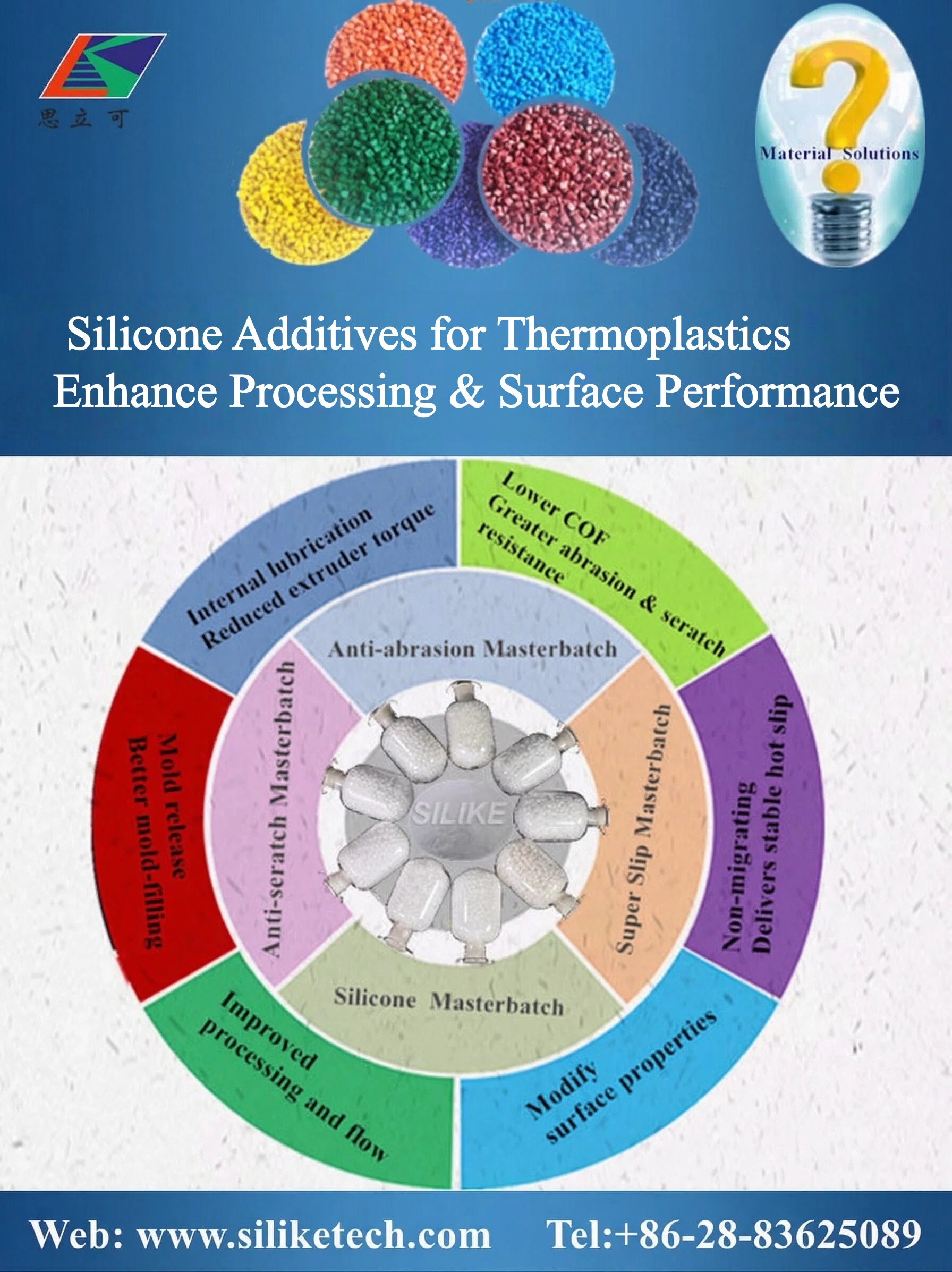
Key Benefits of silicone-based plastic additives
Manufacturers use silicone additives to achieve several technical advantages:
• Reduced coefficient of friction (COF)
• Improved scratch resistance
• Enhanced abrasion resistance
• Improved mold release
• Reduced extrusion torque
• Better surface smoothness
These benefits help manufacturers produce higher quality plastic components with improved efficiency.
Chengdu SILIKE Technology manufactures and trades combo silicone additives (silicone masterbatch/powder) to improve processability and surface quality of thermoplastics in industries including textile, automotive interiors, cable and wire compounds, shoe soles, plastic pipes, and film.
Solutions for plastics
Processing properties: Improved melt flow, lower extruder torque, reduced die pressure & die drool, better mold filling, easier mold release, less energy consumption, and decreased cycle time.
Surface quality: Lower coefficient of friction, improved scratch and wear resistance, better surface slip, and improved hand feel.
What are silicone additives used for? Silicone additives improve polymer processing efficiency and enhance surface properties such as scratch resistance and slip.
What is silicone masterbatch? Silicone masterbatch is a pelletized additive containing polysiloxane dispersed in thermoplastic resin carriers to improve processing and surface performance.
Do silicone additives affect mechanical properties? At recommended dosages, silicone additives generally do not significantly affect mechanical strength or durability.
Can silicone additives replace fluoropolymer processing aids? In some extrusion applications, silicone-based additives can reduce reliance on fluoropolymer processing aids and improve processing stability.
Conclusion
Silicone additives have become essential materials for improving polymer processing efficiency and product durability in modern plastics manufacturing.
By reducing friction, improving surface performance, and enhancing process stability, these additives enable manufacturers to produce high-quality plastic components more efficiently.
If you are looking for a reliable silicone additives manufacturer, the technical team at SILIKE can help evaluate your formulation and recommend suitable additive solutions. Contact Amy Wang via Email: sale@generalmachinery.org.
Any Questions?
We Are Here for You
Contact Us
Request information
Ask us a question
Service Support
Available 24 hours a day, 7 days a week.
Get in Touch
Find a representative
Contact your local representative
View Locations
Login to
Resource Center
If you have previously registered, simply enter your email address below to gain access to your requested content.
Register to
Resource Center
Register with Eagle to gain unlimited access to our Knowledge Center materials. You will only need to complete this form once.
Register with Eagle to gain unlimited access to our Knowledge Center materials. You will only need to complete this form once.
"*" indicates required fields
Sign up for our newsletter
"*" indicates required fields
Manage Cookie Consent
To provide the best experiences, we use technologies like cookies to store and/or access device information. Consenting to these technologies will allow us to process data such as browsing behavior or unique IDs on this site. Not consenting or withdrawing consent, may adversely affect certain features and functions.
Functional
Always active
The technical storage or access is strictly necessary for the legitimate purpose of enabling the use of a specific service explicitly requested by the subscriber or user, or for the sole purpose of carrying out the transmission of a communication over an electronic communications network.
Preferences
The technical storage or access is necessary for the legitimate purpose of storing preferences that are not requested by the subscriber or user.
Statistics
The technical storage or access that is used exclusively for statistical purposes.The technical storage or access that is used exclusively for anonymous statistical purposes. Without a subpoena, voluntary compliance on the part of your Internet Service Provider, or additional records from a third party, information stored or retrieved for this purpose alone cannot usually be used to identify you.
Marketing
The technical storage or access is required to create user profiles to send advertising, or to track the user on a website or across several websites for similar marketing purposes.

.svg)