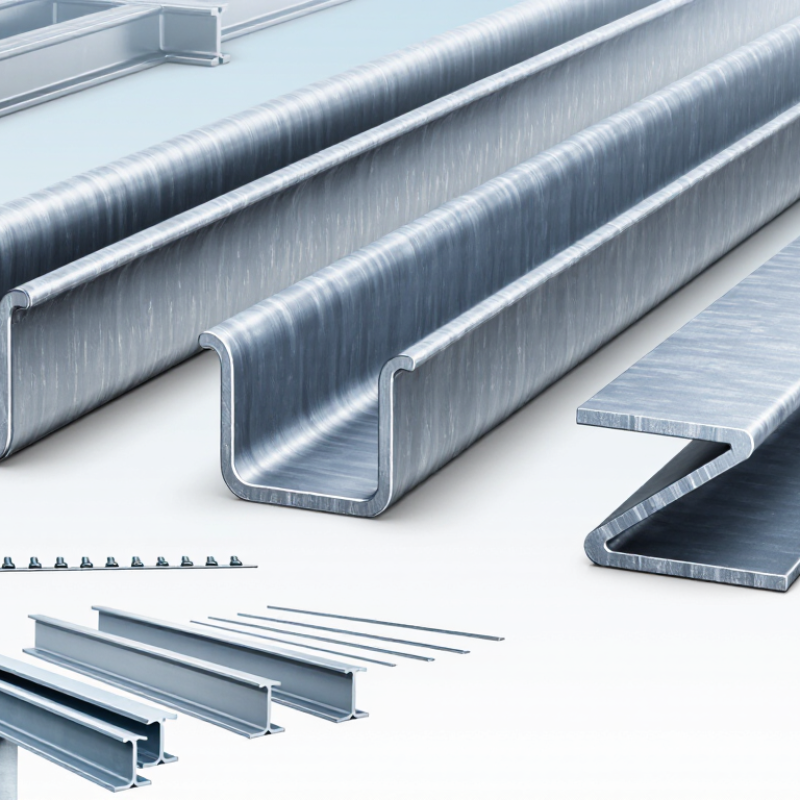
| C-Channel | A web connects two flanges that extend in the same direction, forming a C-shaped cross-section. Structural hot-rolled channels may have tapered inner flange faces; cold-formed C-sections commonly have more uniform sheet thickness and may include return lips. | Hot rolling for structural channel sections; press-brake forming or roll forming for light-gauge sections. | Frames, supports, edge members, equipment bases, and general structural applications. | Check section dimensions, flange geometry, thickness, steel grade, and section properties. Hot-rolled and cold-formed C-sections are not automatically interchangeable. |
| U-Channel | A flat web joins two parallel or near-parallel flanges, creating an open U-shaped profile. European UPN sections typically have tapered flanges, while UPE sections have parallel flanges. | Usually hot rolled for structural sizes; lighter U-shaped profiles can also be roll formed. | Structural supports, cross-members, brackets, tracks, and framing where a U-shaped profile is useful. | Confirm the applicable section standard and whether the flanges are tapered or parallel; these details affect fit-up and connection design. |
| MC Channel | A miscellaneous structural channel profile in the C-family. Its dimensions and proportions can differ from standard American C-channel series. | Hot rolled as a structural section. | Building and industrial framing, supports, and other applications calling for a channel with a particular depth or flange proportion. | Use the exact section designation and published dimensions rather than assuming it matches a similarly sized C-channel. |
| Z-Channel | A web connects two flanges that extend in opposite directions, producing a Z-shaped cross-section. Cold-formed versions often include stiffening lips. | Commonly roll formed from sheet or strip steel; heavier structural versions may be produced by other forming routes. | Roof and wall purlins, girts, framing members, and overlapping or nested secondary framing. | Consider the direction of loading, support conditions, orientation, overlap details, and local buckling behavior. |
| Hat Channel | A raised central web with two side webs and outward feet creates a hat-like outline. The profile is generally symmetric about its centerline. | Typically roll formed from sheet steel; thickness and dimensions vary by application. | Furring, cladding support, ceiling systems, wall framing, and stiffening or spacing applications. | Verify the profile depth, foot width, thickness, fastening method, and required load capacity for the specific system. |
| J-Channel | An open profile with an extended base or web and a return flange on one side, giving the cross-section a J-like appearance. | Usually roll formed from sheet steel. | Edge trim, panel termination, siding or cladding support, and finishing details. | Match the opening and leg dimensions to the panel or edge detail; J-channels are generally selected for fit and trim function, not as a substitute for a structural channel. |
| Hat- and Lip-Stiffened C-Channel | A cold-formed C-profile with small return lips at the flange edges. The lips increase edge stiffness compared with a plain C-section of similar basic proportions. | Roll formed from steel sheet or strip. | Light-gauge steel framing, studs, joists, tracks, and secondary structural members. | Specify base-metal thickness, lip dimensions, steel grade, and design standard. Design capacity depends on the complete section geometry and restraint conditions. |

.svg)