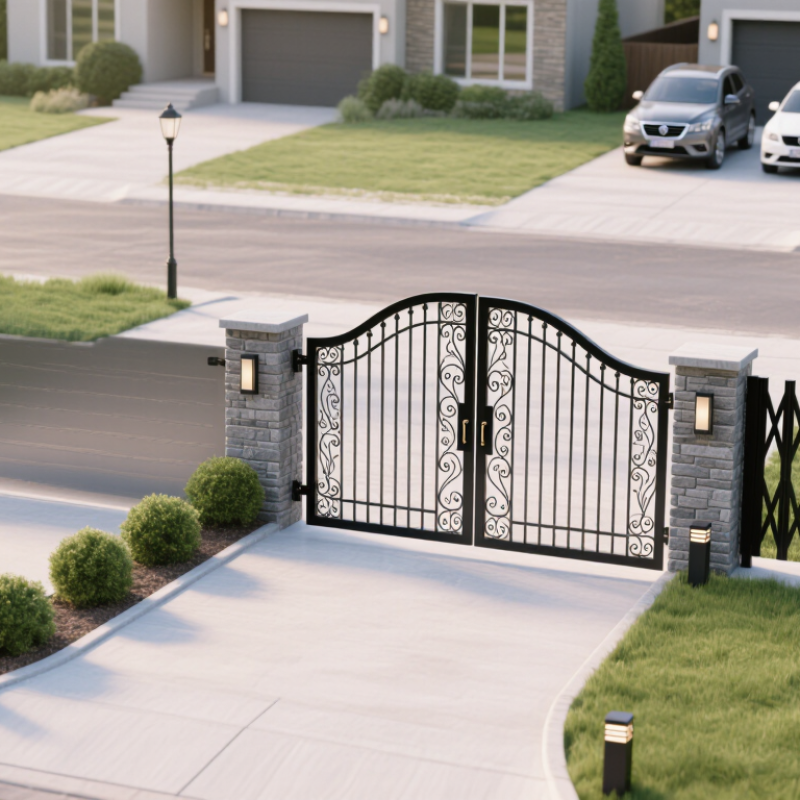
| Swing Gate | One or two gate leaves rotate inward or outward around side hinges using underground or surface-mounted operators. | Requires a clear arc approximately equal to the gate-leaf depth on the opening side. | Moderate | Approximately 12–20 seconds for a full opening, depending on leaf size, weight, and actuator type. | Traditional appearance; generally quiet; suitable for many residential entrances; can work with uneven or decorative gate designs. | Needs sufficient clearance for parked vehicles, slopes, landscaping, and pedestrians; wind can place additional load on the gate. | Residential driveways, low- to medium-traffic private entrances, and properties where appearance is important. | Hinges, stops, hingeside posts, and actuator mounting points should be inspected regularly. Drainage is important for underground operators. | Choose when the property has enough opening clearance and a classic gate layout is preferred. |
| Sliding Gate | A motor drives the gate horizontally along a ground track or a cantilever system beside the entrance. | Requires a side run generally longer than the gate opening, plus room for the motor and safety clearance. | High | Approximately 10–18 seconds for a full opening, depending on gate length and motor settings. | Does not swing into the driveway; performs well on sloped entrances; suitable for wider or heavier gates. | Needs unobstructed side space; ground-track systems can collect dirt, gravel, snow, or ice; cantilever systems may cost more. | Commercial entrances, apartment driveways, industrial sites, and residential properties with limited front-to-back clearance. | Keep tracks clean and aligned, check rollers or cantilever components, and inspect rack-and-pinion engagement and safety sensors. | Often the most practical choice when swing clearance is unavailable or the gate is wide and heavy. |
| Bi-Folding Gate | Two hinged sections fold toward each other as the operator opens the gate, reducing the travel distance of each leaf. | Requires less depth than a conventional swing gate but still needs appropriate side and hinge clearance. | High | Approximately 8–15 seconds for a full opening, depending on the folding geometry and operator. | Opens quickly; reduces driveway intrusion; useful where traffic flow or limited setback is a concern. | Has more hinges, linkages, and moving components; installation alignment is critical; usable opening width may be affected by the folding design. | Busy residential entrances, controlled-access facilities, and sites requiring a relatively fast opening cycle. | Inspect intermediate hinges, folding arms, stops, cables or linkages, and synchronization between the two sections. | Consider when faster operation and reduced swing depth justify higher mechanical complexity. |
| Vertical-Lift Gate | The gate panel rises vertically, usually guided by posts and lifted by a counterbalanced or powered mechanism. | Requires overhead clearance above the opening and adequate structural support for the lifting assembly. | High | Approximately 10–20 seconds for a full opening, depending on gate height and lifting system. | Uses minimal ground space; useful where side and swing areas are restricted; can provide a strong physical barrier. | Requires substantial overhead clearance and structural engineering; installation and servicing can be more specialized. | Industrial facilities, secure sites, and entrances where ground-level space is severely limited. | Inspect lifting cables or chains, guides, counterbalance components, structural anchors, and emergency-release equipment. | Use only after confirming overhead clearance, structural capacity, and professional safety requirements. |
| Vertical-Pivot Gate | The entire gate leaf pivots upward around a vertical axis, often lifting clear of the ground and rotating beside or above the opening. | Requires dedicated clearance for the rotating panel and a strong structural frame. | Moderate | Approximately 10–20 seconds for a full opening, depending on the panel size and operator. | Can operate where conventional swing or sliding movement is difficult; keeps the gate clear of uneven ground. | Requires careful structural design; large panels can create significant wind loads; uncommon components may be harder to service. | Specialized residential, commercial, or industrial entrances with unusual site constraints. | Inspect pivot bearings, structural supports, balance mechanisms, limit settings, and emergency-release systems. | Best treated as a site-specific solution rather than a standard replacement for swing or sliding gates. |
| Barrier Arm Gate | A motor raises and lowers a lightweight horizontal arm to control vehicle access rather than fully closing an opening. | Requires a compact equipment base and a clear lane beneath the arm; no full gate panel is needed. | Very High | Approximately 1.5–6 seconds for the arm to raise or lower, depending on the system and arm length. | Fast vehicle processing; compact footprint; easy visual access; well suited to frequent opening cycles. | Provides traffic control rather than a solid security barrier; vulnerable to impact; may not restrict pedestrians effectively. | Parking facilities, toll or access-control lanes, office entrances, and private roads with frequent vehicle movement. | Check arm balance, pivots, reflective markings, loop detectors, photocells, and impact-damage protection. | Select when vehicle throughput matters more than creating a full-height or solid physical barrier. |
| Telescopic Sliding Gate | Multiple interlinked gate sections slide and overlap, allowing a wide opening within a shorter side run. | Requires side space, but usually less than a single-panel sliding gate of the same opening width. | Very High | Approximately 12–25 seconds for a full opening, depending on the number and weight of sections. | Maximizes usable opening width in restricted side areas; suitable for wide entrances with limited available run-back space. | More rollers, guides, cables, and synchronization components can increase installation cost and maintenance needs. | Commercial, industrial, logistics, and multi-vehicle entrances with constrained side clearance. | Keep all tracks and guides clean; check section alignment, drive cables or chains, rollers, and synchronization controls. | Worth considering when a standard sliding gate cannot fit the available side run. |
| Automated Pedestrian Gate | A powered swing, sliding, or turnstile-style mechanism opens after an authorized credential, request-to-exit signal, or sensor input. | Requires a pedestrian passage with controlled clearance and suitable access-control equipment. | High | Approximately 2–8 seconds, depending on the gate design and safety configuration. | Separates pedestrian and vehicle access; can integrate with card readers, keypads, intercoms, and exit devices. | Must prevent entrapment and unsafe closing; accessibility, emergency egress, and local building requirements may apply. | Residential complexes, offices, schools, healthcare facilities, and controlled pedestrian entrances. | Test sensors, emergency release, access credentials, hinges or rollers, closing force, and backup power where installed. | Choose when pedestrian access needs to be managed independently from vehicle access. |

.svg)