Food Safety Insights

In Eagle’s Advanced Insights Blog, experts share their know-how by keeping you up-to-date with the latest trends to ensure your inspection equipment keeps your products safe. Eagle is an industry leader when it comes to performance and innovation, and we’ll share the news that’s important to you to enhance your quality assurance program.

Suggest topic you would like to see at:

sale@generalmachinery.org

China Top Warehouse Racking System Manufacturers?

China’s warehouse sector is becoming more data-driven, making supplier selection increasingly important. The China Federation of Logistics and Purchasing reported that China’s total social logistics value exceeded RMB 360 trillion in 2024. Its logistics-cost-to-GDP ratio also remained above 14%. These figures show the pressure to improve storage density, handling speed, and inventory accuracy.

A dependable Warehouse Racking System manufacturer should offer more than standard steel frames. Buyers need verified load calculations, clear installation drawings, corrosion protection, and traceable quality inspections. In manufacturing warehouses, one damaged beam can interrupt an entire picking aisle. Small details matter. Rack spacing, pallet dimensions, forklift turning radius, and floor tolerance must work together.

The World Bank’s Logistics Performance Index 2023 placed China among the world’s stronger logistics performers. However, national performance does not guarantee every supplier’s reliability. This is where practical evaluation becomes essential. Companies should compare engineering experience, testing procedures, certifications, delivery records, and after-sales support. MHI’s annual industry reports also highlight the growing role of automation and integrated warehouse technologies. Therefore, leading Chinese manufacturers increasingly combine selective pallet racks with drive-in systems, cantilever racks, mezzanines, and automated storage solutions.

Still, published market data has limitations. Reports often measure equipment demand differently. Some suppliers may also present impressive project numbers without explaining project complexity. A careful buyer should inspect real installations, request load-bearing documentation, and verify references. The best manufacturer is not always the largest one. It is the partner that designs safely, communicates clearly, and adapts the system to actual operating conditions.

China Top Warehouse Racking System Manufacturers?

What Is a Warehouse Racking System?

What Is a Warehouse Racking System?

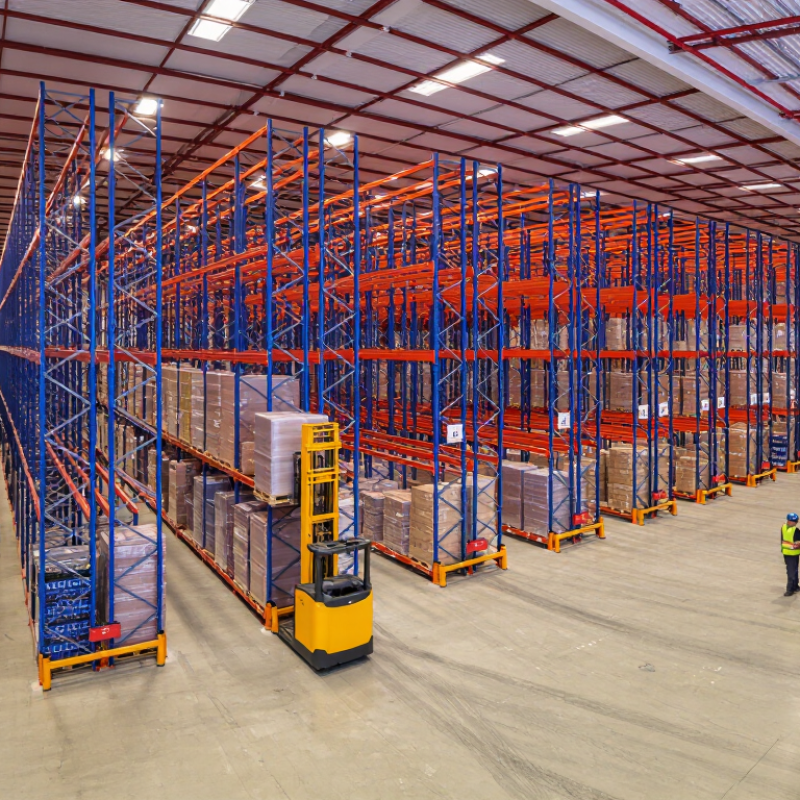
A warehouse racking system is a steel storage structure designed to hold products above the floor. It uses upright frames, horizontal beams, decking, and protective components. These parts create organized storage levels and improve the use of vertical space. Common layouts include selective pallet racks, drive-in racks, cantilever racks, and shelving systems. Each design supports different goods, handling methods, and inventory routines.

In practical warehouse planning, rack selection begins with product weight, pallet dimensions, forklift access, and storage turnover. A rack may look strong, yet poor beam spacing can reduce its real capacity. Load labels should show maximum weights clearly. Anchors, guards, and level floors also matter. During installation checks, I would inspect upright alignment, beam locks, aisle width, and visible damage. Small errors can become expensive problems.

The best system supports safe movement, accurate stock placement, and easier inspections. High-density racks save floor area, but they may slow picking or limit direct access. Selective racks offer flexibility, although they require more aisle space. My first layout would probably seem efficient on paper, but daily traffic could expose weaknesses. That is why warehouse teams should test walking paths, forklift turns, and replenishment tasks before final approval. Experienced manufacturers can adjust drawings, load calculations, and installation details around these findings. Temperature, moisture, and future inventory changes deserve attention too. Warehouses rarely remain unchanged.

China Top Warehouse Racking System Manufacturers? - What Is a Warehouse Racking System?

A warehouse racking system is a structural storage solution used to organize palletized or manually handled goods vertically. The most suitable system depends on load characteristics, available space, inventory rotation, access requirements, handling equipment, and applicable safety standards.

Racking System Type How It Works Typical Storage Density Pallet Selectivity Typical Applications Common Handling Equipment Key Selection Consideration
Selective Pallet Racking Each pallet position is directly accessible from an aisle, normally using adjustable horizontal beams. Low to medium; commonly uses approximately 30%–50% of the available floor area for storage. 100% direct access General distribution, mixed stock-keeping units, and high product variety. Counterbalance forklift, reach truck, or narrow-aisle truck. Best when product variety and fast access are more important than maximum density.
Very Narrow Aisle Racking High-density pallet racking arranged in narrow aisles, with trucks guided through restricted travel lanes. Medium to high; improves space utilization by reducing aisle width. 100% direct access High-throughput warehouses with tall buildings and many pallet positions. Turret truck or specialized narrow-aisle truck. Requires suitable floor flatness, truck compatibility, and accurate aisle layout.
Drive-In Racking Forklifts enter storage lanes supported by rails, allowing pallets to be stored several positions deep. High; fewer aisles increase storage density. Limited; last-in, first-out access is common. Large quantities of similar products with low SKU variety. Counterbalance forklift or reach truck designed for lane entry. Suitable for stable, non-perishable goods where selectivity is not the primary requirement.
Push-Back Racking Pallets are placed on inclined carts or nested rails and pushed backward as new pallets are loaded. High; stores multiple pallets deep while preserving front access. Medium; generally follows a last-in, first-out sequence within each lane. Seasonal goods, buffer stock, and products stored in medium-volume batches. Reach truck or counterbalance forklift. Consider pallet weight, lane depth, product rotation, and loading sequence.
Pallet Flow Racking Pallets move by gravity on roller tracks from the loading side toward the picking side. High; storage and picking aisles are separated. Medium to high; supports first-in, first-out operation. Food, beverage, pharmaceutical, and other date-sensitive inventory. Forklift for replenishment and pallet jack or forklift for picking. Requires compatible pallets, controlled roller speed, and accurate load specifications.
Carton Flow Racking Cartons move on inclined rollers or wheels from the replenishment side to the picking side. Medium to high for case-picking operations. High; supports organized first-in, first-out picking. Small-item distribution, order fulfillment, and piece-picking areas. Manual picking, carts, pallet jacks, or replenishment forklifts. Choose roller pitch and lane dimensions according to carton size and weight.
Double-Deep Racking Two rows of selective racking are positioned back-to-back in depth, requiring access to the rear pallet through the front position. Medium to high; reduces the number of aisles compared with single-deep layouts. Approximately 50% direct access to pallet positions. Operations with moderate SKU variety and several pallets per SKU. Reach truck with sufficient lift and reach capability. Requires inventory planning because rear pallets are less immediately accessible.
Cantilever Racking Horizontal arms extend from upright columns without front posts, creating open storage levels. Medium for long-load storage. High for individual long items. Steel bars, pipes, timber, furniture, panels, and other oversized loads. Side-loader forklift, counterbalance forklift, or overhead crane. Arm length, column height, load distribution, and overall stability must match the products.
Mezzanine-Supported Storage A raised platform creates an additional usable level above the warehouse floor for storage or work areas. Very high vertical-space utilization Depends on the storage equipment installed on the platform. Piece picking, archive storage, packaging, assembly, and multi-level operations. Manual handling equipment, goods lifts, conveyors, or forklifts where permitted. Check building height, structural loading, fire protection, stairs, guardrails, and access control.
Mobile Racking Racking units are mounted on motorized bases that move along floor rails, opening only the required aisle. Very high; can reduce fixed aisle space substantially. High; one access aisle can serve many movable rows. Cold storage, archives, high-value inventory, and space-constrained facilities. Forklift, reach truck, or manual handling equipment depending on the layout. Requires a suitable floor, electrical supply, safety controls, and careful access planning.
Automated Storage and Retrieval System Computer-controlled cranes, shuttles, conveyors, or robotic devices store and retrieve loads. High to very high System-dependent; inventory locations are controlled digitally. High-volume distribution, temperature-controlled storage, and operations requiring traceability. Stacker crane, shuttle, conveyor, robotic vehicle, and warehouse management software. Evaluate throughput, integration, maintenance, power requirements, and return on investment.

Important: Capacity, dimensions, aisle widths, and operating limits are design-dependent. Final specifications should be calculated from the pallet size, unit load, rack height, seismic conditions, floor capacity, forklift characteristics, fire-protection requirements, and the applicable local warehouse-racking code.

How Chinese Warehouse Racking Manufacturers Are Categorized

Chinese warehouse racking manufacturers are best categorized by capability, not factory size alone. Some specialize in selective pallet racking for general warehouses. Others focus on drive-in, cantilever, mezzanine, or shuttle-supported systems. Their product category often reflects the loads, aisle widths, and storage turnover they understand best. A reliable manufacturer should provide load calculations, steel specifications, drawings, and installation guidance. In real projects, these details matter more than polished catalog images.

A second category is based on engineering and production depth. Basic suppliers may offer standard frames and beams with limited customization. More experienced manufacturers can adapt rack dimensions, seismic requirements, floor conditions, and material-handling equipment. Some also provide automated storage integration, safety barriers, inspections, and after-sales support. I have found that communication quality often reveals technical ability. However, this method is not perfect. A small factory may solve a complex project well, while a larger one may miss practical site limitations.

Tips: Ask how the supplier classifies its systems. Request test reports, load tables, coating details, and references from similar warehouses. Check whether drawings match your actual pallet size and forklift turning radius. Confirm tolerances, packaging, delivery terms, and installation responsibilities in writing. A useful warning sign is vague capacity data. Good manufacturers discuss limits, not only advantages.

Which Racking Products and Technologies Do They Offer?

China’s leading warehouse racking manufacturers offer more than standard pallet storage. Their product lines often include selective pallet racks, drive-in systems, cantilever racks, carton flow racks, and multi-tier mezzanines. Each design serves a different handling pattern. Selective racks suit frequent access and varied stock. Drive-in racks improve density but reduce direct access. Cantilever racks support pipes, timber, and long materials.

Manufacturers also supply automated storage and retrieval systems, pallet shuttles, stacker cranes, and mobile racks. These technologies connect with warehouse management software and barcode or RFID tracking. Sensors can monitor rack positions, pallet movement, and equipment status. In cold stores, galvanized or coated components help resist moisture and corrosion. Seismic calculations, load testing, and safety locks are important for demanding sites. Details matter.

I have seen projects where automation looked impressive but did not match daily workflows. Automation is not always better. A smaller warehouse may gain more from adjustable beams and clear aisle planning. Reliable manufacturers usually provide layout drawings, load tables, installation guidance, and inspection records. They may also customize beam lengths, column profiles, guide rails, and protective barriers. However, buyers should verify material grades, weld quality, coating thickness, and testing methods independently. A low quotation can hide future maintenance costs. Rack performance depends on correct installation and disciplined use, not only factory production.

China Top Warehouse Racking System Manufacturers: Products and Technologies

Indicative typical load capacity per pallet position for commonly offered warehouse storage systems. Actual specifications depend on engineering design, load type, rack height, and local safety standards.

Selective pallet racking provides the broadest access and is commonly designed for higher pallet loads. Drive-in, pallet shuttle, mobile, and automated storage systems improve space utilization or handling efficiency, while their final capacity is determined by the rack structure, equipment, and application requirements.

How to Evaluate China’s Leading Racking Suppliers

China Top Warehouse Racking System Manufacturers?

Evaluating China’s leading racking suppliers requires more than comparing catalog prices. Check whether the supplier understands your warehouse layout, pallet weights, aisle widths, and local safety requirements. Ask for load calculations, structural drawings, material grades, and surface-treatment details. A reliable engineering team should explain these points clearly, not hide behind generic claims.

Factory verification matters. Review production equipment, welding areas, coating lines, quality records, and packaging methods. Request inspection reports for steel thickness, beam deflection, weld quality, and corrosion resistance. A sample bay can reveal practical problems, such as sharp edges, poor connector fit, or difficult installation steps. Small defects become expensive at scale.

Communication is another strong indicator. Suppliers should answer technical questions consistently and provide clear installation manuals. Check their ability to manage measurements, revisions, replacement parts, and after-sales support. Speak with recent customers when possible, especially those operating similar warehouses. Certificates are useful, but they do not replace independent checks. A supplier may present polished documents while missing a critical tolerance during production. That weakness deserves attention. Consider an independent pre-shipment inspection, even when the supplier appears experienced. Evaluate delivery records, payment terms, warranty limits, and responsibility for damaged components. The best choice is not always the cheapest quotation; it is the supplier whose evidence matches your operating risks.

What Quality and Export Standards Should Buyers Check?

China Top Warehouse Racking System Manufacturers: What Quality and Export Standards Should Buyers Check?

A reliable racking supplier should provide more than attractive prices and product photos. Request steel mill certificates, load calculations, welding records, and traceable batch numbers. EN 15635 requires regular rack inspections and controlled use, while EN 10204 3.1 certificates help verify steel grade and chemical composition. Check whether the supplier operates an ISO 9001 quality system. It does not guarantee perfect products, but it shows documented control.

Testing should match the destination market. Ask for static load tests, beam deflection results, coating thickness records, and anchor-pull test evidence. For welded components, ISO 3834 certification can indicate stronger welding controls. Buyers shipping to North America should also review applicable local engineering and workplace requirements. MHI’s 2024 Annual Industry Report identified robotics and automation as major warehouse investment priorities, increasing the need for racking that supports automated handling accurately.

Export quality also depends on packaging and documents. Inspect corner protection, moisture barriers, container loading photos, packing lists, commercial invoices, and country-of-origin details. Confirm the supplier can provide installation drawings in English and clear tolerance data. A pre-shipment inspection is worthwhile. However, it can still miss hidden weld defects or poor installation practices. I have seen specifications look complete while omitting floor-strength assumptions. Buyers should verify concrete conditions, seismic loads, forklift clearances, and spare-part availability before signing. Gaps remain possible.

Any Questions? We Are Here for You

Contact Us

Contact Us

Request information

Ask us a question
Service Support

Service Support

Available 24 hours a day, 7 days a week.

Get in Touch
Find a representative

Find a representative

Contact your local representative

View Locations